

PMS Fee Structure: Fixed Fee, Performance Fee and the Hurdle
A PMS fee structure sets what a portfolio manager charges to run your account. It can be a fixed fee on assets, a share of profits above a hurdle, or a mix of the two. SEBI does not cap the fee itself, but it controls how performance fees, expenses and exit loads work.
Those rules decide more of the bill than most investors expect. On ₹1 crore over five years, the gap between fee models in our worked examples runs from about ₹5.5 lakh to ₹14 lakh. Which model costs least depends on the order of good and bad years, which no one knows in advance.
Two worked examples below put PMS fees in India into rupees: ₹50 lakh over three years and ₹1 crore over five. Information is as of October 2026, from SEBI’s master circular and FAQ for portfolio managers.
In this article9 sections
PMS fee structure rules set by SEBI
| Rule | What SEBI requires |
|---|---|
| Fee types | A fixed fee, a performance fee, or both, as set in the agreement |
| Upfront or entry fees | Not allowed, directly or indirectly |
| What fees apply to | The actual value of your assets under management |
| Performance fee basis | Only on gains above the high-water mark |
| Performance fee frequency | No more often than once a quarter |
| Hurdle rate | Optional; if used, stated in the agreement |
| Money added or withdrawn | High-water mark adjusted in proportion |
| Operating expenses (excluding brokerage) | At most 0.5% a year of average daily assets |
| Brokerage | Charged at actual cost |
| Exit load | At most 3% in year one, 2% in year two, 1% in year three; nil after |
| Fee calculator | A multi-year fee calculation tool for clients; new clients since 1 October 2024 get the link before joining |
| Disclosure | Fee amounts and method in the disclosure document and the agreement |
| Return reporting | Net of all fees and expenses, against a benchmark |
Information as of October 2026. Source: SEBI Master Circular for Portfolio Managers (16 July 2025), which carries the fee rules SEBI first set on 13 February 2020, and the SEBI FAQ on Portfolio Managers (20 September 2024).
You pay a manager either a steady percentage of your money, a share of the profit above a set return, or both. The account needs at least ₹50 lakh, and the manager can’t lock your money in. A down year can’t produce a performance fee, and you don’t pay twice for recovering an old loss. Leaving early costs at most 3% of what you take out. GST applies to every fee as well.
The three PMS fee models
A fixed fee is a percentage of the portfolio’s value, charged every year, usually monthly or quarterly. A 2.5% fixed fee on ₹1 crore is ₹2.5 lakh a year before GST, in a good year or a bad one.
A performance fee with a hurdle charges nothing on assets. The manager takes a share, often 20%, of returns above a hurdle such as 8% a year. In a year that returns less than the hurdle, the fee is nil.
A hybrid fee combines a lower fixed fee, often around 1%, with a smaller performance share above a higher hurdle. Many managers offer two or three of these options for the same strategy. The PMS agreement fixes the choice.
Hurdle rate in PMS, high-water mark and fee dates
The hurdle rate in PMS is the return the portfolio must beat before the manager earns a performance fee. On a 10% hurdle, a year that returns 14% pays a performance fee on the 4% above it. Some agreements use the benchmark’s return as the hurdle, so the fee applies only to the margin over the index.
Agreements also differ on whether the hurdle compounds across years and whether the manager earns a share of the hurdle itself through a catch-up. Check both points in the PMS fee structure you are offered.
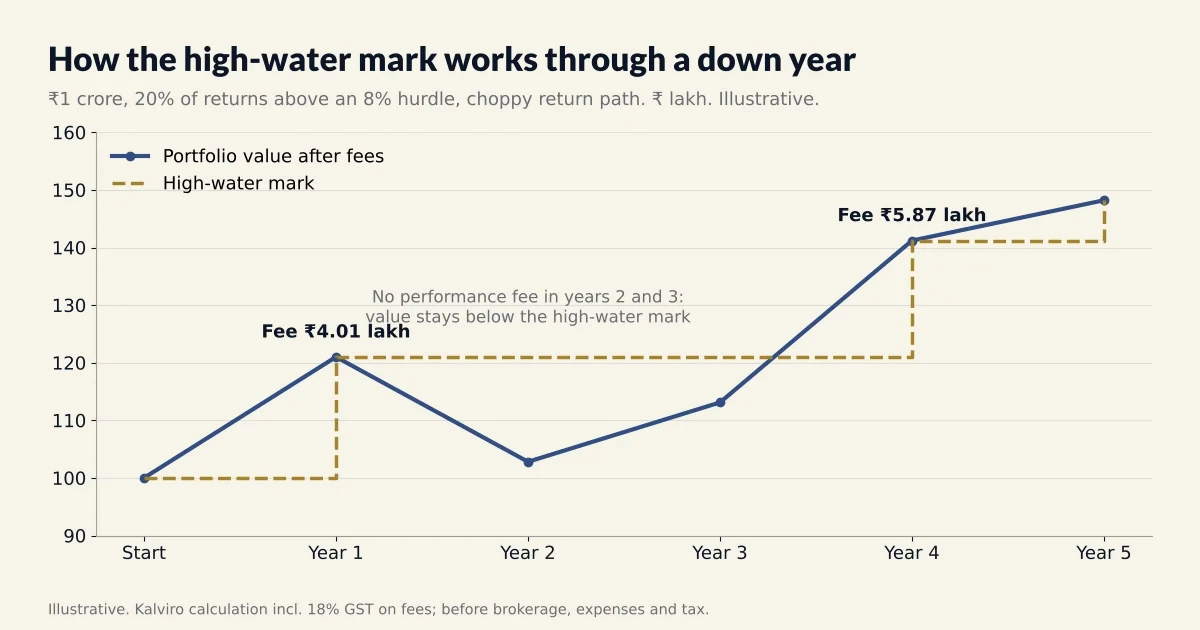
The high-water mark is the highest value the portfolio has reached at a fee date, after fees. SEBI allows a performance fee only on gains above it. If the portfolio falls from ₹1.21 crore to ₹1.03 crore, the manager earns no performance fee until it climbs back past ₹1.21 crore. Our glossary of investing terms defines the hurdle rate, high-water mark and other PMS fee terms in plain words.
SEBI’s master circular gives its own case. ₹50 lakh rises to ₹60 lakh in year one, falls to ₹55 lakh, then reaches ₹65 lakh in year three. The year-three fee applies only to the ₹5 lakh above ₹60 lakh. When you add money or withdraw some, the manager adjusts the high-water mark in proportion.
Crystallisation is the date on which the manager calculates the performance fee and takes it out. SEBI does not allow performance fees more often than once a quarter, and many agreements use one date a year. A longer gap makes it harder for a manager to earn a fee on a short strong spell that later reverses.
A PMS fee structure on ₹50 lakh over three years
This example uses the fee terms in SEBI’s own FAQ illustration: a 1.5% fixed fee plus 20% of returns above an 8% hurdle, with a high-water mark. GST at 18% applies to both fees. The account returns 20% in year one, loses 10% in year two and gains 25% in year three.
| Year | Return | Fixed fee with GST | Performance fee with GST | Value at year end | High-water mark after |
|---|---|---|---|---|---|
| 1 | +20% | ₹88,500 | ₹1,20,714 | ₹57,90,786 | ₹57,90,786 |
| 2 | -10% | ₹1,02,497 | Nil | ₹51,09,210 | ₹57,90,786 |
| 3 | +25% | ₹90,433 | ₹9,919 | ₹62,86,160 | ₹62,86,160 |
| Total | ₹2,81,430 | ₹1,30,633 |
Illustrative. Kalviro calculation; fixed fee on the opening value, performance fee once a year on value above the high-water mark plus 8%; before brokerage, operating expenses and tax.
In year three the account gained 25%, yet the performance fee came to only ₹9,919. The manager had to recover the old high of about ₹57.9 lakh and then clear 8% above it, about ₹62.5 lakh, before earning anything.
Without the high-water mark, an 8% hurdle on that year’s opening value would have produced a performance fee of about ₹1.84 lakh with GST. The mark saved the investor about ₹1.74 lakh in a single year. Over three years the fees total ₹4.12 lakh, and the fixed fee makes up about two-thirds of that.
To try your own amount, fee terms and return path, use Kalviro’s PMS fee calculator. SEBI also requires every manager to give new clients a fee calculation tool that shows several years and applies the high-water mark, so ask for it before you sign.
Five years of PMS fee structure costs on ₹1 crore
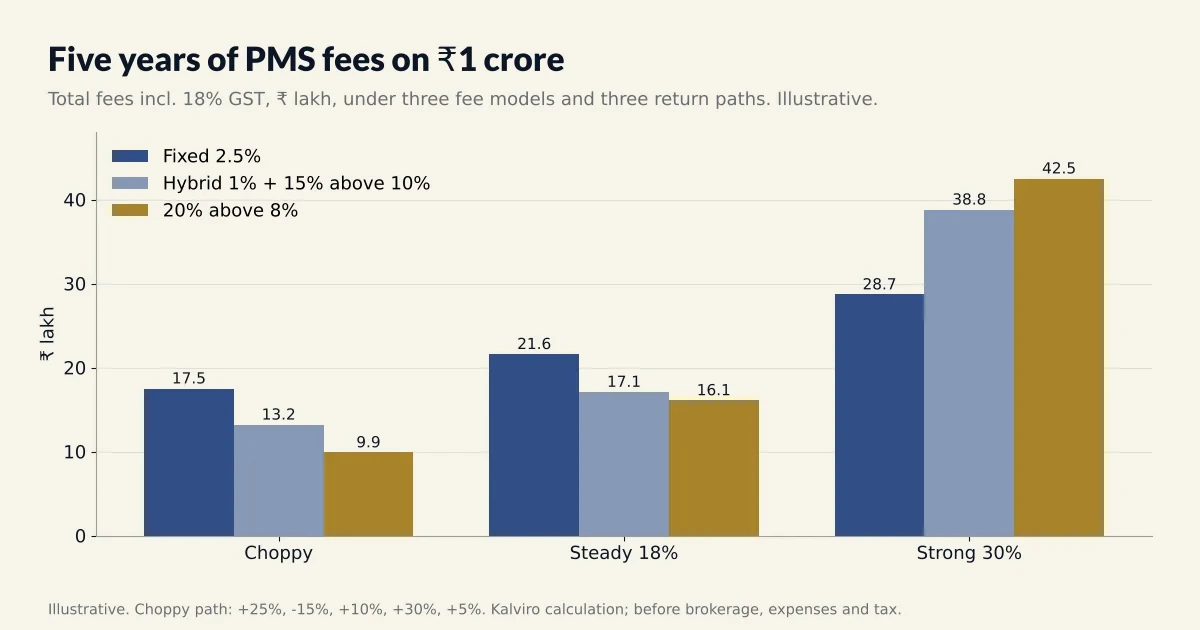
We compared three fee models on ₹1 crore over five years, with GST at 18% on all fees:
- Fixed: 2.5% a year on assets.
- Hybrid: 1% a year on assets plus 15% of returns above a 10% hurdle.
- Performance: 20% of returns above an 8% hurdle, with no fixed fee.
Each faced three return paths: a choppy one (+25%, -15%, +10%, +30%, +5%), a steady 18% a year and a strong 30% a year.
| Return path | Fixed 2.5% | Hybrid 1% + 15% above 10% | 20% above 8% |
|---|---|---|---|
| Choppy | ₹17.5 lakh in fees · ends at ₹1.38 crore | ₹13.2 lakh · ₹1.44 crore | ₹9.9 lakh · ₹1.48 crore |
| Steady 18% | ₹21.6 lakh · ₹1.99 crore | ₹17.1 lakh · ₹2.06 crore | ₹16.1 lakh · ₹2.07 crore |
| Strong 30% | ₹28.7 lakh · ₹3.25 crore | ₹38.8 lakh · ₹3.09 crore | ₹42.5 lakh · ₹3.03 crore |
Illustrative. Kalviro calculation; before brokerage, expenses and tax. Fixed fees on average assets; performance fees annual, above the higher of the high-water mark and the hurdle.
Three patterns stand out. With choppy returns, the performance model costs about ₹7.6 lakh less than the fixed fee, because the high-water mark blocks fees for two years. At a steady 18%, the gap narrows to about ₹5.5 lakh. At 30% a year, the order reverses and the performance model costs about ₹13.8 lakh more.
The fixed fee is predictable but runs through bad years. The performance fee costs little when returns are modest and a lot when they are high, which is also when an investor minds least.
PMS charges beyond the fee structure: GST, expenses and brokerage
GST at 18% applies to management and performance fees, so a 2.5% fixed fee costs 2.95% in practice.
Operating expenses, such as custody and fund accounting, can add up to 0.5% a year under SEBI’s cap. Brokerage adds to that at actual cost, so a strategy that trades often costs more to run. Tax on gains falls on the investor, because the shares sit in the investor’s own demat account.
All of these come out of the return you see. SEBI requires managers to report returns net of fees and expenses, which makes a manager’s reported return the right number to compare with its benchmark. Kalviro’s guide to PMS performance metrics explains how to read those reports.
The same fee weighs more on a lower-return portfolio. In a bond portfolio with an indicative 10.10% yield, a 1% fee plus GST takes about 1.18 percentage points a year, as our explainer on debt PMS in India works out.
Exit loads: what SEBI allows in years one to three
A PMS has no lock-in. A manager may charge an exit load on money withdrawn in the first three years. SEBI caps it at 3% in year one, 2% in year two and 1% in year three. After three years, no exit load applies.
On a ₹1 crore account closed in month eleven, the maximum exit load is ₹3 lakh. On ₹50 lakh withdrawn in year two, the cap is ₹1 lakh. Many agreements charge less, and some charge nothing.
Large-value accredited investors can agree exit terms directly with the manager, outside these caps. Our page on the accredited investor in India explains who qualifies.
Reading a PMS fee structure before you sign
The fee schedule in the PMS agreement answers most questions, if you ask for the detail. Five points matter most.
When is the fee year, and does new money start its own high-water mark? Does the hurdle compound across years, or reset each year? Is there a catch-up, so the manager earns on returns below the hurdle once the hurdle is cleared? Can you switch fee models later, and on what notice? How does the manager charge the fixed fee: on daily, monthly or quarter-end values?
Ask for a worked example in rupees for a flat year, a loss year and a strong year. SEBI’s FAQ includes a year-by-year worked example of its own, which is a useful check on the manager’s method.
Entry load, GST and fee dates: what investors ask about PMS charges
Does the manager charge on profit or on assets? That depends on the PMS fee structure you pick. A fixed fee applies to assets every year; a performance fee applies only to profit above the hurdle and the high-water mark.
Is there an entry load in a PMS? No. SEBI bars upfront fees, directly or indirectly. Pages that still list entry loads of 1% to 3% describe a practice SEBI’s rules no longer allow.
Does GST apply to PMS fees? Yes, at 18% on management and performance fees.
Is there a performance fee in a loss year? No, and the high-water mark stops the manager charging on the recovery.
How often does the manager take the fee? Usually monthly or quarterly for the fixed fee, and no more than once a quarter for the performance fee.
What is a normal fixed fee? Read the figure in the agreement and multiply it by your amount, plus GST. Kalviro’s note on the PMS minimum ticket size works this through on ₹50 lakh.
How do PMS fees compare with AIF fees? AIFs set fees in the private placement memorandum, often on the full commitment from the start. A PMS charges on the actual value of your account. Kalviro’s comparison of PMS vs AIF covers the difference.
Choosing a PMS fee structure means taking a view on the shape of future returns as well as paying a price. A fixed fee charges the same rate in a good year and a bad one. A performance fee costs little in modest years and a lot in strong ones, while the high-water mark and the gap between fee dates limit the extremes. Kalviro’s PMS strategies in India page lists strategies with their fee options.