

PMS vs AIF: Which Fits an HNI Portfolio?
PMS vs AIF is a choice between two structures that SEBI regulates. A Portfolio Management Service (PMS) is an account in your name. A portfolio manager buys shares for it, and they sit in your own demat. An Alternative Investment Fund (AIF) pools money from many investors and issues each of them units.
Both can run an equity idea, and many investors meet them in the same conversation. The differences that matter show up in four places. They are ownership of the shares, the tax, the limits on fees, and the timing of money in and out.
This guide works through each one, using the same ₹1 crore where it helps. It also covers the rule changes of 2025 and 2026, including the new accredited-investor framework. Information is as of October 2026.
PMS vs AIF at a glance
| Point | PMS | AIF |
|---|---|---|
| Full form | Portfolio Management Service | Alternative Investment Fund |
| Regulation | SEBI (Portfolio Managers) Regulations, 2020 | SEBI (Alternative Investment Funds) Regulations, 2012 |
| What you hold | Shares and bonds in your own demat account | Units of a pooled trust, company or LLP |
| Minimum | ₹50 lakh | ₹1 crore (₹25 lakh for the manager’s employees and directors) |
| Accredited investors | Minimum waived where the strategy allows | Minimum waived where the scheme allows |
| Main uses | Listed equity, some debt | Category I and II: private equity, private credit, real estate, infrastructure. Category III: listed equity, long-short, arbitrage |
| Lock-in | None; exit loads capped by SEBI | Category I and II: closed-ended, minimum three-year tenure. Category III: open- or closed-ended |
| Fees | Set in the PMS agreement, within SEBI rules on performance fees, expenses and exit loads | Set in the private placement memorandum (PPM) |
| Tax | Each trade taxed in your hands | Category I and II: mostly taxed in your hands. Category III: taxed inside the fund |
Information as of October 2026. Sources: SEBI regulations and circulars listed in this article.
In plain terms, a PMS hires a manager to run your own shares. You see every holding and pay tax on every sale. An AIF pools many investors’ money, and Category II funds hold it for years. Investors mostly choose one to reach private markets that a PMS account can’t hold.
Shares in your demat or units in a fund
In a PMS, you own each share. The manager trades under a power of attorney, but the shares sit in your demat. Dividends and bonus shares come to you. If you leave, you can usually take the shares with you or have them sold.
In an AIF, you own units, and the fund owns the investments. Your statement shows a NAV, not a list of shares you control. Category I and II AIFs usually hold unlisted companies or loans. No individual account could hold those in the same way.
Ownership also decides what happens at exit. A PMS can return your portfolio in kind. An AIF returns cash, or in some closed-ended funds, unlisted securities when the fund winds up.
PMS vs AIF fees: what SEBI caps and what it leaves open
For PMS, SEBI’s circular of 13 February 2020 set clear limits. A performance fee can apply only to gains above the high-water mark, the portfolio’s previous peak after fees. The manager can charge it only once a year. Operating expenses other than brokerage cannot exceed 0.5% a year of average daily assets. Exit loads cannot exceed 3% of the amount withdrawn in year one, 2% in year two and 1% in year three. After that the exit load is nil. Managers report returns net of all fees and expenses. Kalviro’s guide to the PMS fee structure works through these rules with a five-year example.
For AIFs, the PPM sets the fee. Most funds charge a management fee and a share of profits above a hurdle, often with a catch-up clause. SEBI requires disclosure, not a cap.
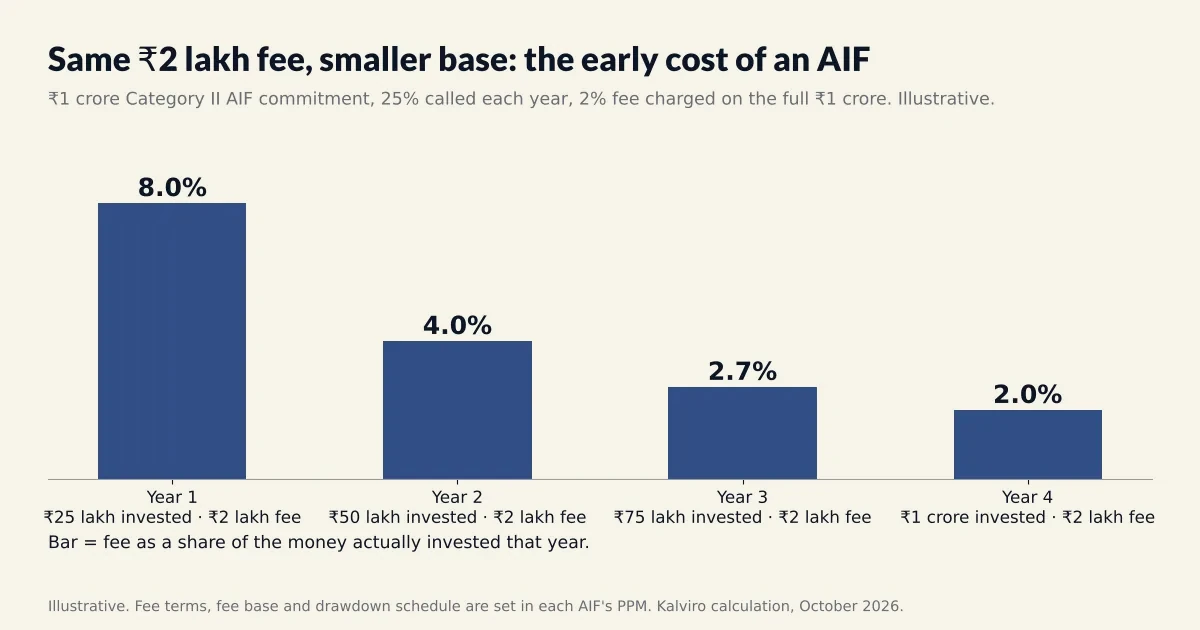
The fee base differs too. A PMS fee runs on the value of your portfolio. Many Category II AIFs charge the management fee on the full commitment from the first close. That applies even before the fund invests most of it. That one detail changes the real cost in the early years, as the next section shows.
PMS vs AIF on ₹1 crore: when the money goes in and comes back
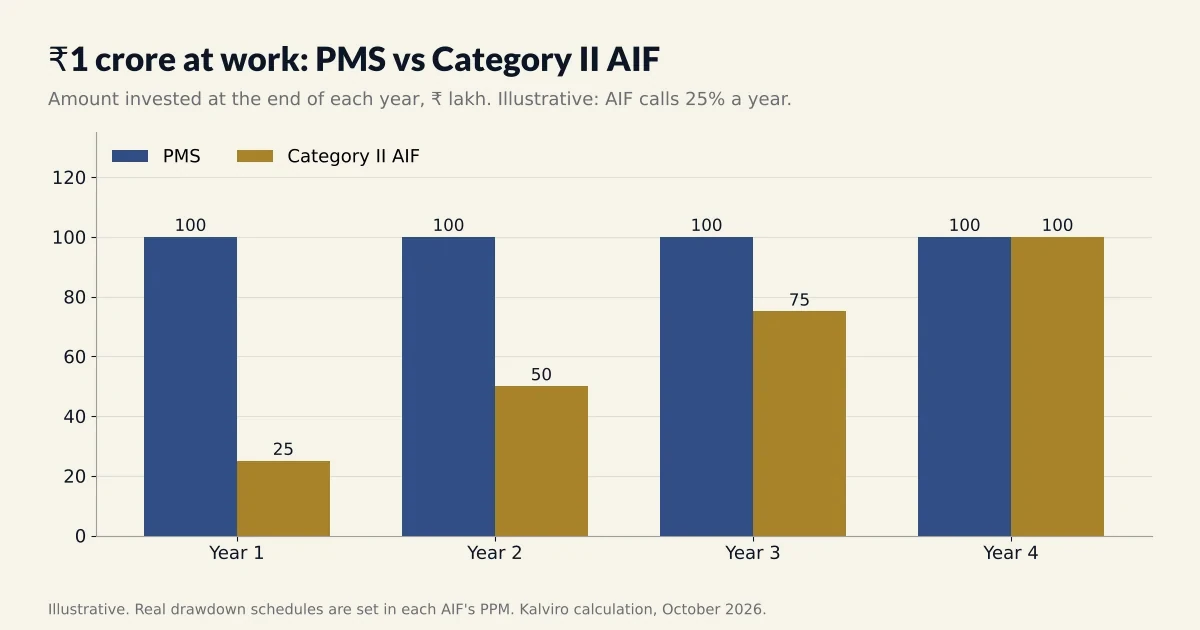
A PMS invests your ₹1 crore within days of onboarding. The full amount starts working, and starts paying fees, at once.
A Category II AIF calls capital in stages. Suppose it calls 25% of a ₹1 crore commitment each year for four years. It charges 2% a year on the full commitment, so the fee is ₹2 lakh every year. In year one that fee equals 8% of the ₹25 lakh at work. It falls to 4% in year two and 2.7% in year three. The fee reaches 2% of invested capital only once the fund has called the full ₹1 crore. These numbers are illustrative; each PPM sets its own schedule.
The money also comes back differently. A PMS investor can withdraw at any time, subject to the exit load. A partial withdrawal must leave at least ₹50 lakh in the account. A Category II AIF returns capital as it sells investments, usually from year four or five. Most funds run for seven to ten years. Kalviro’s note on AIF capital calls explains drawdowns and the J-curve in detail.
How PMS vs AIF returns are taxed in FY 2026-27
In a PMS, every sale creates tax in your hands, because you own the shares. On listed equity held over twelve months, long-term gains above ₹1.25 lakh a year attract 12.5% tax. Short-term gains attract 20%. Dividends count as your income. A manager who trades often creates more short-term gains, so turnover affects your tax bill directly.
Category I and II AIFs pass most income through to investors. The investor pays tax on capital gains and dividends as if they had earned them directly. The fund itself pays tax on any business income, which is rare. Kalviro’s explainer on Category II AIF tax covers the detail, including tax withholding on distributions.
Category III AIFs are not pass-through. The fund pays tax on its own income before distributing, and the investor receives post-tax cash. If the tax department treats the fund’s trading as business income, the rate can rise to the maximum marginal rate. Tax treatment depends on each investor’s facts, so confirm it with a tax adviser before investing.
Exit loads, lock-ins and fund tenure
SEBI does not allow a lock-in on PMS money. The exit load caps above are the only cost of leaving early, plus any market impact of selling.
Category I and II AIFs have a fixed term of at least three years. Most run seven to ten years, plus extensions. Before the fund returns capital, the only usual way out is selling your units privately to another investor.
Category III AIFs vary. Open-ended ones allow redemptions on set dates, often with notice periods and exit loads in early years. Closed-ended ones run for a fixed term.
What changed for PMS and AIF investors in 2025 and 2026
In November 2025 SEBI amended the AIF rules. It created schemes open only to accredited investors. It also cut the Large Value Fund minimum from ₹70 crore to ₹25 crore per investor.
On 24 September 2026 the SEBI Board approved a wider accredited-investor framework, including deemed status for NRIs. It also approved new PMS Regulations, 2026. They add a mutual-fund-only PMS route with a ₹25 lakh minimum and a fixed fee of at most 1% a year. The standard ₹50 lakh PMS minimum stays. Both changes apply once SEBI notifies them. Kalviro’s guide to the accredited investor in India covers what the status allows.
Holding a PMS and an AIF together
Many families use both, for different parts of their wealth. A PMS often holds the listed-equity allocation, where visibility and the ability to exit matter. A Category II AIF then holds private equity or private credit, which a PMS can’t reach. Families usually size it for money they won’t need for seven years.
The overlap to watch is a Category III AIF and a PMS that run similar listed-equity strategies, as TCG does with its TCG Equity Opportunities AIF and its IOP PMS. The holdings may look alike while the tax, fees and liquidity differ, which is the comparison this article sets out.
PMS vs AIF questions investors ask
What are the full forms of PMS and AIF? PMS is Portfolio Management Service. AIF is Alternative Investment Fund. SEBI regulates both under separate regulations.
Which carries more risk? Neither structure decides risk on its own. A concentrated small-cap PMS can swing more than a private-credit AIF. The AIF carries credit, valuation and lock-in risk instead.
Can NRIs invest in both? Yes, subject to FEMA rules, the manager’s policy and KYC. NRIs usually invest in PMS through a PIS-linked NRE or NRO account. For AIFs, the PPM sets out whether the investment is repatriable.
Is there a route below ₹50 lakh? The mutual-fund-only PMS route at ₹25 lakh applies once notified. Accredited investors can go below both PMS and AIF floors where the product allows.
Which reports returns more clearly? PMS managers report time-weighted returns net of fees against a benchmark. You also see every holding. AIFs report NAV, and Category I and II funds add IRR, DPI and TVPI as investments mature.
PMS vs AIF comes down to ownership, tax and timing. A PMS gives you the shares, the tax on each trade and an exit at a capped cost. An AIF pools the money, reaches assets a PMS can’t hold and keeps the capital for the fund’s term. Kalviro’s portfolio management services and alternative investment funds pages list the strategies and funds available in each structure.
