

Category II AIF in India: Private Equity, Credit and Real Estate Funds Explained
A Category II AIF is a SEBI-registered, close-ended pooled fund that invests mainly in unlisted companies, private credit, real estate projects or other funds. It does not borrow to boost returns. It takes ₹1 crore or more from each investor, draws the money over several years and pays it back as investments exit.
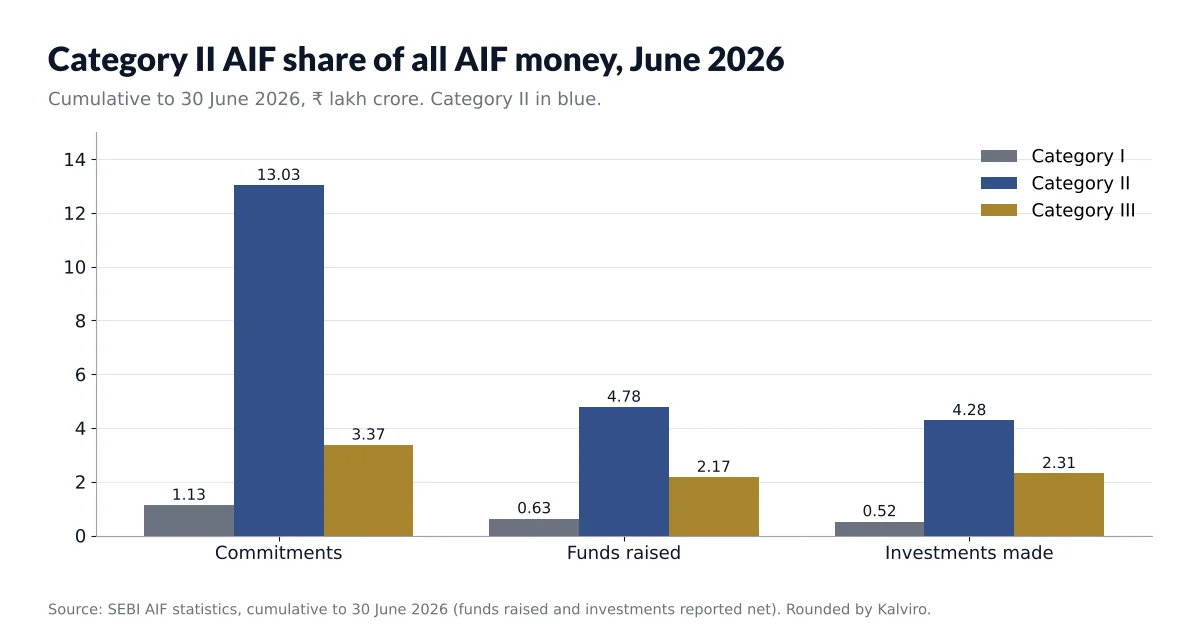
It is also where most of India’s alternative capital now sits. SEBI’s data shows ₹13.03 lakh crore committed to Category II funds by 30 June 2026, three of every four rupees committed to all AIFs.
Most investors still choose these funds on a target return. The benchmark data shows how much of the return so far is cash in hand and how much is still a valuation. This guide covers the rules, the money flows, the fees, the return data, tax and the 2025–26 rule changes. Information is as of October 2026.
Category II AIF at a glance
| Rule | Position |
|---|---|
| Definition | Not Category I or III; no leverage beyond temporary borrowing |
| What it holds | Mainly unlisted securities, and listed debt rated A or below |
| Minimum per investor | ₹1 crore (₹25 lakh for the fund’s or manager’s employees and directors); lower for accredited investors |
| Minimum fund size | ₹20 crore per scheme |
| Investors | Up to 1,000 per scheme (accredited investors excluded from the count) |
| Structure | Close-ended, minimum 3-year term |
| Extension | Up to 2 years, with approval of two-thirds of unitholders by value |
| Borrowing | Only for temporary needs: up to 30 days, 4 times a year, 10% of investable funds |
| Single investee limit | 25% of investable funds (50% for Large Value Funds) |
| Manager’s own stake | Lower of 2.5% of the corpus or ₹5 crore |
| Valuation | Independent valuer, at least every six months |
| Tax | Pass-through: income taxed in investors’ hands, except business income |
Information as of October 2026. Source: SEBI (Alternative Investment Funds) Regulations 2012, consolidated to 14 July 2026.
Put simply, a Category II fund collects commitments from wealthy investors, calls the money when it finds deals and pays it back as those deals exit. The minimum is ₹1 crore, money stays in for the term set in each PPM, often several years, and investors cannot sell early in the usual course. The main risks are that investments return less than expected and that cash comes back later than planned.
What these funds may hold, and what they may not
SEBI defines the category by exclusion. Category I covers venture capital, angel, social impact, infrastructure and special situation funds. Category III covers funds that trade listed securities or use leverage. Category II is everything in between that does not borrow except briefly.
In practice, Category II funds invest primarily in unlisted securities. Since a SEBI Board decision of March 2025, listed debt rated A or below counts alongside unlisted securities, so a credit fund can hold it in full. A Category II fund can also invest in units of other Category I or II funds, which is how funds of funds work.
The leverage rule shapes the product. A Category II fund may borrow only to meet a temporary shortfall, for at most 30 days, four times a year and up to 10% of investable funds. Any return therefore comes from the assets themselves, not from debt at the fund level.
Where Category II AIF money goes: SEBI data to June 2026
| Category | Commitments (₹ crore) | Funds raised (₹ crore) | Investments made (₹ crore) |
|---|---|---|---|
| Category I | 1,13,041 | 63,487 | 51,501 |
| Category II | 13,02,837 | 4,78,195 | 4,28,376 |
| Category III | 3,37,192 | 2,17,227 | 2,30,911 |
| Total | 17,53,070 | 7,58,909 | 7,10,787 |
Information as of 30 June 2026, cumulative. Source: SEBI AIF statistics. Funds raised and investments are reported net.
Category II holds 74.3% of all commitments, 63.0% of funds raised and 60.3% of investments made. Its commitments grew from ₹10.78 lakh crore a year earlier, a rise of 20.8%.
The gap between columns matters more than the totals. Category II funds have raised only about 37% of what investors committed. The rest is undrawn commitment that investors must still fund when called, often years after signing.
Private equity, credit, real estate and fund-of-funds strategies
Category II covers several strategies with very different cash flows. Private equity funds buy minority or control stakes in growing companies and return money mainly on exit. Credit funds lend to companies and pay interest along the way. Real estate funds finance or own projects and return capital as units sell. Funds of funds spread a commitment across several underlying managers.
| Strategy | How the money returns | Kalviro reviews |
|---|---|---|
| Growth and private equity | Mostly on exit, later in the fund’s life | Carnelian Private Growth & Innovation Fund, InCred Growth Partners Fund II, 360 ONE Multi-Stage AI Fund, Nippon India Digital Innovation Fund 2A |
| Secondaries and special opportunities | Exits from bought-in stakes | HDFC Select Opportunities Fund, ICICI Prudential Special Opportunities Fund |
| Private and performing credit | Interest during the term, principal on repayment | 360 ONE Arise Credit Fund, ICICI CCOF, Lighthouse Canton Growth Debt Fund II, Vivriti funds |
| Real estate | Interest or project cash as units sell | ICICI Real Estate Development Fund, ASK Real Estate Special Situations Fund IV |
| Infrastructure and multi-strategy | Asset income plus exit | Neo Infra Income Fund, Neo Prime Fund |
| Fund of funds | Through underlying funds | Singularity Fund of Funds 2 |
Fund details as published in each Kalviro review; check the latest PPM before investing.
Special situation funds that buy stressed assets sit in Category I, not II, under SEBI’s rules. A fund’s name does not decide its category; its registration does.
How the fund draws and returns money
An investor signs a commitment, say ₹1 crore, and pays nothing more until the manager issues a drawdown notice. The manager calls money in tranches as it finds investments, across an investment period set in the PPM. Each notice sets a deadline, and missing it carries penalties set out in the fund documents.
Money comes back in the other direction as investments pay interest or exit. In an equity fund, distributions are thin for the first few years and heavier later, which is the J-curve: the investor’s net position dips while fees and drawdowns run ahead of returns, then climbs. Kalviro’s note on AIF capital calls covers notice periods, defaults and how to keep the undrawn amount ready.
Since December 2024, SEBI rules give every investor rights in each investment and each distribution in proportion to their commitment. An investor who defaults on a call loses that pro-rata right for the investment concerned.
Category II AIF fees: on commitment, on invested capital and carry
SEBI does not cap AIF fees. It requires the manager to disclose them in the private placement memorandum (PPM). Practitioner summaries describe common market terms: a management fee of about 1–2% a year, a hurdle of about 7–12% a year, and carried interest of 10–20% of profits above the hurdle, often with a catch-up.
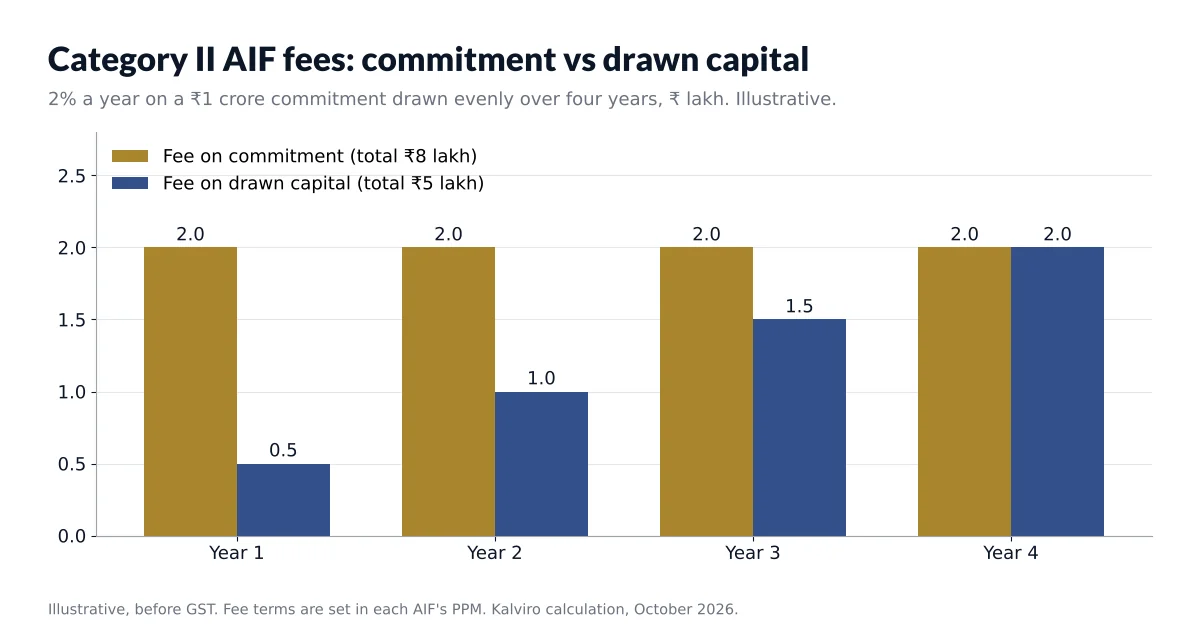
The fee base matters as much as the rate. A fee charged on the full commitment from day one costs far more in the early years than the same rate on money actually drawn.
| Year | Drawn so far (₹) | 2% on commitment (₹) | 2% on drawn capital (₹) |
|---|---|---|---|
| 1 | 25 lakh | 2.0 lakh | 0.5 lakh |
| 2 | 50 lakh | 2.0 lakh | 1.0 lakh |
| 3 | 75 lakh | 2.0 lakh | 1.5 lakh |
| 4 | 1 crore | 2.0 lakh | 2.0 lakh |
| Total | 8.0 lakh | 5.0 lakh |
Illustrative: ₹1 crore commitment drawn evenly over four years, fee shown at year-end drawn amount, before GST. Kalviro calculation.
Fund terms vary. Neo’s Infra Income Opportunities Fund II, for example, charges 2% a year on money drawn during the investment period for its ₹1–2.99 crore class, with 20% carry above a 10% hurdle and no catch-up. Reading the fee base, the hurdle type and the catch-up clause in rupees is part of reading any PPM.
What the vintage data says about Category II AIF returns
SEBI requires benchmarking agencies to measure AIF performance once a scheme is a year past its first close, using data reported half-yearly. The agencies compare Category I and II funds by vintage year, using pooled IRR together with DPI, RVPI and TVPI. CRISIL is one of the benchmarking agencies.
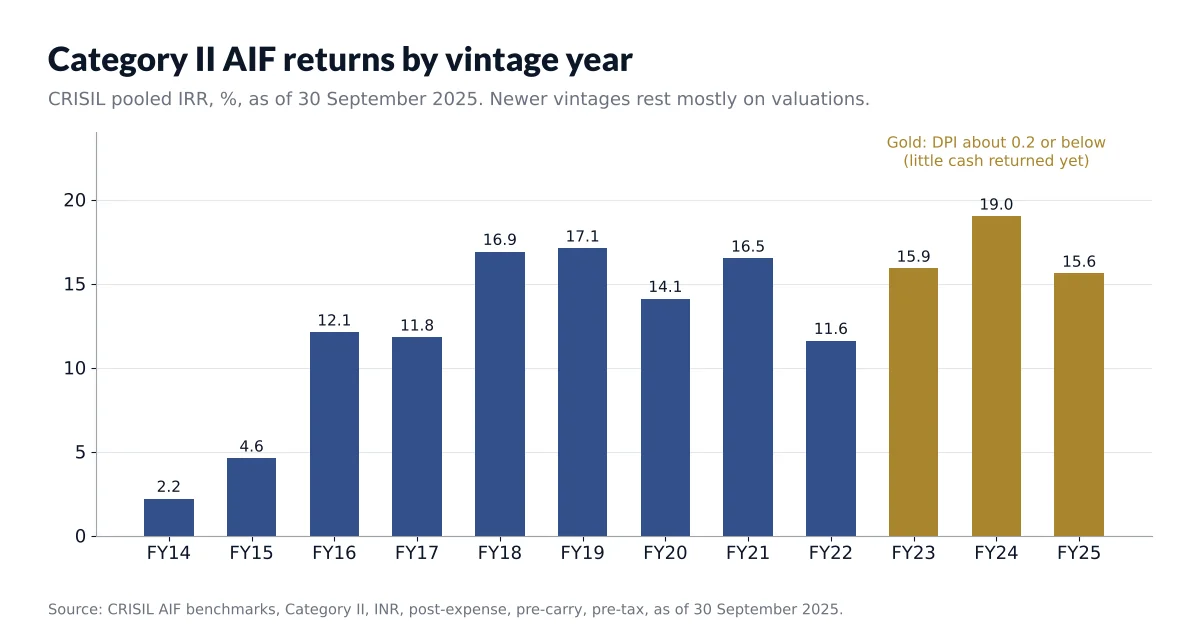
| Vintage (financial year) | CRISIL Category II pooled IRR |
|---|---|
| FY14 | 2.2% |
| FY15 | 4.6% |
| FY16 | 12.1% |
| FY17 | 11.8% |
| FY18 | 16.9% |
| FY19 | 17.1% |
| FY20 | 14.1% |
| FY21 | 16.5% |
| FY22 | 11.6% |
| FY23 | 15.9% |
| FY24 | 19.0% |
| FY25 | 15.6% |
Information as of 30 September 2025, in rupees. Source: CRISIL AIF benchmarks. Post-expense, pre-carry, pre-tax.
Two cautions apply. These figures come before carry and tax, so an investor’s own return is lower. And the newer the vintage, the more of the IRR rests on valuations. CRISIL’s DPI, the cash returned as a multiple of cash paid in, sits around 1.0–1.2 for the FY16–FY18 vintages but around 0.2 for FY23–FY24 and 0.05 for FY25.
An IRR of 19% on a FY24 vintage is therefore mostly an estimate of what portfolio companies are worth. Kalviro’s guide to DPI, TVPI and IRR shows how to read each measure.
How Category II compares with Category I and Category III
| Point | Category I | Category II | Category III |
|---|---|---|---|
| Typical assets | Start-ups, SMEs, infrastructure, social impact, special situations | Unlisted equity, private credit, real estate, other AIFs | Listed shares and derivatives |
| Leverage | Temporary borrowing only | Temporary borrowing only | Allowed within SEBI limits |
| Structure | Close-ended | Close-ended | Open- or close-ended |
| Tax | Pass-through | Pass-through | Taxed at fund level |
| Minimum | ₹1 crore | ₹1 crore | ₹1 crore |
Information as of October 2026. Source: SEBI (Alternative Investment Funds) Regulations 2012, as amended.
The tax column often decides the choice for a listed-equity investor. A Category III fund pays tax before distributing, while a Category II fund passes income through to be taxed in the investor’s hands. Kalviro’s note on Category III AIFs for NRIs explains the fund-level route.
Large Value Funds, accredited-only schemes and co-investment
Three newer structures sit inside the Category II rules. A Large Value Fund takes only accredited investors, each committing at least ₹25 crore since the November 2025 amendment, down from ₹70 crore. In return, it can hold up to 50% in one company, against 25% for a regular scheme.
Accredited-investor-only schemes, created by the same amendment, let managers run funds for accredited investors with fewer of the limits that protect smaller investors. Their investors do not count towards the 1,000-investor cap.
Co-investment came under Regulation 17A in September 2025. An accredited investor in a Category I or II fund can invest alongside the fund in one of its portfolio companies, through a separate co-investment scheme. The terms cannot be better than the fund’s own, and the exit must line up with the fund’s exit.
Valuation and reporting: what a Category II investor receives
The fund must value its holdings through an independent valuer at least every six months, and may move to yearly valuation with approval from 75% of investors by value. Valuations follow industry guidelines for private assets, so the NAV of an unlisted portfolio is an estimate until each asset is sold.
Investors also receive the scheme’s performance data, which benchmarking agencies use to compare funds of the same vintage. A large move in value between two valuations has to be reported to investors.
Category II AIF tax: pass-through under the 2025 Act
Category II funds are pass-through vehicles under section 224 of the Income-tax Act 2025 (earlier section 115UB). Income keeps its character in the investor’s hands, as interest, dividend or capital gain, as if the investor held the investment directly. The fund pays tax only on business income. The Finance Act 2025 treats securities held by these funds as capital assets, which makes business income rare.
The fund deducts tax on distributions: 10% for resident investors, and the rates in force for non-residents, which a tax treaty can lower. Business losses stay in the fund; other losses pass through only on units held for at least 12 months. Kalviro’s note on Category II AIF tax works through the detail.
Rule changes in 2025–26 that matter to investors
| Date | Change |
|---|---|
| 13 Dec 2024 | Pro-rata and pari-passu rights for every investor in each investment and distribution |
| 8 Sep 2025 | Co-investment schemes (Regulation 17A) for accredited investors in Category I and II funds |
| 18 Nov 2025 | Large Value Fund threshold cut from ₹70 crore to ₹25 crore per investor; accredited-investor-only schemes |
| 3 Jun 2026 | Updated SEBI master circular for AIFs |
| 14 Jul 2026 | GARUDA: faster launch of new schemes for filings from this date |
| 24 Sep 2026 | SEBI Board approved a wider accredited-investor framework, including non-residents as deemed accredited investors (effective only when notified) |
Information as of October 2026. Sources: SEBI circulars, amendment regulations and press release 59/2026.
The accredited-investor changes matter most for ticket sizes. Accredited investors can commit below ₹1 crore where a scheme allows it. Kalviro’s guide to the accredited investor in India tracks the framework.
Reading a Category II AIF PPM before you commit
Ten lines in a PPM decide most of the investor’s experience:
- The fee base: commitment, drawn capital or net invested.
- The hurdle: its rate and whether it compounds.
- Catch-up: whether the manager catches up after the hurdle, and how fast.
- Waterfall: whole-fund or deal-by-deal.
- Term and extensions.
- Investment period length.
- Drawdown notice period and default penalties.
- Key-person clause.
- Valuation method and frequency.
- Set-up and other expenses charged to the fund.
Kalviro’s PPM checklist for Category II AIFs covers each with examples.
Questions investors ask about Category II
What is the minimum investment in a Category II AIF? ₹1 crore per investor, or ₹25 lakh for employees and directors of the fund or manager. Accredited investors can go lower where the scheme allows.
Can a Category II AIF use leverage? Only briefly: up to 30 days, four times a year and 10% of investable funds, to meet temporary needs.
How long is money locked in? The legal minimum term is three years. Many funds set longer terms in their PPM: Kalviro’s reviews include 6.5 years plus extensions (Neo Prime), 7 years plus 1 + 1 (Neo Infra Fund II) and 10 years plus extensions (Singularity Fund of Funds 2).
Can NRIs invest in Category II AIFs? Yes, where the PPM allows, on a repatriable route through NRE or FCNR money or a non-repatriable route. Each capital call must come from an account the chosen route permits.
How is a Category II AIF different from a PMS? A PMS holds listed shares in the investor’s own account, and the investor can exit at any time. A Category II AIF pools money into mostly unlisted assets for years. Kalviro’s PMS vs AIF comparison sets them side by side.
A Category II AIF trades liquidity for access to private companies, private credit and real estate projects that listed markets do not offer. The fee base, the drawdown pace and the share of returns already paid in cash decide how that trade works out for an investor. Kalviro’s AIF investments page lists the selective, curated funds available.
