

TCG Equity Opportunities AIF: Terms, Fees & PMS Record
TCG Equity Opportunities AIF Scheme 2 is a Category III fund from TCG Asset Management. It buys 25 to 35 listed Indian companies that gain from India’s capex cycle. The close-ended fund aims to raise up to ₹1,500 crore, including a ₹500 crore green-shoe. It runs for 96 months and has a ₹1 crore minimum.
The AIF follows the same strategy as TCG India Investment Opportunities Portfolio (TCG IOP), a PMS launched on 21 November 2024. APMI shows the PMS up 14.44% a year to 30 September 2026. Over the same period, TCG’s factsheet puts the BSE 500 TRI at 0.9% a year. TCG calls the AIF its first flexicap Category III fund, and it is open for subscription.
Fund terms come from TCG’s fund presentation and its October 2026 note to distribution partners. PMS figures come from APMI and TCG’s September 2026 factsheet. We checked both registrations with SEBI on 23 October 2026.
TCG Equity Opportunities AIF in one table
| Particular | Detail |
|---|---|
| Fund | TCG Equity Opportunities AIF, Scheme 2 (TCG’s name for the strategy: TCG India Investment Opportunities Strategy) |
| Category / structure | SEBI Category III AIF, close-ended, long only |
| SEBI registration | IN/AIF3/24-25/1618, held by TCG Equity Opportunities AIF Trust from 30 October 2024; Scheme 2 is one of its schemes |
| Investment manager | TCG Advisory Services Private Limited (TCG Asset Management), SEBI portfolio manager INP000005133 |
| What it buys | 25 to 35 listed companies across five capex themes; market cap above ₹1,000 crore at purchase; at most 10% in one stock |
| Target size | Up to ₹1,500 crore, including a ₹500 crore green-shoe |
| Status | Open for subscription (TCG, October 2026); first close date and amount raised not published |
| Minimum commitment | ₹1 crore |
| Drawdown | 5% at signing; about 20% more by the end of December 2026; about 75% in 3 to 4 tranches over the next 9 to 12 months (indicative) |
| Commitment period | Up to 18 months from final close, plus up to 6 months at the manager’s discretion |
| Term | 96 months from first close |
| Management fee (Class A) | 2.50% a year from ₹1 crore to under ₹3 crore; 2.25% from ₹3 crore to under ₹10 crore; 2.00% from ₹10 crore; charged on NAV |
| Exit fee (Class A) | 1% of redemption proceeds within 12 months of paying the final drawdown; nil after that |
| Sponsor / manager commitment | 5% of the corpus or ₹10 crore, whichever is less |
| Benchmark | Not disclosed for the AIF; the PMS uses BSE 500 TRI, with BSE India Infrastructure TRI as a second benchmark |
| Track record | None for the AIF; TCG IOP PMS since 21 November 2024 |
Information as of October 2026, as disclosed in TCG’s fund presentation, its October 2026 note to distribution partners and SEBI’s register of AIFs. The PPM and contribution agreement govern the fund’s terms.
Put simply, you commit ₹1 crore and pay it in over about a year. ₹5 lakh goes in at signing, about ₹20 lakh by December 2026 and the rest in three or four calls. The fund buys shares in companies that build power grids, defence equipment, electronics, ports and factories. You can redeem only after paying every call. TCG’s own risk note flags concentration: every holding comes from one investment theme.
What TCG Equity Opportunities AIF buys
The fund owns companies that earn from building India’s power, digital, defence, factory and transport capacity. It largely leaves out financial services, FMCG, IT and healthcare. TCG groups its picks under five themes.
| TCG’s theme | What it covers |
|---|---|
| Energy security, transition and decarbonisation | Power generation and transmission, renewables, electrical equipment, the EV ecosystem |
| Digital infrastructure | Telecom, data centres, digital payments and market infrastructure |
| Defence and electronics | Aerospace and defence, precision manufacturing, semiconductors and electronics |
| Manufacturing and Industry 4.0 | Industrial manufacturing and products, chemicals, building materials, recycling |
| Mobility and urban development | Railways, ports, aviation, roads, logistics, water and real estate |
TCG’s universe holds about 325 of India’s top 750 listed companies, about 40% of the market’s value (5 June 2026). From financial services, it keeps only infrastructure lenders and market infrastructure, such as exchanges, depositories and fintech.
The PMS shows what this looks like in practice. At 30 September 2026 it held 35 stocks, with 40.5% in the top 10 (our sum). Four sectors made up 61.7%: electrical equipment, industrial products, aerospace and defence, and industrial manufacturing. The largest holding, Welspun Corp, makes line pipes. Water-treatment firm VA Tech Wabag and precision engineer MTAR Technologies also feature.
| Top 10 holdings, TCG IOP PMS (30 Sep 2026) | Weight |
|---|---|
| Welspun Corp | 6.1% |
| Syrma SGS Technology | 4.9% |
| GE Vernova T&D India | 4.3% |
| MTAR Technologies | 4.1% |
| Hitachi Energy India | 3.7% |
| Dixon Technologies India | 3.7% |
| VA Tech Wabag | 3.6% |
| Hindustan Aeronautics | 3.4% |
| Jash Engineering | 3.4% |
| Kirloskar Oil Engines | 3.3% |
By SEBI’s size bands, the PMS held 54.5% in small caps and 17.2% in mid caps. Large caps made up 24.6% and cash 3.8%. The AIF builds its own portfolio, which may differ.
Why TCG is betting on India’s capex cycle
TCG’s case starts with government spending. The Ministry of Finance puts effective capital expenditure for FY 2026-27 at ₹17.15 lakh crore, or 4.4% of GDP. That includes ₹4.93 lakh crore of grants to states for capital assets. Defence received ₹7.85 lakh crore. The Ministry of Defence has set aside ₹1.39 lakh crore, 75% of its capital acquisition budget, for domestic industry.
TCG’s thesis is that private companies have now joined in. Its research shows listed-company capex flat at about ₹5 to 6 trillion a year over FY11 to FY21, then doubling by FY26. TCG expects earnings in these sectors to outgrow the market’s over the coming years. These are market figures and the manager’s view, not a forecast for the fund.
The record so far: TCG IOP PMS, not the AIF
The strategy’s only record is the PMS. Over its first 22 months, it returned more than both benchmarks, after falling 11.1% in FY 2024-25.
| Period to 30 Sep 2026 | TCG IOP PMS | BSE 500 TRI | BSE India Infrastructure TRI |
|---|---|---|---|
| 1 month | -0.1% | -5.6% | -2.1% |
| 3 months | 2.2% | -3.6% | -9.4% |
| 6 months | 31.6% | 8.1% | 2.9% |
| 1 year | 28.3% | -2.3% | -5.1% |
| Since 21 Nov 2024 (a year) | 14.4% | 0.9% | -4.1% |
| FY 2024-25 (from 21 Nov 2024) | -11.1% | -2.9% | -6.8% |
| FY 2025-26 | 9.9% | -3.1% | -3.4% |
Past performance of the TCG IOP PMS, not of the AIF, as disclosed in TCG’s factsheet for September 2026. Time-weighted returns after all fees and expenses; periods over one year are annualised. APMI reports 28.25% for one year and 14.44% a year since inception, also to 30 September 2026. Past performance does not indicate future returns.
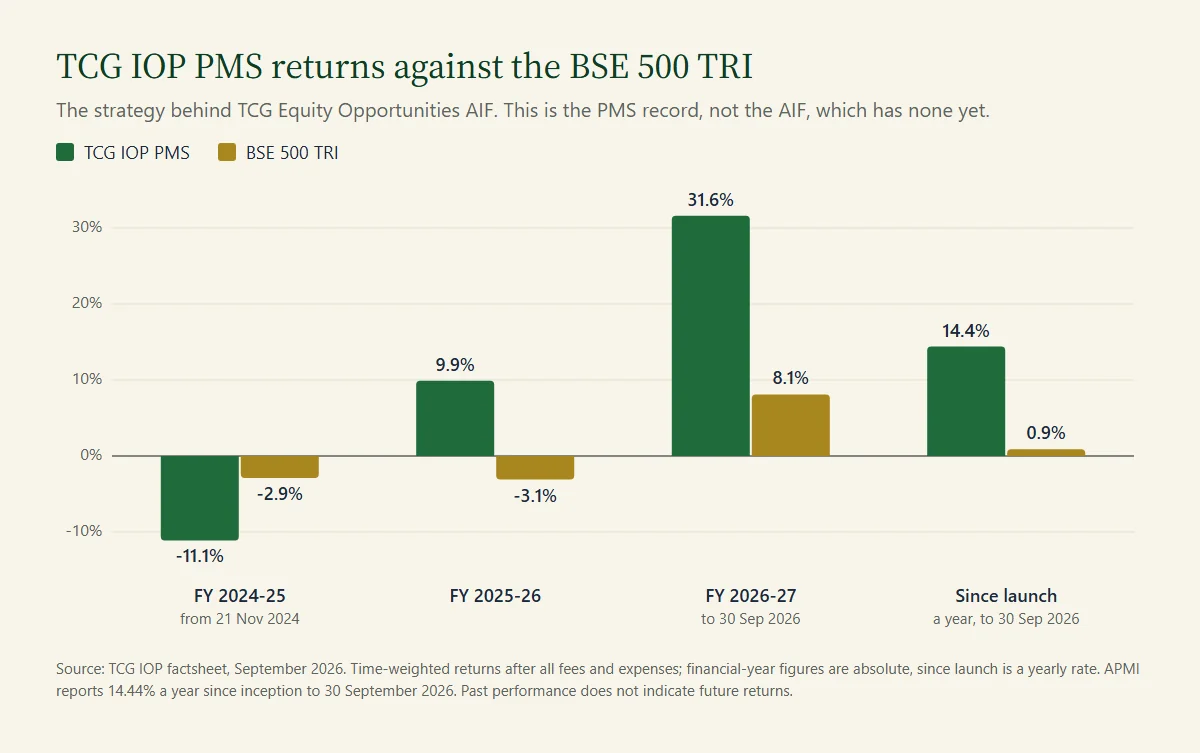
TCG’s update to 16 October 2026 shows 21.1% over one year and 11.8% a year since inception. The BSE 500 TRI shows -4.9% and 1.3% over the same periods. In FY 2024-25, its first four months, the PMS fell 11.1%, more than either benchmark.
The record covers less than two years. APMI also shows the PMS managing ₹5.09 crore at 30 September 2026, so the AIF would run the approach at a far larger size. The AIF’s NAV also carries fund-level costs and tax, so it will differ from the PMS.
TCG Equity Opportunities AIF fees on ₹1 crore
In Class A, a ₹1 crore commitment pays 2.5% a year on the fund’s value. That comes to about ₹2.5 lakh a year once all your money is in. TCG charges the fee on NAV, so it applies to the value of money already paid in, not the full commitment.
| Stage, ₹1 crore commitment (Class A) | Money in the fund | Fee a year at 2.5%, before GST |
|---|---|---|
| At signing | ₹5 lakh | ₹12,500 |
| After the December 2026 call | About ₹25 lakh | About ₹62,500 |
| Fully drawn | ₹1 crore | ₹2,50,000 |
Our illustration, not the manager’s. It assumes the fund’s value equals the money paid in; the fee rises and falls with NAV.
Larger commitments pay a lower rate. Fully drawn, ₹3 crore at 2.25% costs ₹6,75,000 a year, and ₹10 crore at 2.00% costs ₹20,00,000. TCG’s Class A terms list no performance fee, so the rate stays the same in a strong year. An exit within 12 months of your final drawdown costs 1% of the proceeds, or ₹1,00,000 on ₹1 crore.
The fund presentation does not say whether GST applies. TCG’s PMS disclosure document adds 18% GST to its PMS fees. TCG also offers other unit classes, one with a lower fixed fee plus a share of returns above a 10% hurdle. The PPM sets the rules for each class, and we can take you through them. Our note on long-only funds and Category III AIFs compares the structures.
When your ₹1 crore goes in
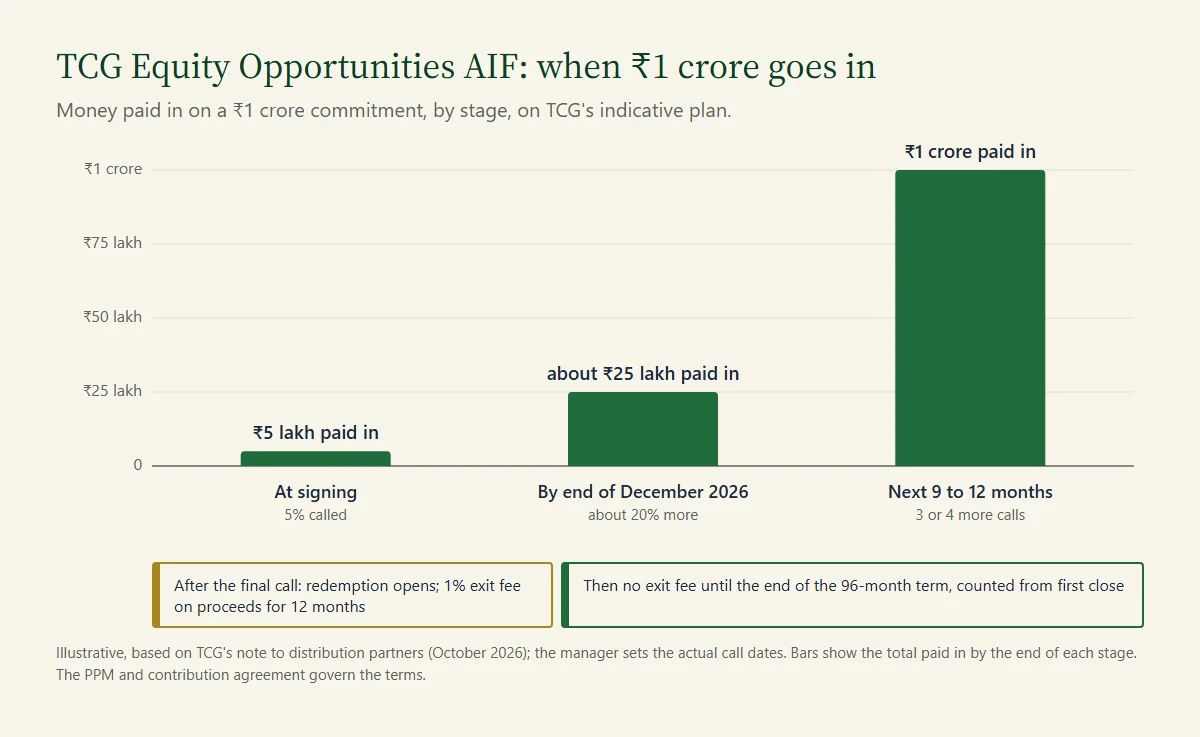
Most of the money goes in within about a year. TCG expects to have called about 25% by the end of December 2026. The other 75% follows over the next 9 to 12 months.
| Step | You pay | Total paid in | Timing (TCG’s indicative plan, October 2026) |
|---|---|---|---|
| Initial drawdown | ₹5 lakh | ₹5 lakh | At signing |
| Second call | About ₹20 lakh | About ₹25 lakh | By the end of December 2026 |
| Three or four calls | About ₹75 lakh in all; ₹18.75 lakh to ₹25 lakh each (our estimate) | ₹1 crore | Over the next 9 to 12 months |
| After the final call | Nil | ₹1 crore | Redemption opens; 1% exit fee for 12 months |
| End of term | Nil | ₹1 crore | 96 months from first close |
Indicative, from TCG’s October 2026 note to distribution partners. The manager sets the actual call dates.
If you join later, your first payment covers 5% plus every call already made. Under the fund’s terms, an investor who misses a drawdown cannot redeem. Our guides to AIF capital calls and the PPM checklist explain what to check before you sign.
Who runs the money at TCG Asset Management
Vivek Ganguly, TCG’s designated fund manager since July 2024, has about 25 years in Indian equities. He spent over 11 years at Nine Rivers Capital, managing its small-cap and multi-cap products. Before that, he was an analyst and joint fund manager at Quantum AMC.
Shahzad Madon, MD and CEO, has more than 30 years in the industry. His earlier roles include head of alternative investments at Nippon Life India Asset Management. He was also an executive director at ICICI Prudential AMC. TCG says its seven-member equity team has about 150 years of combined experience. TCG Asset Management belongs to The Chatterjee Group, founded by Dr Purnendu Chatterjee.
TCG picks stocks bottom-up, looking for visible order books, earnings at a turning point and strong balance sheets. It watches for high debt, commodity dependence and technology that may date fast. The sponsor and manager commit 5% of the corpus or ₹10 crore, whichever is less. At any corpus above ₹200 crore, that means ₹10 crore.
Risks in TCG Equity Opportunities AIF
TCG’s documents say a focused portfolio “is likely to lead to a higher concentration risk”. The PMS has one theme, almost no financial stocks and about 62% in four industrial sectors. In FY 2024-25 the PMS fell 11.1%, against 2.9% for the BSE 500 TRI.
TCG’s own risk list includes a policy shift away from infrastructure and slower private capex. It also names a fading AI story that would hit power and data-centre stocks. Over half the PMS sits in small caps, which cost more to sell in a falling market. TCG also cites “rich valuations on a trailing basis” as a source of volatility. The PMS record covers less than two years, and the fund has a fixed term: you can leave only after paying every call. The fund also pays tax before anything reaches you.
TCG Equity Opportunities AIF: questions investors ask
Investing in TCG Equity Opportunities AIF
Is TCG Equity Opportunities AIF open for investment?
Yes. TCG said in October 2026 that the scheme is open for subscription. It has not published a first close date or the amount raised.
How do I invest in TCG Equity Opportunities AIF?
You complete KYC and sign the contribution agreement for your commitment. You then pay 5%, plus any calls already made, and each later call on notice. We can take you through the documents.
What is the minimum investment?
₹1 crore. Under SEBI rules, accredited investors in India can invest less where a scheme allows it; ask us.
The AIF or the PMS
How does the AIF differ from the TCG IOP PMS?
The PMS is an account in your own name with a ₹50 lakh minimum. New PMS money currently goes in only through a systematic transfer plan: 25% upfront, the rest in 2 to 5 tranches. In the PMS you pay tax on your own gains, and one of the fee options is a fixed 2.5% a year. The AIF pools money from ₹1 crore, runs for 96 months and pays tax at fund level. Our PMS investments page lists the strategy.
NRIs, tax and exit
Can NRIs invest?
TCG’s documents do not address NRIs. Our note on Category III AIFs for NRIs sets out the points that apply. If you live abroad, ask a tax professional how your country treats fund units.
How is a Category III AIF taxed?
Under current rules for FY 2026-27, a Category III AIF does not pass income through. The fund pays tax on its gains, and you receive what remains. Confirm your own position with a tax professional.
Can I exit early?
Only after you have paid every drawdown. Within 12 months of your final drawdown, an exit costs 1% of the proceeds. After that it is nil until maturity. TCG has not published how often it processes redemptions; the PPM sets this.
Are returns assured?
No. TCG offers no guaranteed or indicative return. The PMS record belongs to the PMS, not to this fund.
What the trade-off looks like
TCG Equity Opportunities AIF gives ₹1 crore of exposure to 25 to 35 companies building India’s power, defence, digital and transport capacity. The same approach, run as a PMS, returned 14.44% a year from November 2024 to 30 September 2026 (APMI). In return, your money goes in within about a year and stays for 96 months. Class A costs 2.5% a year, and every holding comes from one investment theme. Our AIF investments page lists the other AIFs we cover.
