

AIF Capital Calls and the J-Curve for Indian Investors
AIF capital calls are the requests a Category I or II alternative investment fund sends when it needs part of the money an investor has committed. A ₹1 crore commitment is a promise to pay on notice, in stages, usually over three to five years. Very little cash comes back in the early years.
For an investor, the cash question comes before the strategy: can the money be ready each time the fund calls, and can it stay invested for a decade?
This guide covers how calls work, a worked ₹1 crore example, what a missed call costs, and what Indian benchmark data shows about the J-curve. Data is as of 30 June 2026 for SEBI figures and 30 September 2025 for benchmark returns, the latest published.
AIF capital calls at a glance
| Term | What it means for you |
|---|---|
| Commitment | The total you agree to invest over the fund’s life, ₹1 crore at minimum for most investors |
| Capital call (drawdown) | A notice asking you to pay part of the commitment by a due date |
| Paid-in capital | What you have actually paid so far |
| Undrawn commitment | What the fund can still call |
| Distribution | Cash the fund returns as it sells investments |
| J-curve | Early returns look weak while fees run and investments are young, then improve if exits go well |
Information as of 10 October 2026. Source: SEBI AIF Regulations; terms as used in Indian contribution agreements.
For a first-time investor, an AIF commitment works like a pledge. You pay in parts when the fund asks, you get money back only when it sells investments, and the full cycle often runs seven to ten years. The main risk is needing that money before the fund returns it.
How AIF capital calls work, from commitment to distribution
You sign the contribution agreement and commit an amount. The fund then calls money as it finds investments or needs to pay fees and expenses. Each notice states the amount, the purpose and the due date, and the agreement sets how much notice you get.
Most Category I and II AIFs are close-ended, so the money stays in until the fund sells its holdings. Category III funds usually take more of the money upfront, though some call it in stages: TCG Equity Opportunities AIF takes 5% at signing and the rest over about a year. Sundaram ECCO II, a Category II credit fund, calls 25% upfront and the rest in tranches over 12 to 15 months. Kalviro’s guide to reading the PPM shows where the drawdown terms sit in the documents.
The scale is large. SEBI data shows ₹13,02,837 crore committed to Category II AIFs at 30 June 2026, against ₹4,78,195 crore of funds raised, about 37% of commitments. SEBI reports the raised figure on a net basis, but the gap shows how much money investors have promised and not yet paid in.
A ₹1 crore commitment drawn over four years
The pattern below is illustrative. Each fund’s pace depends on how fast it finds investments.
| Year | Called in the year | Paid in so far | Still undrawn |
|---|---|---|---|
| 1 | ₹25 lakh | ₹25 lakh | ₹75 lakh |
| 2 | ₹30 lakh | ₹55 lakh | ₹45 lakh |
| 3 | ₹25 lakh | ₹80 lakh | ₹20 lakh |
| 4 | ₹15 lakh | ₹95 lakh | ₹5 lakh |
Illustrative Kalviro example, as of 10 October 2026. Not based on any specific fund.
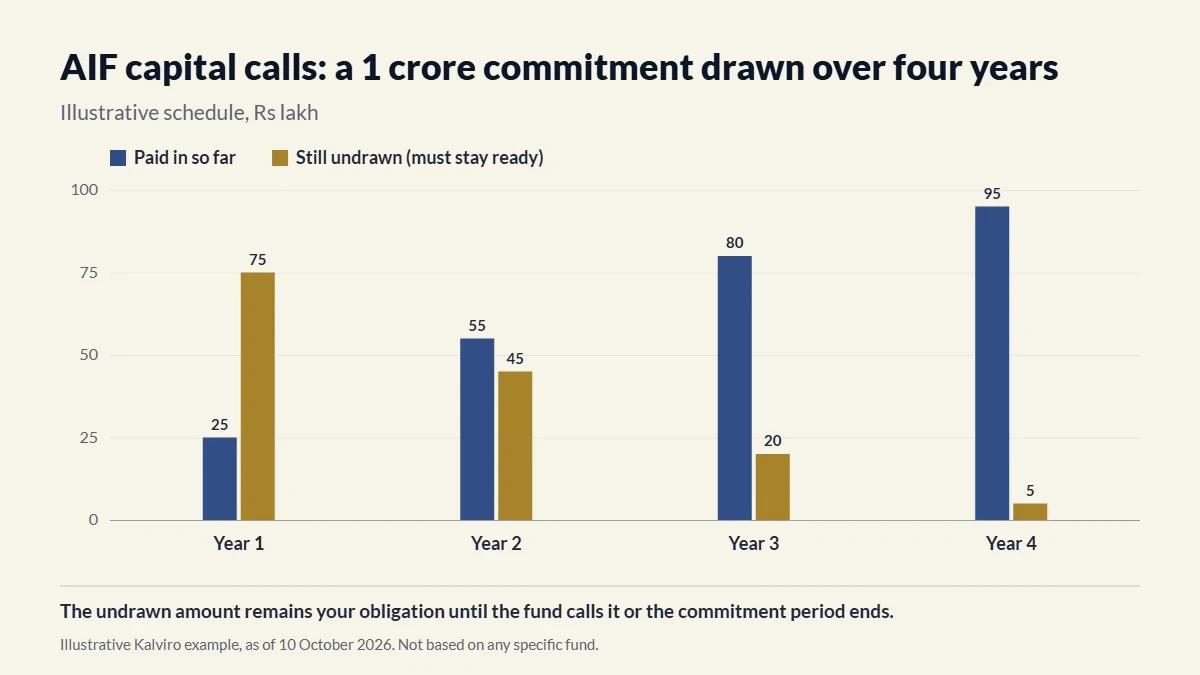
The undrawn ₹75 lakh in year 1 is still your obligation. It has to stay liquid enough to meet the next call, so it cannot go into anything with a lock-in of its own.
Fees on the commitment and fees on drawn money
Many funds charge the management fee on the full commitment during the investment period. At 2% a year on ₹1 crore, that is ₹2 lakh a year even when only ₹25 lakh is invested. In year 1 of the example, the fee equals 8% of the money actually at work. Bharat Tech Fund, for example, plans to call about 25% of commitments a year.
Other funds charge on drawn capital, or switch from commitment to invested capital after the investment period. The fee base matters as much as the fee rate, so check which one the PPM uses. Kalviro’s note on private equity through Category II AIFs covers carry and hurdles.
What happens if you miss an AIF capital call
A missed call is a breach of the contribution agreement. The remedies in that agreement can include interest on the late amount, suspension of your rights in the fund, and a forced sale or forfeiture of part of your interest.
SEBI’s rules add a further cost. Under its circular of 13 December 2024, an investor who defaults on a call loses the pro-rata share in that investment. If that deal later does well, the defaulting investor does not share in it.
The J-curve in Indian AIF data
Benchmark data from NSE Indices, one of the agencies appointed to benchmark Indian AIFs, shows how slowly cash comes back. DPI is cash returned divided by paid-in capital; TVPI adds the value still held.
| Vintage (Category II, INR) | Schemes | DPI | RVPI | TVPI | Pooled XIRR |
|---|---|---|---|---|---|
| FY 2016 | 16 | 1.24 | 0.58 | 1.82 | 12.52% |
| FY 2018 | 41 | 1.02 | 0.84 | 1.87 | 16.46% |
| FY 2020 | 53 | 0.63 | 0.66 | 1.29 | 12.16% |
| FY 2022 | 86 | 0.38 | 0.90 | 1.29 | 11.48% |
| FY 2024 | 95 | 0.23 | 0.93 | 1.16 | 18.36% |
| FY 2025 | 47 | 0.05 | 1.07 | 1.13 | 21.47% |
Information as of 30 September 2025, the latest edition published. Post-expenses, pre-carry and pre-tax, so an investor’s own figure will be lower. Source: NSE Indices AIF Benchmark Report Highlights.
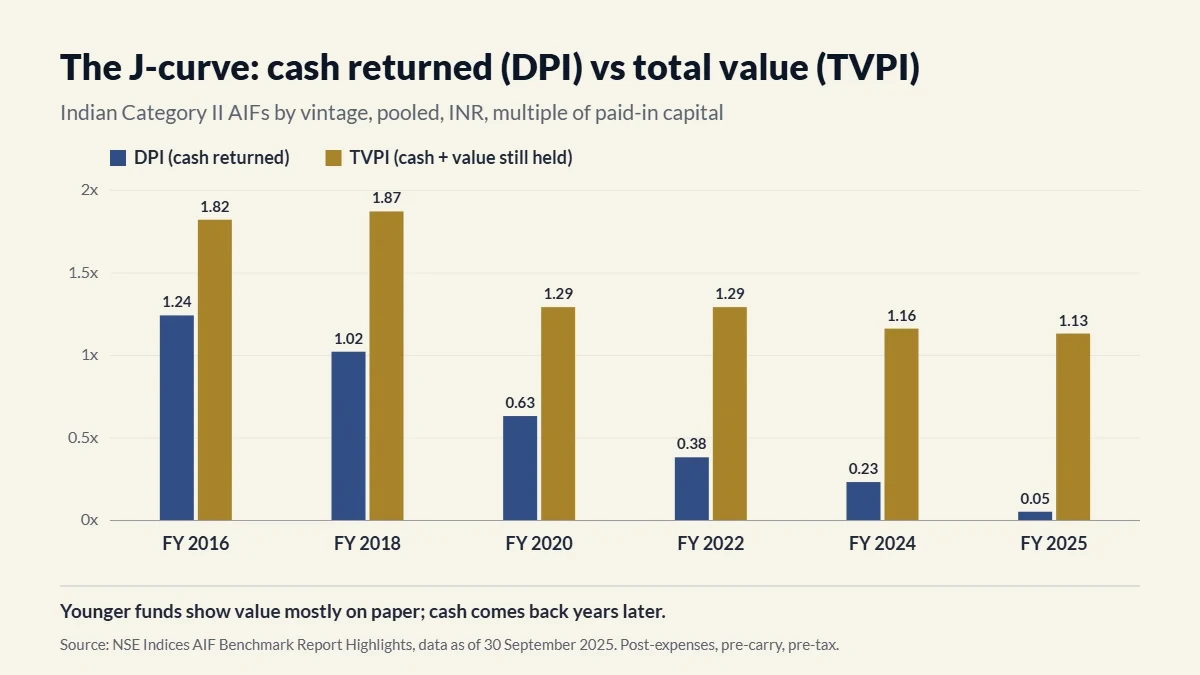
Funds started in FY 2025 had returned 5% of paid-in capital in cash. Funds from FY 2018 had returned all of it, seven years on. The high XIRR of the youngest funds rests almost entirely on valuations, which Kalviro’s guide to DPI, TVPI and IRR explains.
Planning cash for AIF capital calls
Keep the undrawn commitment in instruments you can sell within the notice period, such as liquid or arbitrage funds. Treat it as spoken for, even though it still sits in your name.
Calls rarely arrive evenly. A fund can call heavily in a year when it finds several deals, and that can coincide with a weak market for your other assets. If you hold several AIFs, add up the undrawn amounts across all of them.
Accredited investors can commit below ₹1 crore in some funds, which Kalviro’s guide to accredited investors covers. The cash planning is the same at any size.
Funding drawdowns as an NRI
NRIs can invest in Indian AIFs on a repatriable basis from NRE or FCNR money, or on a non-repatriable basis from NRO money. The account you fund from decides how freely distributions can go back abroad, so it is worth settling before the first call. SEBI data shows NRIs had put ₹11,451 crore into Category II AIFs by 30 June 2026.
Currency also matters. A call in rupees can cost more or less in your home currency depending on the exchange rate on the day you pay.
Questions investors ask about AIF capital calls
How much notice does an AIF give before a capital call? The contribution agreement sets the notice period. Read it before you commit, and keep the undrawn amount where you can reach it within that time.
Can I pay the whole commitment upfront? Most Category I and II funds call money only as they need it. Some accept an advance or a larger first call; the PPM says whether yours does.
Does every AIF use capital calls? No. Category III funds, which invest mainly in listed markets, usually take most of the money at the start.
How is tax handled when the fund returns money? Category I and II AIFs pass most income through to investors, as Kalviro’s note on Category II AIF tax explains.
Can this guide tell me whether I can afford a commitment? No. It explains the mechanics. Your other assets, cash needs and tax position decide that, so map them against the fund’s likely call pattern before you sign.
An AIF commitment buys access to private companies and private credit, and in return asks you to keep money ready for years and wait longer still for cash to come back. Kalviro’s AIFs in India page lists the funds on offer and their minimums.
