

Bharat Tech Fund by Piper Serica: a Category II AIF explained
Bharat Tech Fund is an ₹800 crore SEBI Category II Alternative Investment Fund (AIF) from Piper Serica: a ₹600 crore base plus a ₹200 crore green-shoe. It backs unlisted Indian companies building their own technology in semiconductors, AI, space, defence, biosciences and fintech infrastructure. The minimum commitment is ₹1 crore.
It is Piper Serica’s second venture fund. The first, launched in 2022, reports an IRR of about 44% across 35 companies, with no write-offs so far. Over 60% of the new fund’s first close came from those same investors. Bharat Tech Fund now writes larger cheques, from Series A onwards, and targets a 30% gross IRR.
Fund figures come from Piper Serica’s fund presentation and SEBI’s register of AIFs, as of October 2026; sector figures come from the government sources named below.
Bharat Tech Fund at a glance
| Particular | Detail |
|---|---|
| Fund | Bharat Tech Fund (Fund II of Piper Serica’s venture strategy) |
| Category / structure | SEBI Category II AIF, closed-ended trust (Bharat Tech Fund Trust) |
| SEBI registration | IN/AIF2/26-27/2182, from 19 May 2026 |
| Manager | Piper Serica Advisors; founder and fund manager Abhay Agarwal |
| What it buys | Stakes in unlisted, IP-led technology companies from Series A onwards |
| Sectors | Semiconductors and advanced electronics, AI, spacetech, defencetech, biosciences, fintech infrastructure |
| Fund size | ₹600 crore, plus ₹200 crore green-shoe (₹800 crore in total) |
| First close | ₹400 crore, over 60% from Fund I investors |
| Minimum commitment | ₹1 crore |
| Cheque per company | ₹20 crore to ₹50 crore |
| Drawdowns | About 25% of commitment a year (indicative) |
| Commitment period / term | 5 years / 10 years, extendable by 2 years |
| Fees | 2% a year management fee (by investor class); 12.5% hurdle; 20% additional return; up to 0.4% operating expenses |
| Target return | 30% gross IRR over a 6-year average holding period |
| Benchmark | Not disclosed for Fund II; the manager compares Fund I with CRISIL’s Category I AIF benchmark |
Information as of October 2026, as disclosed in Piper Serica’s fund presentation and on SEBI’s register of AIFs. The PPM and contribution agreement govern all terms.
In plain terms, you commit ₹1 crore and the fund draws about a quarter of it each year. It uses the money to buy stakes in young Indian tech companies. Your money grows or shrinks with those companies and comes back as the fund sells its stakes, within ten to twelve years. Until then the values are estimates, and you cannot withdraw early.
What Bharat Tech Fund invests in
The fund buys minority stakes of ₹20 crore to ₹50 crore in companies with a product and paying customers, usually from Series A. On ₹600 crore that means roughly 15 to 30 companies, by our estimate. Each one will matter to the result, and the team will often take a board seat.
Fund I shows the kind of company to expect. Pantherun builds data encryption and Sensesemi designs edge AI chips. Astrogate Labs makes laser communication links for small satellites, and Six Sense makes vehicle control electronics for OEMs such as Eicher and Sonalika.
Part of the portfolio is already visible. Piper Serica names 18 Fund I companies as “pre-vetted” opportunities, with about ₹500 crore of potential investment between them. The team sits on several of their boards and has tracked them for years, a head start on diligence. The PPM sets the rules for pricing and approving investments in Fund I companies, and we can take you through them.
The opportunity in Indian deeptech
Government policy is creating demand in exactly these sectors. The Union Cabinet approved ₹76,000 crore in December 2021 to build semiconductor and display manufacturing under the Semicon India programme. IN-SPACe, the space regulator, aims to grow India’s space economy to USD 44 billion by 2033, about five times its 2023 size. Defence production reached a record ₹1.78 lakh crore in FY 2025-26, according to the Ministry of Defence.
Spending at this scale needs Indian suppliers for chips, satellites, encrypted communications and defence electronics. Piper Serica’s thesis is that the companies winning those contracts will grow fast and attract larger investors and buyers. Bharat Tech Fund aims to own them at the stage where that growth begins.
Why investors are backing Piper Serica’s venture fund again
Over 60% of the ₹400 crore first close came from Fund I investors. Investors who have seen a manager’s first fund from the inside know it best. A high repeat share is one of the more telling signals in a venture raise.
| Fund I (Piper Serica Angel Fund, Category I AIF) | As disclosed by the manager |
|---|---|
| Vintage / commitment | 2022 / ₹273 crore |
| Investments | 35 |
| MOIC | >2.0x |
| IRR | ~44% (average holding period 19 months) |
| DPI | 0.1 |
| Write-offs | 0 |
| Companies that raised a next round | 14 |
| Exits / follow-on rounds | 2 / 8 |
Past performance as disclosed by the manager in its fund presentation (October 2026); it does not indicate future returns. The manager has not said whether these figures are gross or net of fees. It compares Fund I with CRISIL‘s Category I AIF benchmark but does not disclose the benchmark figure.
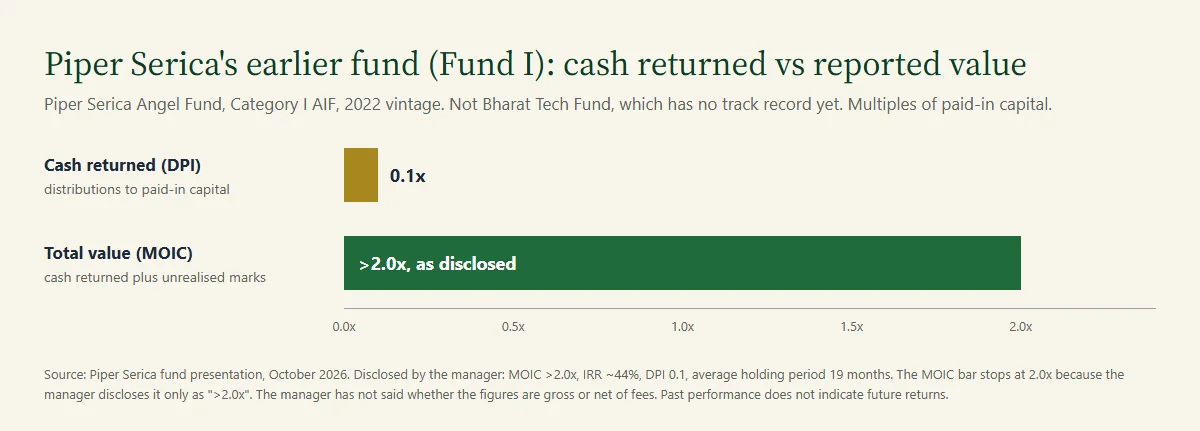
MOIC is the total value of the fund divided by the money put in, so above 2.0x means each ₹1 invested is now valued at over ₹2. DPI counts only cash paid back, about ₹10 for every ₹100 so far. A four-year-old venture fund usually returns most of its cash in the second half of its life. Most of Fund I’s gain still sits in valuations that later investors have put on its companies. DPI vs TVPI vs IRR explains the three measures.
What the Bharat Tech Fund target could mean for ₹1 crore
If the fund meets its target, ₹1 crore invested for six years would grow to about ₹4.8 crore before the manager’s share, fees and expenses. The target is a 30% gross IRR over a six-year average holding period, which compounds to about 4.8 times the money invested; it is the manager’s aim, not a promise. The table shows what three outcomes mean each year, set against the 12.5% hurdle.
| If the fund’s investments return (gross, over 6 years) | Gross return a year | Value of ₹1 crore before the manager’s share, fees and expenses |
|---|---|---|
| 2.0x | About 12.2% (just under the 12.5% hurdle) | ₹2.0 crore |
| 3.0x | About 20.1% | ₹3.0 crore |
| About 4.8x (the 30% target) | 30% | ₹4.8 crore |
Our illustration, not the manager’s. It assumes the full ₹1 crore stays invested for six years. You would receive less: the manager takes 20% of profit above the 12.5% hurdle, and management fee and expenses come on top. The presentation does not say exactly how that share is worked out (for example any catch-up, or whether across the whole fund or deal by deal), so we do not estimate your net amount; the PPM sets this. A target is not a promise, and venture funds can also return less than the money invested.
How the drawdown works on ₹1 crore
Your ₹1 crore goes in over about four years, as the manager calls roughly 25% of the commitment a year. AIF capital calls and the J-curve explains why early statements often show a small loss.
| Period | You pay in | Total paid in | What usually happens |
|---|---|---|---|
| Year 1 | About ₹25 lakh | ₹25 lakh | Fund starts investing; fees begin |
| Year 2 | About ₹25 lakh | ₹50 lakh | More companies added |
| Year 3 | About ₹25 lakh | ₹75 lakh | Follow-on rounds in early holdings |
| Year 4 | About ₹25 lakh | ₹1 crore | Portfolio largely built |
| Years 5 to 10 | Nil | ₹1 crore | Exits begin; money returns as stakes sell or companies list |
| Years 11 to 12 | Nil | ₹1 crore | Possible 2-year extension to finish exits |
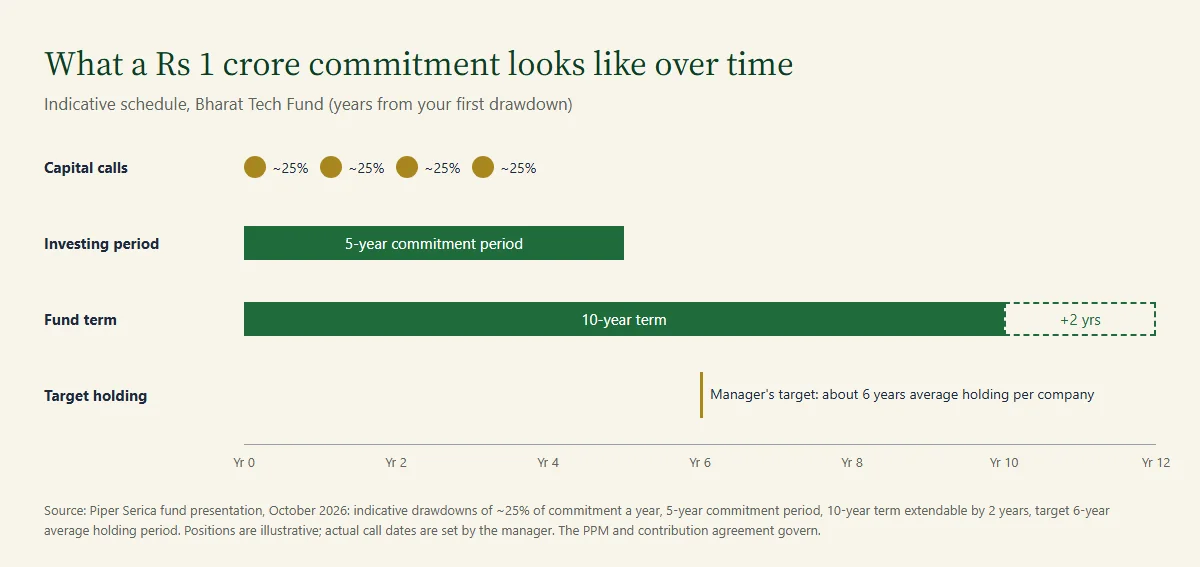
Illustrative, based on the indicative 25% a year in the fund presentation; the manager sets actual call dates.
Keep cash ready for each call. The PPM in AIF Category 2 sets out what happens if you miss one.
Bharat Tech Fund fees in rupees
On ₹1 crore, yearly costs are up to about ₹2 lakh in management fee plus up to ₹40,000 in expenses, and the manager shares in profits only above a 12.5% annual return.
| Fee | As disclosed | On ₹1 crore |
|---|---|---|
| Management fee | 2% a year, “subject to investment class” | ₹2 lakh a year if charged on commitment; ₹50,000 in year one if charged on the ₹25 lakh drawn |
| Operating expenses | Up to 0.4% a year, on actuals | Up to ₹40,000 a year |
| Hurdle | 12.5% | You receive this return before the manager shares in profit |
| Additional return | 20% | The manager’s share of profit above the hurdle |
The 12.5% hurdle protects investors. The manager earns its 20% share only after your money has compounded at 12.5% a year. The PPM confirms whether the 2% applies to commitment or to money drawn, and the fee by investor class.
The team and how it picks companies
A team that invests in both listed and unlisted companies runs the fund, led by founder and fund manager Abhay Agarwal. He has over 30 years in investing, including leadership roles at JP Morgan Private Equity and Citibank India. He also runs Piper Serica’s SEBI-registered PMS. Rajni Agarwal, Director and Head of Research, previously managed funds at SBI Mutual Fund. Ajay Modi, Director (Investments), led the Fund I raise.
Piper Serica’s listed-market roots shape its venture process. The manager says it tracks more than 1,000 listed companies to check that a start-up has real corporate buyers. Its Yoda.ai model scores start-ups on 17 parameters, and only those scoring 70% or more go to full due diligence. Advisers include Dr S Christopher, former chairman of DRDO, and four founders of Fund I companies.
Risks to keep in mind with the Bharat Tech Fund
Unlisted values are estimates until a company sells, and a weak market can lower them and delay exits. Deeptech companies need long build cycles and often depend on government or OEM orders, which can slip. With ₹20 crore to ₹50 crore per company, one failure can cost several percent of the fund. Money stays locked in for up to 12 years, and results depend on a small senior team.
Bharat Tech Fund questions investors ask
The fund and its manager
How much has Bharat Tech Fund raised?
Piper Serica’s fund presentation discloses a first close of ₹400 crore, with over 60% from Fund I investors. The target is ₹600 crore, with a ₹200 crore green-shoe. The fund presentation does not give a final close date.
What other AIFs does Piper Serica run?
Piper Serica Angel Fund, a Category I AIF launched in 2022 (SEBI registration IN/AIF1/21-22/1028), is its first venture fund, and Bharat Tech Fund is the second. Piper Serica also runs a SEBI-registered PMS in listed Indian equities.
Investing, minimum and NRIs
How do I invest in Bharat Tech Fund?
You complete KYC, sign the fund’s contribution agreement for your commitment and pay each drawdown when the manager sends a notice. After that you receive periodic statements, and money comes back as the fund exits its holdings. We can take you through the documents.
What is the minimum investment?
₹1 crore, the SEBI minimum for most AIF investors. Resident Indians invest directly; accredited investors can invest lower amounts; ask us.
Can NRIs invest in Bharat Tech Fund?
The fund presentation does not cover NRIs. Indian rules generally allow NRIs to invest in Category II AIFs, subject to the fund’s PPM and KYC. If you live abroad, ask a tax professional how your country treats fund units.
Tax, exit and the 30% target
How is a Category II AIF taxed?
For FY 2026-27, a Category II AIF passes most income through to investors. You pay tax on gains as if you held the shares yourself. Category II AIF tax covers the detail; confirm your position with a tax professional.
Can I exit early?
Generally, no. Money comes back as the fund sells its holdings, over a term of up to 12 years. The fund is on SEBI‘s register as Bharat Tech Fund Trust, a Category II AIF, and Category II AIFs run for a fixed term.
Is the 30% IRR assured?
No. It is the manager’s gross target over a 6-year average holding period, before fees, expenses, the manager’s share and tax.
Bharat Tech Fund gives ₹1 crore of exposure to Indian companies building chips, satellites, defence electronics and AI. It invests at the stage where government demand starts turning into revenue. It comes from a manager whose first fund has doubled its value on paper and whose investors have come back for the second. The trade-off is time: money goes in over about four years and comes back over the following six to eight. Kalviro’s AIF investments page lists the other AIFs we cover.
