

Long-Only vs Long-Short Fund vs Category III AIF: How They Differ
A long-short fund buys shares it expects to do well and bets against shares it expects to lag. It can make money on both sides. A long-only fund only buys. Category III AIF names neither strategy: it is the SEBI category that holds many Indian long-short funds, and many long-only ones too.
The three terms often come up together as if they were three choices. They answer different questions. Long-only and long-short describe what the manager does with your money. Category III describes the legal structure the fund sits in, which sets the minimum, the limits on borrowing and shorting, and who pays the tax.
Long-short strategies also come in more structures than before. A Specialized Investment Fund (SIF) offers one from ₹10 lakh, and SEBI has approved rules that will let a PMS use derivatives beyond hedging. The rules described here are as of October 2026.
| Long-only | Long-short | Category III AIF | |
|---|---|---|---|
| What the term describes | A strategy | A strategy | A SEBI fund category (the legal structure) |
| How it makes money | Holdings rise in price | Longs rise, shorts fall, or longs beat shorts | Depends on the strategy in its PPM |
| Short positions | None | Central to the strategy | Allowed if the PPM permits |
| Market exposure | Close to fully invested | Set by the manager, often well below 100% net | Depends on the strategy |
| Leverage | Usually none | Common, through futures | Up to 2 times NAV |
| Minimum in India | From ₹500 (mutual fund) | ₹10 lakh (SIF), ₹1 crore (AIF) | ₹1 crore |
| Main risk | Falls with the market | Picks fail on both sides; short squeezes; leverage | Strategy risk, plus tax inside the fund |
Information as of October 2026. Sources: SEBI AIF master circular (3 June 2026); SEBI SIF framework.
A long-only fund makes money when its stocks go up. A long-short fund depends more on its manager picking both the winners and the laggards. That can soften a market fall, but it adds a second way to lose. A Category III AIF needs ₹1 crore, pools your money in a trust and pays tax before you see the NAV.
Long-only: one bet on prices rising
A long-only manager buys shares it expects to rise and holds them. Most mutual funds and PMS strategies work this way, as do many Category III AIFs. The result follows the market’s direction and the manager’s stock picks. A ₹100 crore portfolio that rises 15% is worth ₹115 crore before costs. If it falls 15%, it is worth ₹85 crore.
The appeal is simplicity: you judge the fund on what it owns and its record against its benchmark. The weakness is that nothing offsets a broad market fall.
How a long-short fund makes and loses money
A long-short fund makes money when its long book rises or its short book falls, and loses when either side moves the wrong way. The long book holds companies the manager expects to do well; the short book bets on companies it expects to fall or trail. Indian funds build most shorts through stock and index futures, and SIFs may short only through derivatives.
Take a fund with ₹100 crore of investors’ money, its NAV. It holds ₹100 crore of shares and sells ₹40 crore of futures on companies it dislikes. Gross exposure, both books added together, is ₹140 crore or 140% of NAV. Net exposure, longs minus shorts, is ₹60 crore or 60%.
The same ₹100 crore long book in three markets
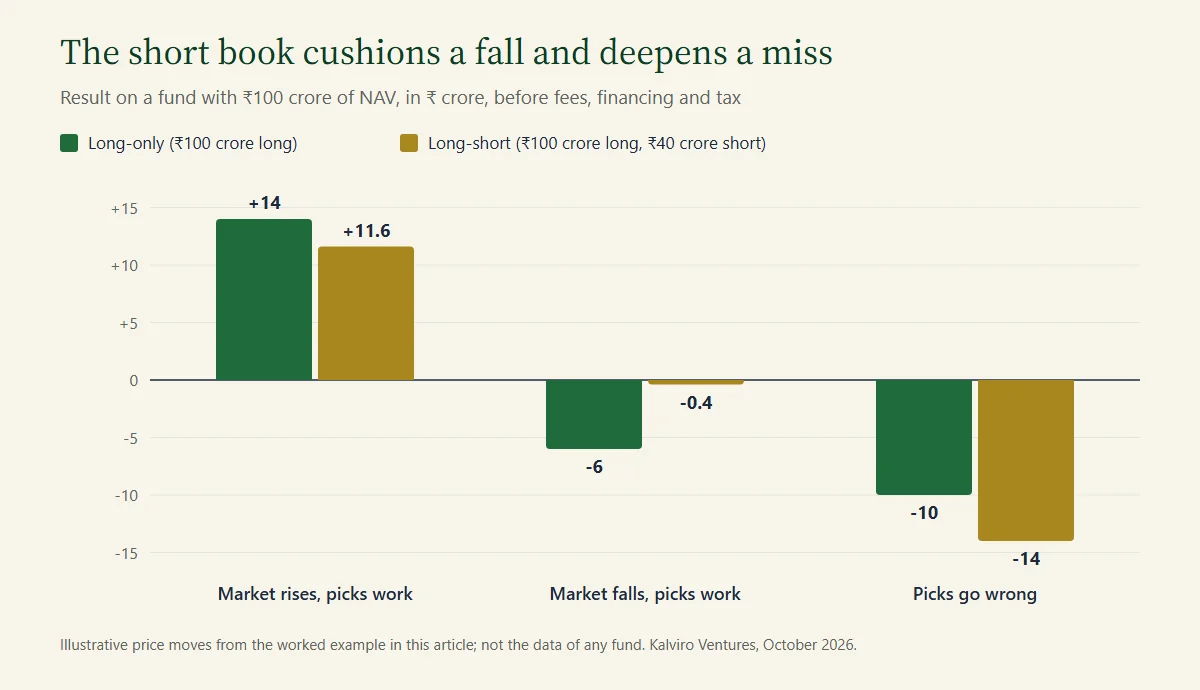
The table compares this fund with a long-only fund holding the same ₹100 crore long book. The price moves are illustrative. Results are before fees, financing costs and tax.
| Scenario | Long book | Short book | Long-only result | Long-short result |
|---|---|---|---|---|
| Market rises, picks work | +14% | +6% | +₹14 crore | +₹11.6 crore |
| Market falls, picks work | -6% | -14% | -₹6 crore | -₹0.4 crore |
| Picks go wrong | -10% | +10% | -₹10 crore | -₹14 crore |
In the rising market the short book costs ₹2.4 crore of gains. In the falling market it absorbs almost the whole loss. When the manager reads the companies wrongly, it makes the loss bigger. The long-short fund trades some upside for a cushion, and takes on a risk the long-only fund doesn’t have.
A short position has no ceiling on its loss, because a share price has no upper limit, so managers cap each short and watch for short squeezes.
Gross and net exposure in a long-short fund
Net exposure shows how much of the fund rides on the market’s direction; gross exposure shows how much the manager has at work in total. Gross exposure drives stock-picking risk, margin needs and financing costs, so read both numbers and how they have moved over time.
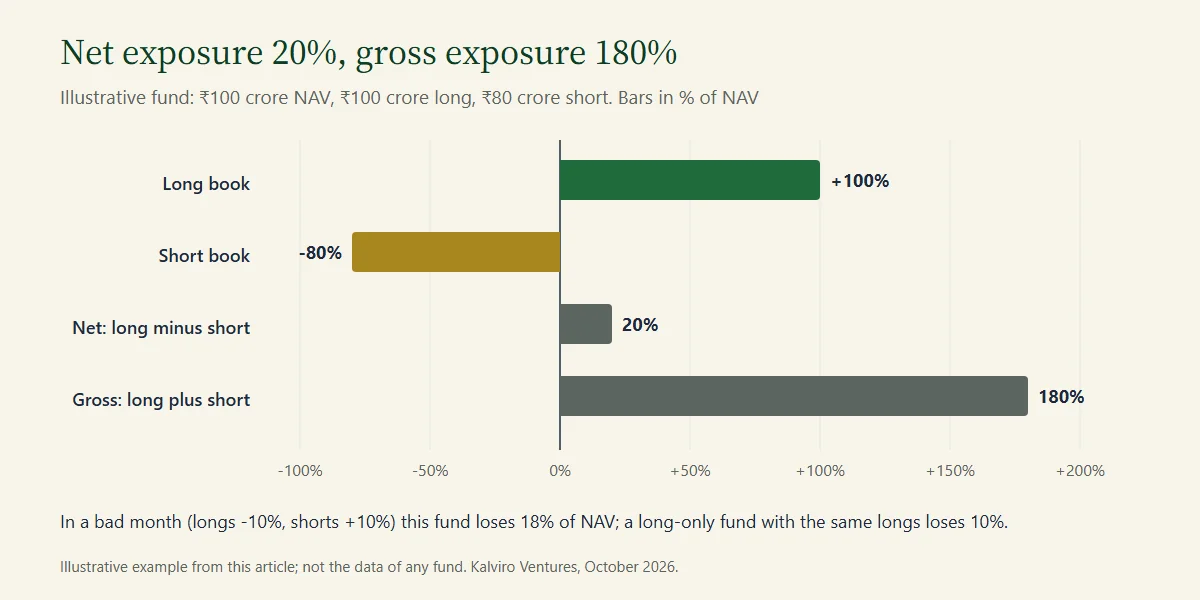
Take a fund with ₹100 crore long and ₹80 crore short against ₹100 crore of NAV. Net exposure is 20%, which sounds cautious. Gross exposure is 180%. Suppose the long book falls 10% and the short book rises 10% in a bad month. The fund loses ₹18 crore, or 18% of NAV. Net exposure describes direction; it puts no cap on the loss.
The range matters as much as today’s figure. One fund may run 80% net in a rally and 10% in a correction. Another may sit near 50% throughout. They took very different risks, even if both report the same three-year return.
A market-neutral fund aims for net exposure near zero, so its return comes only from the gap between its longs and shorts.
Category III AIF: the legal structure behind the fund
Category III is the SEBI category for funds that trade listed shares and derivatives and may borrow to do so, so it holds long-only, long-short and arbitrage funds alike. The label does not tell you the strategy. NISM researchers wrote in Mint (August 2025, updated March 2026, views their own) that very few Category III funds have meaningfully pursued shorting, and most are long-biased. The fund’s private placement memorandum (PPM) tells you which one you are buying. Our checklist for reading an AIF PPM covers what to look for.
SEBI limits a Category III fund’s leverage to 2 times its NAV. Under SEBI’s master circular for AIFs (3 June 2026), the fund adds its long and short positions after permitted hedge offsets. That total cannot exceed twice the NAV. A ₹100 crore fund can run up to about ₹200 crore of exposure.
The minimum is ₹1 crore. Accredited investors in India can invest lower amounts; ask us. You own units of a pooled trust, not the shares themselves. Open-ended Category III funds typically allow monthly or quarterly redemption. Close-ended funds return money at the end of their term. For non-residents, our note on Category III AIFs for NRIs covers the fit.
Three ways to own a long-short fund in India
A resident investor can reach a long-short strategy through three structures. Each limits shorting in a different way.
| Category III AIF | SIF (equity long-short) | PMS | |
|---|---|---|---|
| Minimum | ₹1 crore | ₹10 lakh across one fund house’s SIF strategies | ₹50 lakh |
| What you own | Units in a pooled trust | Units in a pooled fund | Shares in your own demat account |
| How far it can go short | Total exposure up to 2 times NAV | At least 80% in equity; unhedged shorts up to 25% of net assets | Now: derivatives only to hedge or rebalance. From 1 April 2027: derivatives up to 1.25 times your assets |
| Liquidity | Set by the PPM | Redemption as often as daily, as the fund house decides | Withdrawal on request, subject to exit load |
| Tax | Paid by the fund before NAV | In your hands, like mutual fund units | In your hands, trade by trade |
Information as of October 2026. Sources: SEBI AIF master circular (3 June 2026); SEBI SIF framework; SEBI board meeting, 24 September 2026.
The SIF route opened in 2025. An equity long-short SIF must keep at least 80% in equity and can short no more than 25%. So it stays at least 55% net long: a mostly long fund with a hedge. A Category III fund can run far closer to neutral. Our SIF explainer covers the other SIF rules.
PMS is the route that is changing. SEBI’s board approved new Portfolio Managers Regulations on 24 September 2026, per PR No. 59/2026, and they take effect on 1 April 2027. They allow exchange-traded derivatives up to 1.25 times a client’s assets. SEBI’s consultation paper tied this to each client’s explicit consent. Until then a PMS can use derivatives only to hedge or rebalance. For the wider trade-offs, see SIF vs PMS vs AIF.
What fees and tax take from a long-short fund
Fees take a bigger share of a long-short fund’s return than of a long-only fund’s, and in a Category III AIF tax comes out before you see the NAV. Category III funds usually charge a yearly management fee plus a share of returns above a hurdle. Take illustrative terms on ₹1 crore: 2% a year, plus 20% of returns above a 10% hurdle, measured after the management fee, with no catch-up.
| Portfolio return before fees | Management fee | Performance fee | You keep |
|---|---|---|---|
| 14% (₹14 lakh) | ₹2 lakh | ₹40,000 | ₹11.6 lakh |
| 9% (₹9 lakh) | ₹2 lakh | Nil | ₹7 lakh |
A long-short fund built to give up some upside earns less in good years by design. A fixed fee then takes a larger share of what it makes: at 9%, the ₹2 lakh fee takes over a fifth of the gain. Compare funds on returns after all fees. Check for a high-water mark too, which stops a manager charging twice on the same gains. The same logic applies to PMS fees with a hurdle.
Tax adds a second layer. A Category III AIF pays tax inside the fund, and the NAV you see comes after that tax. For FY 2026-27, gains from futures usually count as business income and attract the highest rate. Futures drive most short books, so ask a tax professional how this compares with an SIF or PMS taxed in your hands.
What to check in a long-short fund’s documents
Five numbers and terms separate one long-short fund from another, and the PPM and the manager’s reports should show each of them.
| Check | Why it matters |
|---|---|
| Gross and net exposure, month by month for three years, and the internal limits | How much rides on the market, and how the risk has moved |
| How the fund shorts: index futures, single-stock futures or borrowed shares | Index shorts hedge the market; stock shorts are a stock-picking bet |
| Worst month, deepest fall from a peak and time to recover | How the strategy behaved under stress |
| How leverage is measured against SEBI’s 2 times limit, and the cash kept for margin calls | Whether a sharp move could force selling |
| Redemption frequency, notice period and gating terms | When you can get your money out |
We can take you through these documents for any fund you are considering.
Long-short funds: what investors ask
Does a long-short fund lose less in a falling market?
It can, if its shorts fall more than its longs. If the picks go wrong, it can lose more than a long-only fund, as the scenario table shows.
Can a Category III AIF be long-only?
Yes, and many are. The category allows shorts and leverage; each fund’s PPM decides whether it uses them.
What is the minimum for a long-short fund in India?
₹1 crore in a Category III AIF. ₹10 lakh in an SIF, counted across one fund house’s SIF strategies. Accredited investors can invest less in both.
How do I invest in a long-short fund?
In an SIF, you apply to the fund house after KYC, from ₹10 lakh. In a Category III AIF, you complete KYC, sign the contribution agreement and invest at least ₹1 crore. We can take you through the documents.
Who can invest in a long-short fund?
Resident Indians can use all three structures. NRIs face extra limits, mainly in Category III AIFs; ask us before you commit.
For any of the three, ask what has to happen for the fund to make money, and what happens when it doesn’t. A long-only fund needs its stocks to rise. A long-short fund needs its manager to pick both winners and laggards, and Category III adds a ₹1 crore minimum and tax inside the fund. Kalviro’s alternative investment funds in India page is the place to start for Category III funds.
