

ICICI Prudential PIPE Fund: Cat III Terms, Fees & PMS Record
ICICI Prudential PIPE Fund is a new Category III Alternative Investment Fund from ICICI Prudential Asset Management Company. It buys mainly small-cap Indian stocks and runs for a fixed term. The fund sits under ICICI Prudential Strategic Alpha Fund and targets ₹750 crore, with a green-shoe of another ₹750 crore.
The approach has a record. ICICI Prudential has run the PIPE Strategy as a portfolio management service (PMS) since September 2019, and an earlier version ran from November 2013 to January 2018. The new fund puts the same stock-picking process inside a pooled AIF with staged capital calls and exit charges.
So the question for an investor is practical. What changes when a strategy you could hold in your own PMS account arrives as a seven-to-nine-year pooled fund? This review covers the process, team, portfolio and returns, then works through the fee in rupees, the drawdowns, tax and the risks to check.
Figures come from ICICI Prudential’s fund presentation dated September 2026. Market data runs to 30 September 2026 and strategy data to 31 August 2026. Points from the manager’s October 2026 call with distribution partners appear where the audio was clear.
ICICI Prudential PIPE Fund at a glance
| Particular | Detail |
|---|---|
| Fund | ICICI Prudential PIPE Fund, a scheme of ICICI Prudential Strategic Alpha Fund |
| Category / structure | SEBI Category III AIF, closed-ended |
| SEBI registration (AIF) | IN/AIF3/16-17/0310 |
| Investment manager | ICICI Prudential Asset Management Company Limited (SEBI-registered portfolio manager, INP000000373) |
| Key investment team | Anand Shah, Chockalingam Narayanan, Sandip Santdasani, Prem Khurana |
| Strategy | Mainly small-cap listed equity; up to 10% of total assets in unlisted equity |
| Target fund size | ₹750 crore, plus green-shoe of ₹750 crore |
| Minimum commitment | ₹1 crore (Class B1); ₹5 crore (Class B2) |
| Management fee | 2.25% a year (B1); 2.00% a year (B2) |
| Performance fee / hurdle | Not disclosed in the presentation; set out in the PPM |
| Drawdown | Five drawdowns of 20% each |
| Term | 7 years from first close, extendable by two periods of 1 year each with two-thirds investor consent |
| Exit charge | 3% / 2% / 1% of exit proceeds in years 1 / 2 / 3 after final closing; nil after 36 months |
| Benchmark | Not stated for the AIF; the parent PMS strategy reports against BSE 500 TRI |
| Track record | None for the AIF; parent PMS PIPE Strategy since 5 September 2019 |
Information as of September 2026, per ICICI Prudential’s fund presentation. The Private Placement Memorandum (PPM) and contribution agreement govern these terms.
Put simply, the fund pools money from many investors and buys shares of smaller listed Indian companies. A small slice can go into unlisted ones. You commit at least ₹1 crore, pay it in five instalments and should expect it to stay invested for seven years or more. The main risk: small-cap stocks can fall sharply and stay down for years, and this fund offers few ways out when they do.
What an allocator notices first about the ICICI Prudential PIPE Fund
The record belongs to the PMS. Every return, holding and case study in the presentation comes from the ICICI Prudential PMS PIPE Strategy. The AIF has no NAV history yet. The PMS numbers show how the team picks stocks, but they cannot show what this pooled vehicle will earn after its own fees, tax and cash drag.
Five 20% drawdowns change the entry path. A PMS client invests the full amount on day one. Here the first 20% goes in when you sign, and the other 80% arrives in four further calls. If small caps rise before the later calls, part of your money buys in higher; if they fall, it buys in lower. ICICI Prudential can also change the number and size of drawdowns.
Tax moves to the fund. A Category III AIF has no pass-through status, so the fund pays tax on its gains before it distributes anything. In a PMS, each investor pays capital gains tax individually. The section on tax below sets out what that means for FY 2026-27. Our long-short fund comparison sets out how Category III tax differs from the SIF and PMS routes.
Exits carry a price for three years. An exit costs 3% of proceeds in the first year after final closing, dropping to 2% in year two and 1% in year three. The fund allows no exit before final closing, or until you have paid your full commitment.
The fee schedule stops at management fee. The presentation shows 2.25% and 2.00% by class. It leaves the performance fee, hurdle and distribution waterfall to the PPM. Those terms decide most of the cost in a good year, so read them closely.
A seven-year PMS strategy moves into a closed-ended AIF
ICICI Prudential’s fund presentation credits the PIPE approach with “over a decade of existence”. PIPE 1 ran for about four years, from November 2013 to January 2018, and the current PIPE Strategy has run for about seven years since September 2019. On the October 2026 call, the presenter said PIPE had built its record as a PMS. The ICICI Prudential PIPE Fund now brings the same philosophy to an AIF.
The scheme objective sets the boundaries. The fund seeks long-term capital growth by investing “predominantly” in small-cap equity. Stock choices rest on economic moat, special situations and companies turning with the business cycle. It may hold large and mid caps for defence, liquidity or diversification, and may also use REITs, InvITs, debt and derivatives within SEBI’s AIF rules.
ICICI Prudential manages more than ₹10,000 crore across its small and mid cap (SMID) PMS and AIF strategies. That is about 25% of its Alternates equity AUM (data as of 31 August 2026). Kalviro has also covered the ICICI Prudential Special Opportunities Fund and the ICICI Real Estate Development Fund. Both invest in different assets on different terms.
How the ICICI Prudential PIPE Fund picks stocks
Business, management, valuation
The manager runs every idea through its BMV framework: business, management, valuation. It wants a strong business with competent management at a reasonable price. The presentation names three sources of return. Earnings growth comes from businesses whose growth looks sustainable. A higher P/E can follow rising demand and wider margins. Margin of safety comes from buying in special situations or at a weak point in the cycle, a growth-at-reasonable-price (GARP) style.
The special-situations leg is the distinctive part. The PMS strategy’s risk note says it buys companies “undergoing special situations or are in midst of an unfavourable business cycle”. It adds that such bets “may take longer than anticipated to play out”. On the call, the team said these situations can offer a lopsided risk-reward over the long run. Some of these companies are going through a very tough period and may even be making losses. For such turnaround cases, the team said it values the business on its assets, looking for a margin of safety there. These bets also tie up capital for longer, and a seven-year fixed term gives the manager that time.
From about 2,500 companies to 35–40
The selection process runs in five stages, per the September 2026 presentation.
| Stage | Number of companies |
|---|---|
| Initial in-house screening | 2,500 |
| Active research coverage | 680 |
| After the BMV filter | 170–190 |
| After the strategy-level filter | 60–65 |
| Final portfolio | 35–40 |
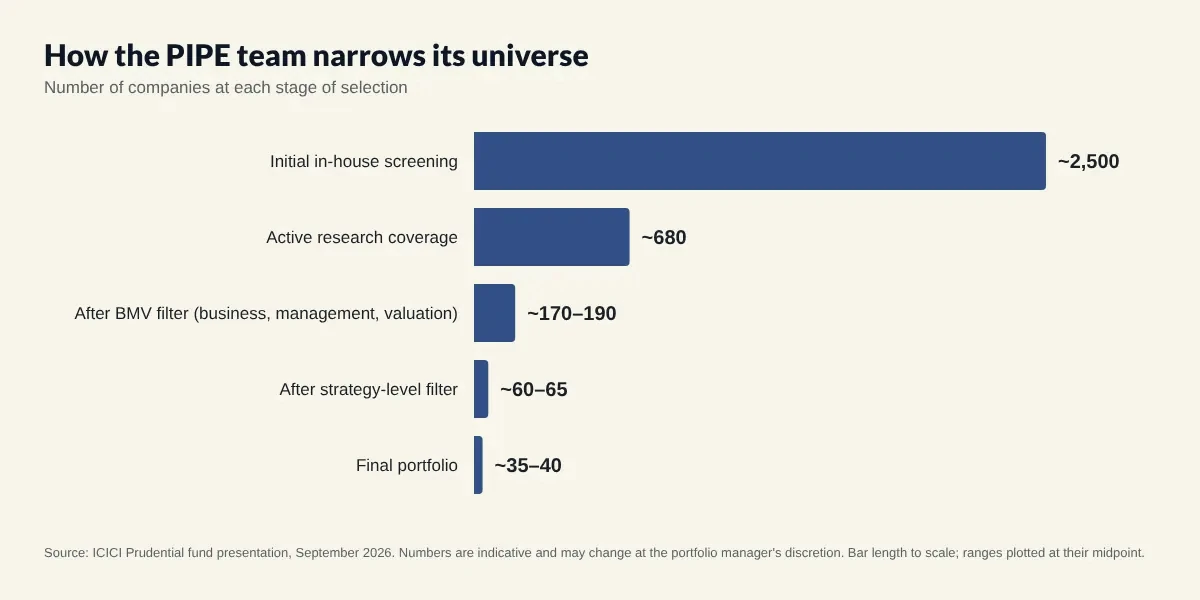
A research team of more than 20 people covers the ~680 companies across 20+ sectors. The team has combined experience of over seven decades. ICICI Prudential calls these numbers indicative; the portfolio manager can change them. Owning 35–40 small caps leaves each stock with real weight, and a single small-cap stock can fall 40% or more in a bad year.
Why the manager is leaning into small caps now
ICICI Prudential’s case rests on two sets of data. The first is opportunity size. Its study of the top 500 NSE companies shows far more five-year multibaggers outside the top 100. In the five years to 2025, 40 small caps (the next 250) returned more than 5x, against only one top-100 company. The Nifty MidSmallcap 400 also spans 113 basic industries, against 52 in the Nifty 100 (as of 31 July 2026). A small-cap fund can own businesses that a large-cap index does not hold.
The second is the correction. On 30 September 2026, the BSE 500 stood 10.5% below its September 2024 peak and 8.6% below its 52-week high. About 63% of the small caps in the BSE 500 traded more than 20% below their 52-week highs. The share was about 49% for mid caps and 38% for large caps.
What the earnings and valuation data show
The same presentation holds a detail worth reading closely. It tracks the two years from 30 September 2024 to 30 September 2026. The Nifty Midcap 150 fell 1% in price, its earnings per share rose 25% and its P/E fell 21%, so mid caps got cheaper because profits grew. The Nifty Smallcap 250 fell 2% in price, but its EPS fell 6% and its P/E rose 4%. On that index measure, small caps cost more per rupee of earnings than at the 2024 peak.
Recent quarters point the other way. Small-cap profit after tax in the Nifty 500 grew 29% year on year in Q1 FY27. On a trailing basis to June 2026, it grew 25% (Motilal Oswal data cited by the manager). So the case reads both ways: earnings are recovering, but entry multiples for the segment have not reset, which puts the weight on stock selection. The team made the same point on the call: it expects returns to differ widely across strategies in this market.
The team behind the ICICI Prudential PIPE Fund
Anand Shah, CIO for PMS and AIF, leads the team. He has more than two decades of fund management experience and holds a PGDM from IIM Lucknow and a B.E. from Regional Engineering College, Surat. The scheme’s key investment team has four members:
| Name | Role |
|---|---|
| Anand Shah | CIO, PMS & AIF |
| Chockalingam Narayanan | Head, Equities, Alternates |
| Prem Khurana | Senior Fund Manager, Alternates |
| Sandip Santdasani | Fund Manager, Alternates |
Ankur Pandey, also a fund manager in Alternates, sits in the wider team.
On the call, the team said its fund managers average more than 20 years of investment experience. Three investment specialists, Ankita Dutta, Akanksha Walia and Tejas Hegde, brief investors and distributors. The portfolio managers also draw on ICICI Prudential AMC’s common equity research team.
What the PMS PIPE portfolio holds today
The presentation shows the portfolio of the oldest client in the PMS PIPE Strategy, as of 31 August 2026. Other clients’ portfolios may differ. The ICICI Prudential PIPE Fund will build its own.
| Measure | PMS PIPE Strategy (oldest client) |
|---|---|
| Number of stocks | 41 |
| Top 10 stocks | 35.86% |
| Top 5 sectors | 47.55% |
| Small cap / mid cap / cash and others | 83.58% / 13.78% / 2.64% |
| Top 10 holdings | Weight | Top 5 sectors | Weight |
|---|---|---|---|
| Honasa Consumer | 4.48% | Textiles & apparels | 13.64% |
| Sarda Energy & Minerals | 4.11% | Industrial products | 10.53% |
| Vardhman Textiles | 3.86% | Capital markets | 9.08% |
| FSN E-Commerce Ventures | 3.82% | Ferrous metals | 7.18% |
| Usha Martin | 3.59% | Retailing | 7.12% |
| Arvind | 3.57% | ||
| Rategain Travel Technologies | 3.57% | ||
| Kalpataru Projects International | 3.00% | ||
| Karur Vysya Bank | 2.98% | ||
| Jindal Stainless | 2.88% |
Two features stand out. Close to 84% sits in small caps, so the PMS already runs at the small end of SMID. The sector bets are also clear: textiles, ferrous metals and industrial products make up about a third of the portfolio. These are cyclical areas, where the special-situations approach shows up in practice. On the call, the team described the portfolio’s tilt as towards manufacturing-oriented sectors.
The manager illustrates the approach with two anonymised PMS holdings. One, an industrial and energy company, moved from commodities into power; its energy capacity rose from 191 MW to 929 MW, and its share price rose 12x over 67 months (60% CAGR). The other, a power transmission business, rose 5.3x over 27 months (133% CAGR). The manager chose both winners to explain the process, so they say nothing about the hit rate across the portfolio.
PMS PIPE returns against the BSE 500 TRI
| Period (to 31 August 2026) | PMS PIPE Strategy | BSE 500 TRI |
|---|---|---|
| 1 month | 3.18% | -0.09% |
| 3 months | 6.91% | 3.86% |
| 6 months | 10.33% | 1.43% |
| 1 year | 12.88% | 4.72% |
| 2 years | 4.76% | -0.11% |
| 3 years | 16.20% | 12.09% |
| 4 years | 22.04% | 11.90% |
| 5 years | 21.51% | 10.91% |
| Since inception (5 Sep 2019) | 24.95% | 16.12% |
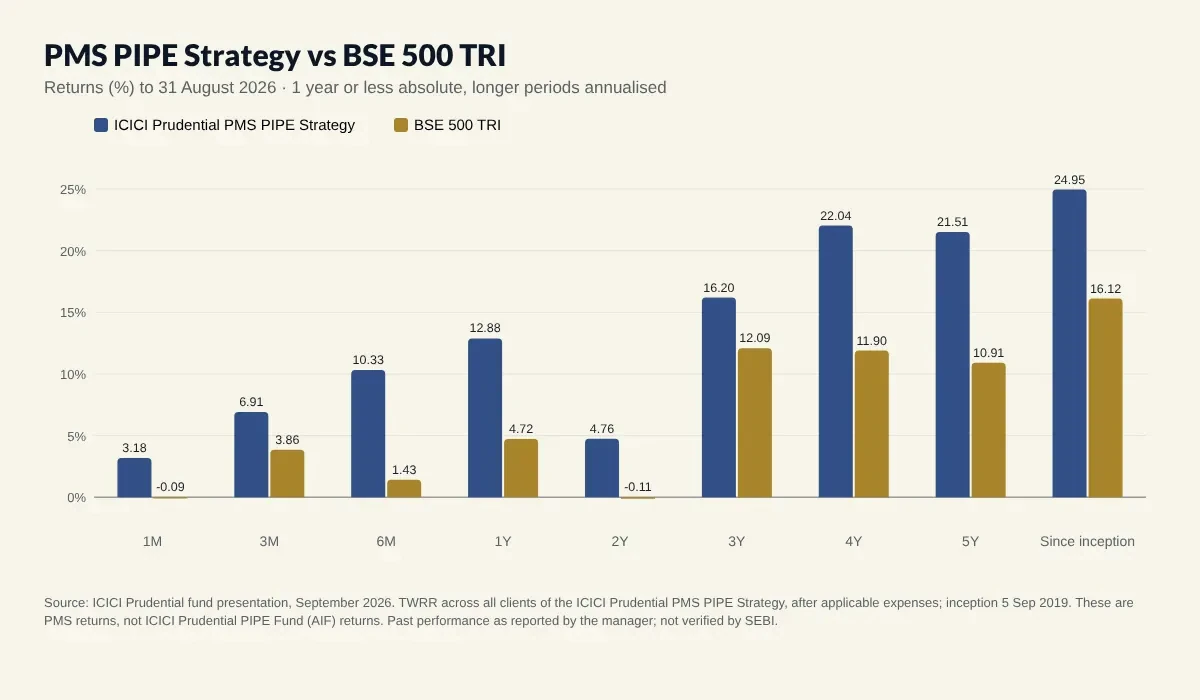
Past performance as reported by the manager for the ICICI Prudential PMS PIPE Strategy, not the AIF; as of 31 August 2026. TWRR across all clients, after applicable expenses. Periods of one year or less are absolute; longer periods are annualised. Not verified by SEBI.
The strategy has stayed ahead of its benchmark in every period shown. The two-year figure of 4.76% a year is the reminder: anyone who entered near the September 2024 peak has earned modest returns, even though the index did worse. The presentation also charts five-year rolling alpha against the Nifty Mid-Smallcap 400. It averaged 5.29% across the months from December 2024 to August 2026. Individual client returns vary with entry timing. APMI publishes the strategy’s reported returns.
The ICICI Prudential PIPE Fund’s 10% unlisted sleeve
The fund may put up to 10% of total assets into unlisted equity, aimed at pre-IPO companies. The manager points to 266 companies that filed draft red herring prospectuses with SEBI in FY2026. It also cites about $20.6 billion raised across 373 IPOs in calendar 2025.
This sleeve is the one part of the fund a PMS client cannot easily copy. It also raises a valuation question, because unlisted holdings carry estimated prices until they list or sell. The presentation itself says such valuations “involve a degree of judgment and may differ from the actual realization value upon exit”. An investor who leaves early gets proceeds based on those estimates.
ICICI Prudential PIPE Fund fees on ₹1 crore
The ICICI Prudential PIPE Fund charges a management fee of 2.25% a year for Class B1, with a ₹1 crore minimum. Class B2, from ₹5 crore, pays 2.00%. The presentation does not say whether the fee runs on commitment, drawn capital or NAV. That choice changes the early cost a lot.
| Fee base (Class B1, ₹1 crore commitment) | Annual management fee | With 18% GST |
|---|---|---|
| Full commitment of ₹1 crore | ₹2,25,000 | ₹2,65,500 |
| First drawdown only (₹20 lakh) | ₹45,000 | ₹53,100 |
| Fully drawn ₹1 crore growing to a NAV of ₹1.5 crore | ₹3,37,500 | ₹3,98,250 |
At Class B2, a ₹5 crore commitment costs ₹10,00,000 a year at 2.00%. At the B1 rate it would cost ₹11,25,000, so the larger class saves ₹1,25,000 a year before GST. The performance fee and any hurdle sit in the PPM. In a strong year for small caps, that fee can exceed the management fee.
This structure needs at least ₹1 crore committed for seven years, with two possible one-year extensions, paid in over five calls.
Drawdowns, term and exit charges in rupees
The first 20% falls due when you sign the contribution agreement. Four more drawdowns of 20% follow on notice from the manager. The presentation gives no calendar for them, so keep the other 80% liquid. Late payment attracts interest under the PPM, and exits stay shut until the full commitment is in. Kalviro’s guide to AIF capital calls explains how drawdown notices work.
The ICICI Prudential PIPE Fund’s term runs seven years from first closing. Investors holding two-thirds of commitments can extend it twice, by one year each time. Plan for nine years.
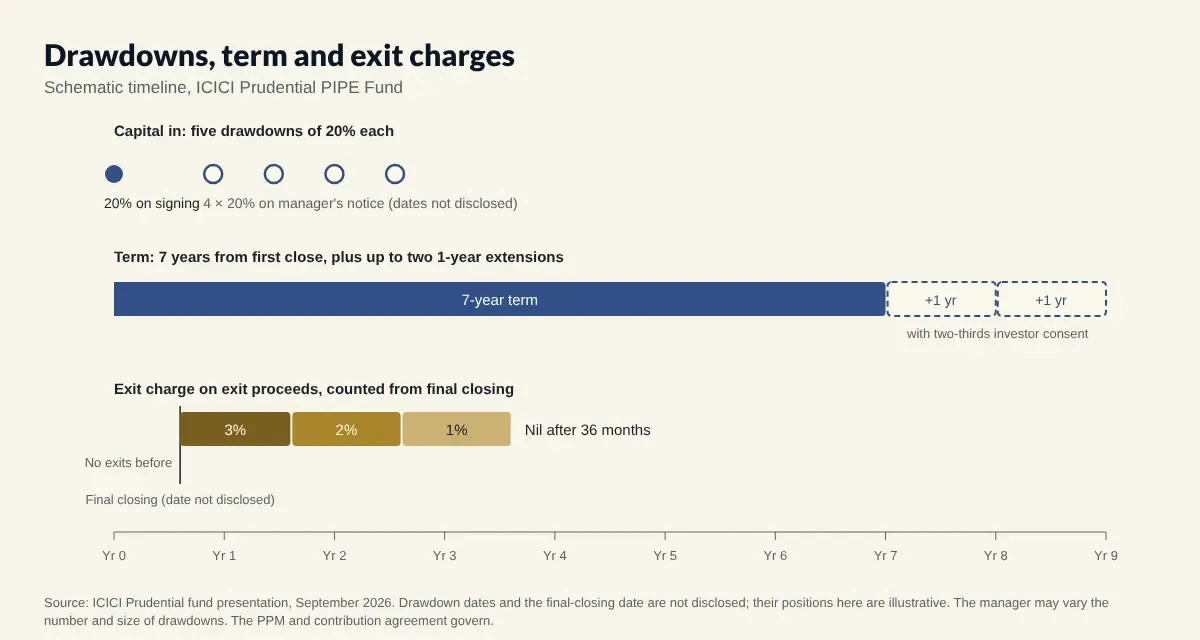
Exit charges apply to exit proceeds and fall each year after final closing.
| Exit request received | Exit charge | On ₹1.20 crore of exit proceeds |
|---|---|---|
| Within 12 months of final closing | 3% | ₹3,60,000 |
| 12–24 months | 2% | ₹2,40,000 |
| 24–36 months | 1% | ₹1,20,000 |
| After 36 months | Nil | Nil |
Fund-level tax on a Category III AIF (FY 2026-27)
Section 115UB gives Category I and II funds pass-through status, as Kalviro’s note on Category II AIF tax explains. Category III funds do not get it. The fund pays tax on its income and gains, and investors receive distributions only after that tax. For FY 2026-27, a determinate trust pays 20% on short-term gains from listed equity. Long-term gains pay 12.5%, plus surcharge and cess. An indeterminate trust pays the maximum marginal rate on all income.
Two practical effects follow. You cannot set your own capital losses elsewhere against the fund’s gains, and the surcharge applies at the fund level. Ask whether the scheme is a determinate trust and how it treats income from derivatives and debt. Tax rules change often, so take advice on your own position.
Risks in the ICICI Prudential PIPE Fund worth checking
ICICI Prudential lists four risks: market liquidity, concentration, company-specific risk and valuation. An allocator would turn each into a specific check.
Liquidity cuts both ways. Small caps can be hard to sell in a falling market, and a ₹1,500 crore fund, if the green-shoe fills, needs depth to trade 35–40 small companies. Ask how position sizes will scale across the PMS and the AIF together.
Special situations can take years. The manager’s own note warns that these bets “may take longer than anticipated to play out”. In a closed-ended fund, that time comes from your term.
Cyclical concentration shows up in the PMS portfolio. Textiles, metals and industrial products make up about a third of it. A downturn in industrial demand would hit several holdings at once.
Governance and disclosure are thinner in small caps. The strategy’s risk note lists lower transparency, weaker governance at some companies and less resilience to economic shocks.
Track-record transfer is the last check. The PMS returns use TWRR across all clients; the ICICI Prudential PIPE Fund will report its own NAV after fund-level costs and tax. The two will not match even with identical stock picks.
ICICI Prudential PIPE Fund: questions investors ask
What is the minimum investment? ₹1 crore for Class B1, which matches SEBI’s floor for AIFs, and ₹5 crore for Class B2. SEBI rules let accredited investors in India invest below that floor where a scheme allows it. The presentation does not mention such a class.
Is the ICICI Prudential PIPE Fund the same as the PMS PIPE Strategy? It uses the same team, framework and small-cap focus. The PMS is a separate account in your name, invested in full on day one. Each PMS client pays their own tax. The AIF pools money, calls it in stages, pays tax itself, charges for early exits and can hold 10% unlisted.
Can NRIs invest? The presentation does not address NRI eligibility. Category III funds raise specific issues for NRIs, covered in Kalviro’s note on Category III AIFs for NRIs. Confirm repatriation and tax terms in the PPM.
What benchmark will the fund use? The September 2026 presentation does not state one for the AIF. The parent PMS reports against the BSE 500 TRI.
How long will my money stay in? Seven years from first closing, plus up to two one-year extensions if two-thirds of investors agree. After final closing you can exit early, at a charge of up to 3% in the first three years.
Where are the full terms? In the PPM and the contribution agreement, which prevail over the presentation. Kalviro’s PPM checklist lists the clauses worth reading first.
The trade-off in one view
ICICI Prudential PIPE Fund offers a small-cap process whose PMS version has beaten the BSE 500 TRI over seven years. It adds a 10% unlisted sleeve the PMS cannot hold. In return, an investor commits at least ₹1 crore for seven to nine years and pays in over five calls. The fund pays tax before distributing, early exits cost up to 3%, and the performance fee still sits in the PPM. Kalviro’s AIFs in India page sets out how Category III funds sit alongside other AIF structures.
