

WhiteOak REIT InvIT Fund 2: Open-Ended Category III AIF Explained
WhiteOak REIT InvIT Fund 2, in full WhiteOak Capital REIT & InvIT Alternates Fund 2, is an open-ended SEBI Category III AIF from WhiteOak Capital. It buys units and debt of listed and private REITs and InvITs, the trusts that own office parks, malls, toll roads and power lines. The minimum investment is ₹1 crore.
WhiteOak told us the fund aims for a gross return of about 14% a year. After fees and the tax the fund pays, it expects about 9% a year to reach the investor. An Income Plan pays out quarterly. After a 12-month lock-in, you can redeem once a quarter. WhiteOak says its group has put more than ₹4,000 crore into REITs and InvITs across its funds.
Fund terms come from WhiteOak’s October 2026 fund presentation. The target return is WhiteOak’s figure, given to us in November 2026. We checked the registration on SEBI’s register on 2 November 2026.
In this article13 sections
WhiteOak REIT InvIT Fund 2 at a glance
| Particular | Detail |
|---|---|
| Fund | WhiteOak Capital REIT & InvIT Alternates Fund 2, a scheme of WhiteOak Capital Equity Trust |
| Category / structure | SEBI Category III AIF, open-ended |
| SEBI registration | IN/AIF3/26-27/2292, held by WhiteOak Capital Equity Trust from 14 August 2026 |
| Manager | WhiteOak Capital Asset Management Limited |
| What it buys | REIT units, public and private InvIT units, and REIT and InvIT debt (target 90%+); up to 10% in equity |
| Single holding limit | 10% of NAV |
| Fund size | Not disclosed |
| Minimum investment | ₹1 crore (Class A1 / A2) |
| Payment | 100% of the commitment at once |
| Plans | Income Plan (quarterly payouts) and Growth Plan |
| Lock-in | 12 months from the date of investment |
| Redemption | Quarterly, in February, May, August and November, with 15 days’ notice; gate at 25% of the fund’s NAV |
| Management fee | 1.50% a year from ₹1 crore, falling to 1.00% from ₹50 crore; no performance fee listed |
| Operating expenses | At actuals, capped at 0.30% a year of daily average AUM |
| Target return | About 14% a year gross; about 9% a year net to the investor after fees and fund-level tax (WhiteOak, November 2026) |
| Track record | None for this fund; Fund I, a close-ended Category III AIF, is registered as IN/AIF3/25-26/1994 |
Information as of November 2026, as disclosed in WhiteOak’s October 2026 fund presentation, with the target return as stated to us by WhiteOak, and checked against SEBI’s register of AIFs. The PPM and contribution agreement govern the fund’s terms.
Put simply, you pay ₹1 crore in one go, and the fund spreads it across trusts that collect rent, tolls and transmission charges. In the Income Plan, most of what they pay the fund reaches you each quarter. Your money stays in for at least a year, then leaves only in quarterly windows. WhiteOak’s risk pages list occupancy, interest rates, leverage and policy change.
What WhiteOak REIT InvIT Fund 2 buys
WhiteOak targets more than 90% of the portfolio in REITs, InvITs and their debt. It may hold up to 10% in equity, and no single holding can exceed 10% of NAV. To be fully invested, the fund needs at least 10 holdings (our arithmetic).
REITs earn rent from offices, malls and data centres; InvITs earn tolls, transmission charges and usage fees from roads, power lines, pipelines and towers. WhiteOak’s presentation names Embassy Office Parks and Nexus Select Trust as REIT examples, and India Grid Trust and Altius as InvIT examples. These are examples of the asset class, not the fund’s holdings.
What the fund adds to holding REIT units
The fund reaches parts of this market that a single investor usually cannot. A listed REIT unit costs a few hundred rupees on the stock exchange. Private InvITs, by WhiteOak’s figures, trade in lots of about ₹25 lakh, largely between institutions. As a Category III AIF, the fund can also take part in REIT and InvIT IPOs, QIPs and block deals, and lend to the trusts through their debt.
WhiteOak’s team visits sites, runs channel checks with clients, brokers and valuers, and tests each trust’s debt against interest-rate moves. On ₹1 crore, this costs about ₹2.07 lakh a year in fees and expenses.
REITs and InvITs in India: the market in numbers
India’s REITs and InvITs hold more than ₹10 lakh crore of assets between them (our sum of the figures below), seven years after the first REIT listed in April 2019. The Indian REITs Association counts 6 listed REITs, with more than ₹3,15,000 crore of gross assets and 214 million sq ft of space (Q1 FY2027 results; asset values mostly as of March 2026). They have more than 4.8 lakh unitholders and have distributed more than ₹34,800 crore.
InvITs are larger. WhiteOak’s presentation, citing the Bharat InvITs Association, counts 28 registered InvITs with more than ₹7 lakh crore of assets, 9 of them publicly listed (July 2026). They have distributed more than ₹91,000 crore since inception.
SEBI’s rules require a public REIT to pay out at least 90% of its net distributable cash flow, at least once every six months (SEBI FAQ on REITs). WhiteOak’s presentation summarises the other limits: at least 80% of a REIT’s or public InvIT’s assets in completed, income-generating projects, and borrowings capped at 49% of asset value for REITs and 70% for InvITs.
Income and the 14% target
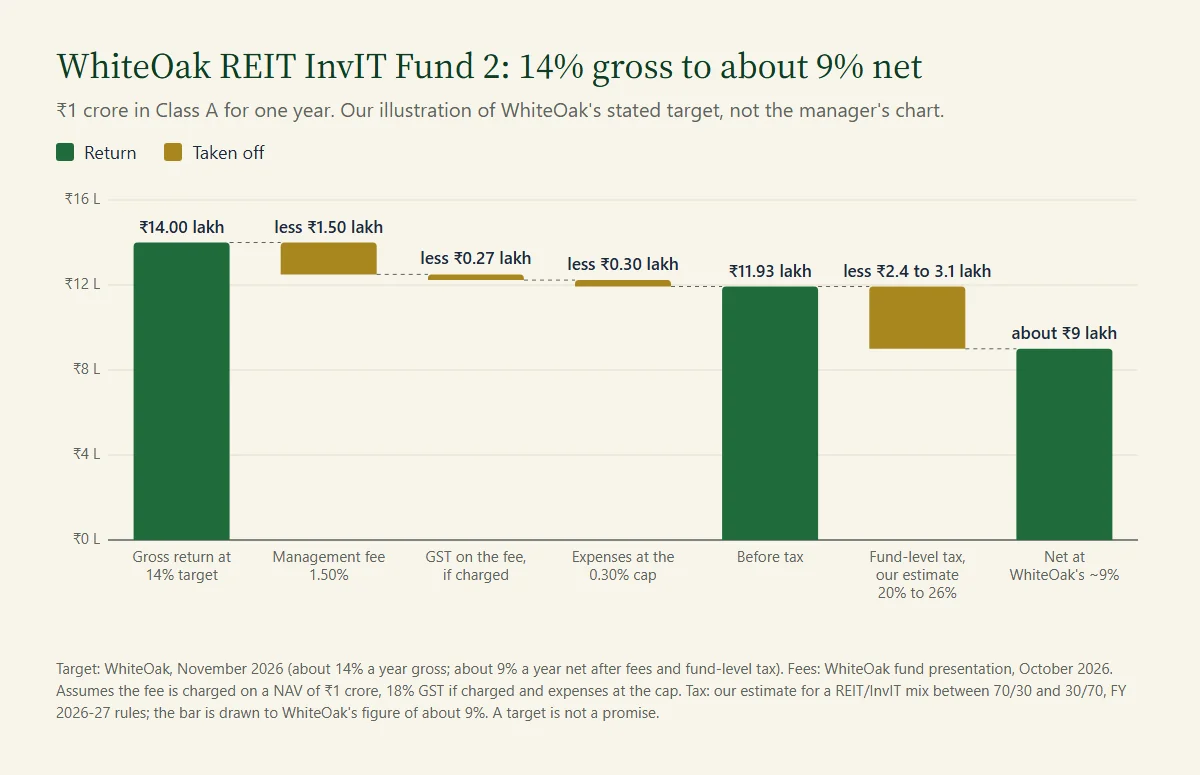
WhiteOak aims for about 14% a year before costs and expects about 9% a year to reach the investor. On ₹1 crore, that is about ₹9 lakh a year.
| Step, ₹1 crore in Class A, one year | Amount |
|---|---|
| Gross return at WhiteOak’s 14% target | ₹14,00,000 |
| Management fee at 1.50% | ₹1,50,000 |
| GST on the fee at 18%, if charged | ₹27,000 |
| Operating expenses at the 0.30% cap | ₹30,000 |
| Return before tax | ₹11,93,000 |
| Fund-level tax, our estimate (about 20% to 26% of the return before tax) | About ₹2,40,000 to ₹3,10,000 |
| Net, our estimate (WhiteOak: about 9%) | About ₹8,90,000 to ₹9,50,000 |
Our illustration, not the manager’s. It assumes ₹1 crore invested for one year, the fee charged on a NAV of ₹1 crore, and expenses at the cap. The table includes management fees, GST and expenses; the tax rows are our estimate for a REIT/InvIT mix between 70/30 and 30/70. A target is not a promise, and REIT and InvIT prices can fall.
Listed REITs currently pay out about 6% a year on their unit price and listed InvITs about 10% (our averages of the larger trusts, November 2026). Income Plan payouts follow what the trusts distribute, so they vary by quarter.
Tax inside WhiteOak REIT InvIT Fund 2
A Category III AIF does not pass income through. The fund pays tax on what it earns, and you receive what remains. The Delhi High Court held in July 2025 that a Category III AIF is a determinate trust, taxed at its investors’ rates. The Supreme Court declined to interfere in October 2026.
Under current rules for FY 2026-27, REIT and InvIT dividends are not taxed in unitholders’ hands. Interest is taxed at slab rates. Gains on units held over a year are taxed at 12.5% plus surcharge and cess. Any business income is taxed at the maximum marginal rate of about 42.7%.
Our estimate puts the fund’s tax at about 20% to 26% of its return before tax, depending on its mix of REITs and InvITs. At WhiteOak’s 14% target, that leaves about 8.9% to 9.5% a year, in line with WhiteOak’s figure of about 9%. Confirm your own position with a tax professional.
WhiteOak REIT InvIT Fund 2 fees on ₹1 crore
A ₹1 crore investment pays a fixed 1.50% a year, or ₹1.5 lakh, plus expenses of up to ₹30,000. The rate falls as the amount rises.
| Class (Income / Growth) | Investment | Management fee a year | On the class entry amount |
|---|---|---|---|
| A1 / A2 | ₹1 crore to under ₹2.5 crore | 1.50% | ₹1,50,000 |
| B1 / B2 | ₹2.5 crore to under ₹5 crore | 1.40% | ₹3,50,000 |
| C1 / C2 | ₹5 crore to under ₹10 crore | 1.30% | ₹6,50,000 |
| I1 / I2 | ₹10 crore to under ₹25 crore | 1.20% | ₹12,00,000 |
| J1 / J2 | ₹25 crore to under ₹50 crore | 1.10% | ₹27,50,000 |
| S1 / S2 | ₹50 crore to under ₹100 crore | 1.00% | ₹50,00,000 |
Our illustration, not the manager’s. Fee shown on NAV equal to the amount invested, before GST. Operating expenses are extra, at actuals and capped at 0.30% a year of daily average AUM.
The presentation lists no performance fee, so the fee stays the same in a strong year. It does not say whether GST applies, or what exit load, if any, the fund charges. The PPM sets these out, and we can take you through them. Our note on long-only funds and Category III AIFs explains how Category III structures compare.
When you can take money out of WhiteOak REIT InvIT Fund 2
Your money stays in for at least 12 months, then leaves only in a quarterly window.
| Step | Timing (illustrative) |
|---|---|
| Invest ₹1 crore | November 2026 |
| Lock-in ends | November 2027 |
| First redemption window you could use | November 2027 or February 2028, depending on the window date and the 15-day notice |
| Later windows | Every February, May, August and November |
Our illustration, from the terms in WhiteOak’s October 2026 fund presentation. The PPM sets the exact window dates and when payment follows.
The fund also has a gate at 25% of its NAV. A gate lets a fund limit how much it pays out in one window when many investors ask to leave at once. The PPM sets how the gate applies.
Risks the manager’s documents name
WhiteOak’s risk pages for REITs list occupancy, pricing, interest rates, regulation and manager-investor misalignment. WhiteOak notes that the market counts about 70% of India’s roughly 1 billion sq ft of office stock as outdated, and that the top five IT firms have added no net hiring in the last three years. It also notes that REIT occupancies are above 90% and that Grade A space took 91% of 2025 leasing.
For InvITs, the presentation lists mixed asset types, complex concession contracts, borrowing of up to 70% of asset value and dependence on government and private counterparties. Higher interest rates raise financing costs and the discount rate used to value the trusts. Tax rules and monetisation policy can change.
WhiteOak REIT InvIT Fund 2 itself has a 12-month lock-in, quarterly exits and a 25% gate. India has only 6 listed REITs and 9 publicly listed InvITs, so the listed choice is narrow. Prices of listed units move daily and can fall.
WhiteOak Capital’s REIT and InvIT team
A three-person team covers the REIT and InvIT market at WhiteOak. Shariq Merchant, who covers auto, consumer and real estate, has 16 years in financial services. WhiteOak says he has anchored its investments since India’s first REIT listing and helped build its REIT and InvIT franchise. He is a chartered accountant and has cleared all three CFA levels. Arth Akolia covers power, oil and gas, and Saahas Jain covers real estate, auto, building materials and logistics.
Prashant Khemka founded WhiteOak Capital Group in June 2017. At 30 September 2026 the group managed or advised about US$13.01 billion (about ₹1,24,884 crore).
Listed REIT and InvIT returns, not the fund’s
The 15 listed REITs and InvITs in WhiteOak’s presentation returned more than the Nifty 50 TRI over one, two and three years to 30 September 2026. They are 6 REITs, 6 public InvITs and 3 private InvITs.
| Annualised return to 30 Sep 2026 | 1 year | 2 years | 3 years |
|---|---|---|---|
| Average of the 15 trusts | 15.8% | 17.7% | 18.5% |
| Median of the 15 trusts | 13.3% | 18.2% | 19.8% |
| Nifty 50 TRI | -7.1% | -10.3% | 5.7% |
Returns of listed REITs and InvITs selected by WhiteOak, not of WhiteOak REIT InvIT Fund 2, which has no track record yet. XIRR as disclosed in WhiteOak’s October 2026 fund presentation, compiled by WhiteOak from Bloomberg data. The presentation shows no figure for a trust listed for less than the period. The Nifty 50 TRI is an equity index, the comparison WhiteOak uses. Past performance does not indicate future returns.
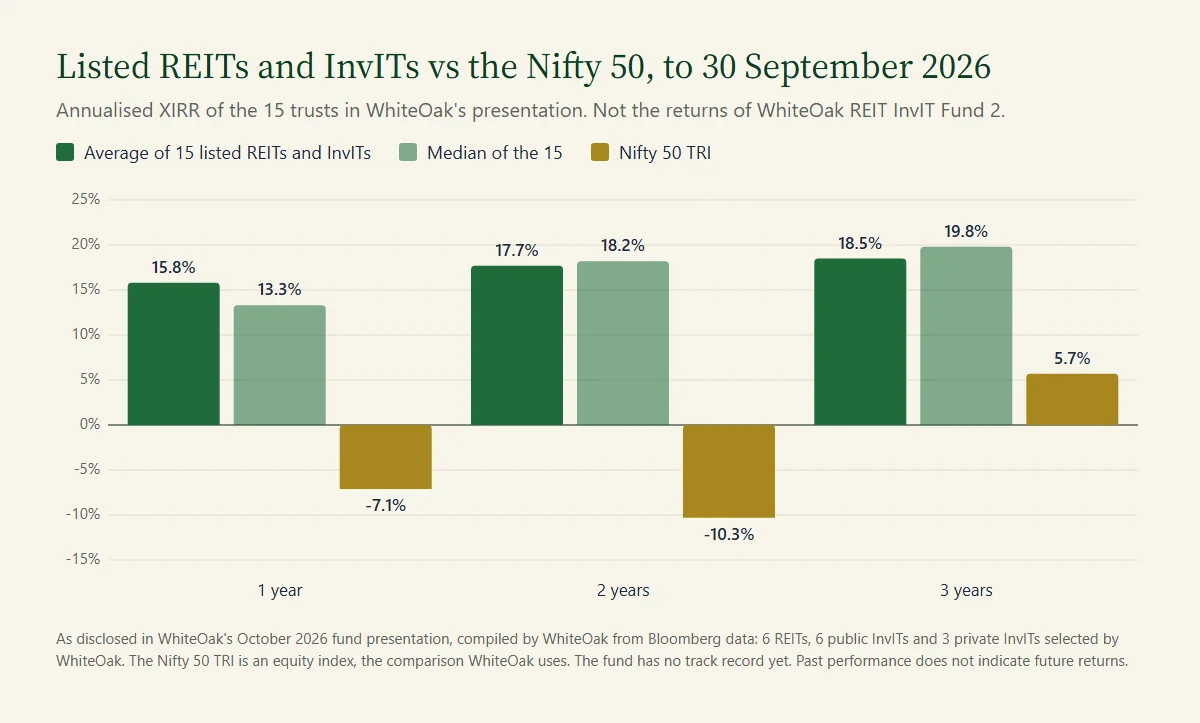
WhiteOak puts the average beta of these trusts against the Nifty 50 at 0.19, where 1 means moving in step with the index.
WhiteOak REIT InvIT Fund 2: questions investors ask
Investing in WhiteOak REIT InvIT Fund 2
Is WhiteOak REIT InvIT Fund 2 open for investment?
The fund presentation is dated October 2026. As an open-ended fund, it takes new money over time; the PPM sets the subscription dates. Ask us for the current dates.
How do I invest?
You complete KYC, sign the contribution agreement and pay the full amount, since the fund draws 100% of the commitment. We can take you through the documents.
What is the minimum investment?
₹1 crore, in Class A. Under SEBI rules, accredited investors can invest less where a scheme allows it; ask us.
Returns, tax and exit
Is the 14% return assured?
No. About 14% gross and about 9% net is WhiteOak’s target, not a promise, and REIT and InvIT prices can fall.
How is the fund taxed?
Under current rules for FY 2026-27, a Category III AIF pays tax at the fund level and does not pass income through. Our estimate puts that tax at about 20% to 26% of the fund’s return before tax. Confirm your own position with a tax professional.
Can NRIs invest?
Yes. Since October 2026, SEBI’s AIF rules treat persons resident outside India, as defined under FEMA, as accredited investors. The ₹1 crore regulatory minimum therefore does not apply to them. Each fund still sets its own minimum and eligibility. WhiteOak’s presentation does not set out NRI terms, so we check them against the PPM. Money can come from an NRE, FCNR or NRO account or from abroad, but not from the NRE-PIS account kept for share trading. The fund pays Indian tax before money reaches you. If you live abroad, ask a tax professional how your country treats fund units.
Can I exit early?
Not in the first 12 months. After that, in any quarterly window with 15 days’ notice, subject to the 25% gate.
The offer in rupees and years
WhiteOak REIT InvIT Fund 2 puts ₹1 crore into the trusts that own India’s offices, roads and power lines, with a quarterly income option and WhiteOak’s net target of about ₹9 lakh a year. It costs about ₹2.07 lakh a year in fees and expenses, and the money stays in for at least 12 months, then leaves only in quarterly windows. The fund has no record of its own yet; the listed REITs and InvITs it can buy do. Our AIF investments page lists the other AIFs we cover.