

Sundaram ECCO II Emerging Corporate Credit Opportunities Fund: Returns, Fees, Minimum
Sundaram ECCO II, the Emerging Corporate Credit Opportunities Fund Series II, is a close-ended Category II AIF from Sundaram Alternates. It lends to mid-market Indian companies. It targets ₹2,500 crore, with an option to accept up to ₹1,500 crore more (a greenshoe). The minimum commitment is ₹1 crore.
Its predecessor, Ecco I, launched in June 2022, had raised about ₹1,040 crore by June 2026. It had made 20 investments, with five full exits and no capital losses, as Sundaram discloses. For ECCO II, the manager’s indicative target is 17% to 19% a year after expenses and before tax. Income is paid out every quarter.
Terms and figures come from Sundaram Alternates’ July 2026 fund presentation and executive summary for ECCO II. Market figures come from SEBI’s AIF data to 30 June 2026.
| Sundaram ECCO II at a glance | |
|---|---|
| Fund | Emerging Corporate Credit Opportunities Fund, Series II (SA Ecco II) |
| Structure | Close-ended Category II Alternative Investment Fund: you cannot withdraw before the term ends |
| Manager | Sundaram Alternate Assets Limited, Sundaram Finance group |
| SEBI registration number | Not disclosed in the fund presentation |
| What it buys | High-yielding debentures and convertible securities, including equity warrants, mainly of mid-market Indian companies |
| Strategy mix | Senior secured 40% to 45%, special situations 40% to 45%, opportunistic 10% to 20% |
| Size | ₹2,500 crore target, plus a ₹1,500 crore greenshoe |
| Fundraising status | Target first close (when the fund first accepts money) of ₹300 crore to ₹500 crore; no close date given |
| Minimum | ₹1 crore |
| Portfolio | 15 to 25 investments, including money lent again after repayment; ₹100 crore to ₹300 crore per deal (estimated) |
| Drawdowns | 25% upfront, the balance in tranches over 12 to 15 months |
| Term | 6.5 years from initial closing; up to 2 more years with investor consent |
| Distributions | All accrued income, every quarter, from first close |
| Fees | Management fee 1.00% to 2.00% a year by commitment size; set-up fee up to 2.00%; expenses up to 0.25% a year; 20% performance fee above a 12% pre-tax IRR, no catch-up, at maturity; taxes extra |
| Target return (indicative) | 19% to 21% gross portfolio return; 17% to 19% after expenses, before tax |
| Sponsor commitment | 10% of fund size |
| Tax status | Pass-through to investors (Category II AIF) |
| Benchmark | Not disclosed |
Information as of July 2026, as disclosed in Sundaram Alternates’ ECCO II fund presentation and executive summary. The PPM (private placement memorandum, the fund’s offer document) and the contribution agreement govern the fund’s terms.
In plain terms, a quarter of your ₹1 crore goes in first. The rest follows over the next 12 to 15 months. The fund lends the money to companies and passes on the interest every quarter. Principal comes back as borrowers repay, within a 6.5-year life. Sundaram’s documents state that AIF schemes do not guarantee or assure income.
What the Sundaram Emerging Corporate Credit Opportunities Fund II lends to
Sundaram ECCO II invests in debentures and other securities of mid-market companies, across three buckets. Most loans amortise: the borrower repays principal in instalments, not in one payment at the end.
| Bucket | Share of the fund | What it finances | Target gross deal IRR |
|---|---|---|---|
| Senior secured | 40% to 45% | Growth capital for borrowers with moderate credit profiles or a liquidity event ahead | 18% to 20% |
| Special situations | 40% to 45% | Debt settlements, growth capital after a period of stress, cash-flow gaps, asset or partner buyouts | 20% to 22% |
| Opportunistic | 10% to 20% | Bridge and interim finance, pre-pre-IPO and mezzanine deals (loans repaid after senior lenders, often with an equity link) for established corporate groups | 20% to 24% (about 15% fixed plus equity-linked upside) |
As disclosed in the ECCO II fund presentation (July 2026). Deal-level IRRs are gross, before fees and tax, as the manager states; the deal mix is indicative.
Each borrower needs revenue of at least ₹250 crore and a positive operating profit (EBITDA). Its leverage must be below 4x, with no unresolved defaults. Each loan needs assets worth at least 1.5 times the principal, and expected cash flows of at least 1.5 times the loan. The interest floor is 10%. Security can include secured debentures, share pledges, post-dated cheques and personal guarantees.
Category II AIF growth and the private credit gap Sundaram sees
SEBI’s data shows money committed to Category II AIFs rose 20.8% in the year to June 2026 (our calculation). This category includes private credit funds, along with equity and real estate funds. SEBI’s data shows ₹13,02,837 crore committed at 30 June 2026, against ₹10,78,208 crore a year earlier. Of the commitments, ₹4,78,195 crore had been raised and ₹4,28,376 crore invested (net figures).
Sundaram’s presentation says banks and NBFCs do not cover many mid-market needs. Acquisition finance, promoter funding and bridge capital are its examples. Citing EY, Praxis-IVCA and its own analysis, Sundaram estimates the yearly addressable opportunity at about ₹2,00,000 crore by 2027, against about ₹50,000 crore in 2022. Our explainer on private credit AIFs covers how these funds lend.
Ecco I: the record behind Sundaram ECCO II
Ecco I, Sundaram’s first corporate credit fund, has made 20 investments since its June 2022 launch. It had fully exited five and reported no capital losses as of June 2026. Its loans carry a 19.5% contracted IRR before fees, which is the return written into the loan terms, including payments still to come. ECCO II has no record of its own yet.
| Ecco I (Emerging Corporate Credit Opportunities Fund I), not ECCO II | As disclosed by the manager, June 2026 |
|---|---|
| Capital raised | About ₹1,040 crore |
| Gross capital deployed, including money lent again | About ₹1,596 crore |
| Investments | 20 |
| Exits | 5 full, 3 partial (at least 50% of the amount deployed) |
| Portfolio IRR, gross, contracted | 19.5% |
| Investor returns | 17.2% (basis not stated) |
| Exit IRRs | About 21.4% (basis not stated) |
| TVPI | 1.6x, at an average fund life of about 4 years |
| Cash yield from year 1, on average capital drawn | 15% a year |
| Capital losses | Zero |
| Average security cover | About 2.5x |
| Repeat promoter groups | About 55% of deal sizes |
Past performance as disclosed by the manager in the ECCO II fund presentation (July 2026, data as of June 2026); it does not indicate future returns.
TVPI adds the cash already returned to the value of what the fund still holds, then divides by the money paid in. The presentation does not give DPI, the cash returned on its own.
Sundaram launched Ecco I in June 2022. Its product page lists the fund as closed, with deals of about ₹30 crore to ₹60 crore each, outside real estate. ECCO II plans ₹100 crore to ₹300 crore per deal and allows real estate up to 25% of the fund. Its ₹2,500 crore target is 2.4 times what Ecco I raised (our calculation).
How the Sundaram ECCO II target return is built
Most of Sundaram’s 17% to 19% target comes from a 12% to 14% cash coupon paid each quarter. A redemption premium of about 7% is added when loans are repaid, and about 2% of costs is taken off. The redemption premium is an extra amount the borrower agrees to pay on repayment.
| Part of the return | Indicative figure (manager) |
|---|---|
| Gross cash coupon, distributed quarterly | 12% to 14% |
| Redemption premium | About 7% |
| Gross portfolio return | 19% to 21% |
| Fees, expenses, carry and treasury drag (lower returns on cash waiting to be lent) | About 2% |
| Return to investors, after expenses and before tax | 17% to 19% |
As disclosed in the ECCO II fund presentation (July 2026), “based on prevailing market conditions”. Actual figures may differ substantially.
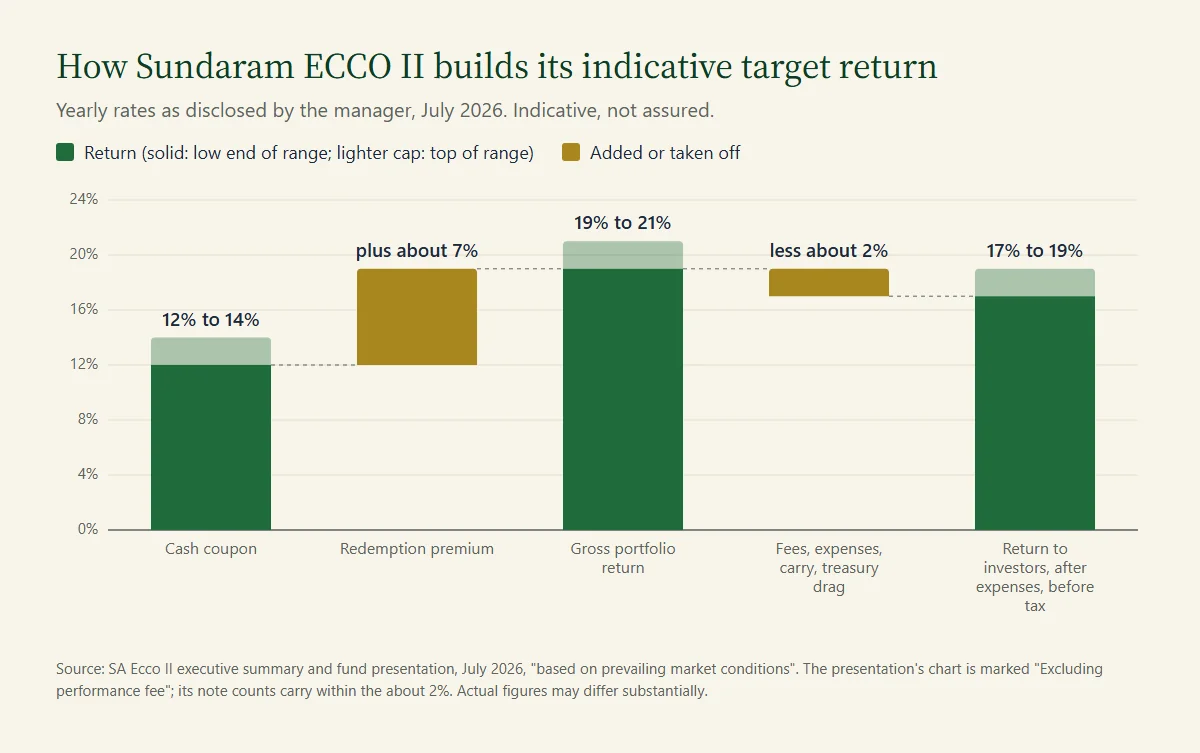
The presentation’s return chart is marked “Excluding performance fee”, while its note counts carry within the 2%. It does not make clear whether the 17% to 19% is before or after the performance fee, or which fee class the 2% assumes. On ₹1 crore, the management fee and expenses alone come to up to 2.25% a year.
On ₹1 crore fully invested, a 12% to 14% coupon comes to ₹12 lakh to ₹14 lakh a year. That is ₹3 lakh to ₹3.5 lakh a quarter, before fees, expenses and tax. After the 2.00% management fee and up to 0.25% in expenses, that falls to about ₹9.75 lakh to ₹11.75 lakh a year, before GST on fees, the performance fee and income tax. This is our illustration, not the manager’s, and a target is not a promise.
How your ₹1 crore goes in and comes back
Your ₹1 crore goes in over about 15 months, and income starts from first close. During the investment period, the fund lends repaid principal again. After it, principal comes back to investors with the quarterly payouts.
| When | Called | Total called | What happens |
|---|---|---|---|
| First drawdown | ₹25 lakh | ₹25 lakh | 25% of the commitment |
| Next 12 to 15 months | ₹75 lakh, in tranches | ₹1 crore | Balance called as deals close |
| Every quarter from first close | None | Accrued income paid out | |
| Investment period (length not disclosed) | None | Principal repaid by borrowers is reinvested | |
| After the investment period, to year 6.5 | None | Principal returned with quarterly payouts | |
| Years 6.5 to 8.5, if extended | None | Up to 2 more years, with investor consent |
Drawdown terms as disclosed in the ECCO II fund presentation (July 2026); the split of the ₹75 lakh and the timing of each repayment are illustrative and depend on the PPM and the manager’s deals.
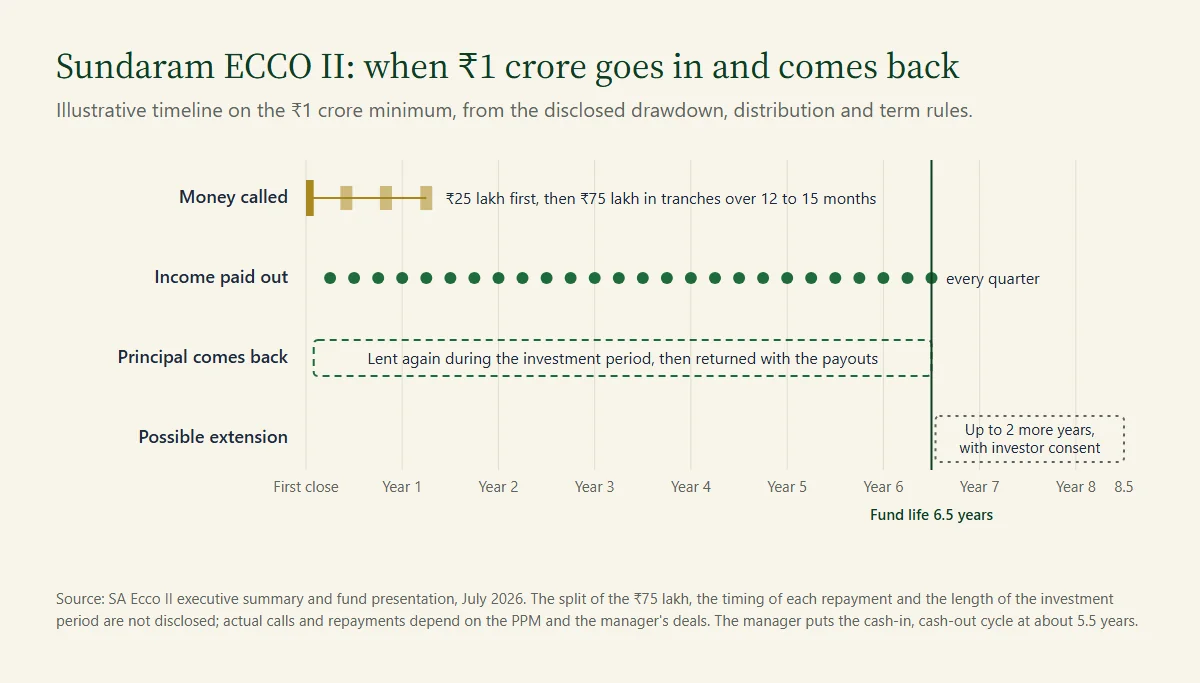
The manager puts the cash-in, cash-out cycle at about 5.5 years. Loans run 5 to 6 years, with an average duration of 4 to 5 years.
Fees on the ₹1 crore minimum
On ₹1 crore, yearly costs are up to ₹2 lakh in management fee and up to about ₹25,000 in expenses. A one-time set-up fee of up to ₹2 lakh comes on top. The manager shares in profits only above a 12% pre-tax IRR, called the hurdle.
| Fee | As disclosed | On ₹1 crore (class A2: commitments of ₹1 crore to ₹1.99 crore) |
|---|---|---|
| Management fee | 2.00% a year | ₹2 lakh a year on the full commitment, or ₹50,000 a year on the first ₹25 lakh drawn (base not disclosed) |
| Set-up fee | Up to 2.00% of commitment, at the manager’s discretion | Up to ₹2 lakh, once |
| Operating expenses | Up to 0.25% a year of the corpus | Up to about ₹25,000 a year (our estimate, pro rata) |
| Performance fee | 20% of returns above a 12% pre-tax rupee IRR, no catch-up, charged only at maturity | Cannot be calculated from the disclosed terms |
| Taxes | Charged in addition | Not included above |
As disclosed in the ECCO II fund presentation (July 2026). Rupee figures are our estimate, not the manager’s.
The management fee falls as the commitment grows. It is 1.75% from ₹2 crore, 1.50% from ₹10 crore, 1.25% from ₹25 crore and 1.00% from ₹50 crore. With no catch-up, the manager takes 20% only of the return above 12%. The PPM sets the fee base and the expense rules, and we can take you through them.
Who runs Sundaram ECCO II at Sundaram Alternates
Three fund managers run ECCO II, and an investment committee approves every deal. The sponsor commits 10% of the fund’s size, which the presentation calls the maximum RBI norms allow.
Chandan Kumar has more than 16 years at Sundaram Alternates, InCred Capital and Yes Bank. His work covers mezzanine, acquisition and special situations credit. Shekaar Subramaniam has more than 18 years in structured finance and private debt. He built the wholesale lending desk at FedBank Financial Services. Arjun Sankar has more than 14 years in real estate credit. He oversees about ₹4,500 crore across Sundaram Alternates’ three real estate credit funds.
The committee has five members, four of them from Sundaram Finance. They are Harsha Viji (Executive Vice Chairman), Rajiv Lochan (Managing Director), A N Raju (Deputy Managing Director) and M Ramaswamy (Chief Financial Officer). The fifth is Karthik Athreya, Managing Director of Sundaram Alternates. He has helped build its private credit platform, which manages over USD 1.5 billion.
The team reports evaluating over 300 deals and making 20 investments. It targets 75 to 90 days from sourcing to financial close. Each deal gets legal counsel, independent collateral valuation and financial diligence. Quarterly reviews follow the investment.
Sundaram ECCO II risks, as the documents state them
Sundaram’s documents say the fund carries market, credit and investment risk, that AIF schemes do not guarantee or assure income, and that returns are “purely indicative”. Up to 45% of the fund can go to special situations, such as debt settlements and companies recovering from stress.
The opportunistic bucket accepts a flexible security structure and includes mezzanine and pre-pre-IPO deals. One borrower can take about 10% to 15% of the fund, one industry about 25% and real estate up to 25%. The fund focuses on South and West India and does not target particular sectors, with ESG exclusions. It has a fixed 6.5-year life and can run 2 more years with investor consent. The presentation does not describe a way to exit early.
Sundaram ECCO II: questions investors ask
Status, minimum and how to invest
Is Sundaram ECCO II open, and how much has it raised?
The July 2026 presentation targets a first close of ₹300 crore to ₹500 crore. It gives no close date or amount raised.
What is the minimum investment?
₹1 crore, as the fund presentation states. SEBI’s rules for accredited investors differ, and the presentation does not say whether ECCO II accepts them below ₹1 crore; ask us.
How do I invest in Sundaram ECCO II?
You complete KYC, read the PPM and sign a contribution agreement for your commitment. You pay 25% on the first drawdown. The manager calls the rest over the next 12 to 15 months.
Is Ecco I still open, and how does ECCO II differ?
Sundaram’s site lists Ecco I as closed. ECCO II targets ₹2,500 crore, 2.4 times what Ecco I raised, with deals of ₹100 crore to ₹300 crore against Ecco I’s ₹30 crore to ₹60 crore. Our page on Sundaram PMS covers Sundaram Alternates’ four equity strategies.
NRIs, tax, exit and assured returns
Can NRIs invest in Sundaram ECCO II?
The presentation proposes a GIFT City feeder fund for offshore investors, “subject to minimum economics”. It sets no NRI terms for the Indian fund. The hurdle is measured in rupees; our note on currency risk for NRIs explains what that means abroad. If you live abroad, ask a tax professional how your country treats fund units.
How is Sundaram ECCO II taxed?
As a Category II AIF, the fund has pass-through status. Under current rules for FY 2026-27, investors generally pay tax on its income as if they had earned it themselves. Business income, if any, is taxed in the fund’s hands. Our guide to Category II AIF tax explains the rules; confirm your own position with a tax professional.
Can I exit before the fund ends?
The fund has a fixed term, and the presentation does not describe early redemption. The PPM sets any transfer rules.
Is the 17% to 19% return assured?
No. Sundaram’s documents state that AIF schemes do not guarantee or assure income, and that returns are indicative.
Sundaram ECCO II in rupees and years
ECCO II lends to mid-market companies, mainly through debentures, and pays income every quarter. On ₹1 crore fully invested, the 12% to 14% coupon is ₹12 lakh to ₹14 lakh a year before fees and tax (our illustration). The indicative target is 17% to 19% after expenses and before tax. Money goes in over 12 to 15 months and comes back as borrowers repay, across a 6.5-year life that can run to 8.5. Our AIF investments page lists the curated funds we offer.
