

Nippon India Digital Innovation Fund 2A: what a new investor is buying
Nippon India Digital Innovation Fund 2A (NIDI Fund 2A) is a Category II alternative investment fund from Nippon Life India AIF Management. It buys stakes in 8 to 12 growth-stage Indian technology companies, picked from start-ups backed by the venture funds in its sister fund’s portfolio.
A first-time AIF investor usually has three questions. What will my money own, when do I pay it, and when does it come back? The fund now holds two companies, and its current drawdown is 28% of commitments. Part of the answer is no longer a promise.
This review uses Nippon India AIF’s fund presentation (August 2026), company materials from the two portfolio companies and the manager’s October 2026 update. The fund is open for subscription as of October 2026.
Nippon India Digital Innovation Fund 2A at a glance
| Item | Details |
|---|---|
| Fund | Nippon India Digital Innovation (NIDI) Fund 2A |
| Structure | Category II AIF, SEBI-registered, close-ended |
| Manager | Nippon Life India AIF Management Ltd |
| Strategy | Direct stakes in growth-stage (Series B and C) tech start-ups |
| Portfolio | 8 to 12 companies, ₹20 to 60 crore each including reserves |
| Target size | ₹750 crore |
| Minimum | ₹1 crore commitment |
| Current drawdown | 28% of commitments, payable on joining |
| Term | Until March 2033, extendable by two one-year periods |
| Fees | 1.50% to 2.05% a year by commitment size, 20% carry over a 10% hurdle |
| Benchmark | Not disclosed in the documents reviewed |
Information as of October 2026. Sources: Nippon India AIF fund presentation (August 2026); manager update (October 2026).
You promise ₹1 crore or more, and the fund asks for it in instalments as it finds companies. The money stays in unlisted start-ups until the fund sells them or they list, which can take until 2033 or later. The main risk is that these companies lose value, or take longer to sell than planned.
What your money owns in NIDI Fund 2A
Your units give you a share of a pool that owns minority stakes in private companies. The August 2026 fund presentation sets out the manager’s preferences. It invests mainly in new funding rounds, though it can also buy existing shares. It prefers to invest across more than one round and to take a board seat.
With 8 to 12 companies, each holding is a large slice of the fund. One strong exit can carry the result, and one failure takes a visible bite. That trade-off is common to private equity through Category II AIFs, and it is sharper here because the list is short.
How Nippon India Digital Innovation Fund 2A picks companies
The fund draws its candidates from its older sibling. NIDI Fund 1, a ₹737 crore fund of funds from 2020, backs 14 Indian venture funds, including Blume, Chiratae, Fireside, Arkam and 3one4 Capital. Those funds hold 437 start-ups, which gives Nippon years of reporting on each company before it writes a direct cheque.
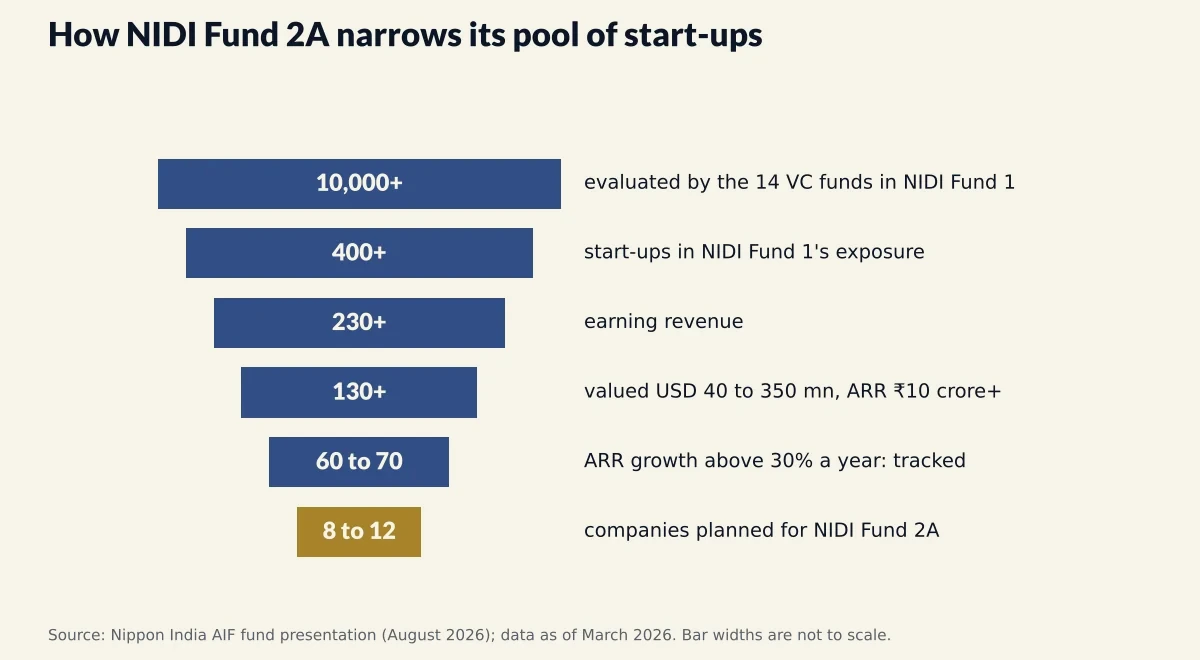
The fund presentation (data as of March 2026) shows the filter. Of 10,000+ start-ups the underlying funds evaluated, NIDI has exposure to 400+, and 230+ earn revenue. About 130 meet the size test: a valuation of USD 40 to 350 million and annual recurring revenue (ARR) of at least ₹10 crore. The 60 to 70 growing ARR by more than 30% a year form the shortlist.
As in the latest PPT, that shortlist shows a median ARR of INR 1,204 Mn and median YoY ARR growth of 109%. Its portfolio IRR is 40.7%, as of 31 December 2025 or the latest available. Those are the companies’ figures and the underlying funds’ returns on them. They describe the pool NIDI Fund 2A picks from, not a return the fund has earned.
The first two companies in NIDI Fund 2A
Supertails runs an online pet-care marketplace with vet clinics, a pharmacy and its own brand, Henlo. The fund presentation puts FY26 revenue at about ₹200 crore, with about 85% CAGR from FY23 to FY26. Its own materials show 12 clinics and 43 dark stores. Repeat buyers brought in 80%+ of revenue as of March 2025. Its founders worked together as senior executives at Licious for about six years.
OLYV is a digital lender making small, short loans, including to self-employed and grey-collar borrowers. Its investor presentation shows AUM of INR 1,200 Cr+ and an average loan of about ₹24,400 over about 7.6 months. FY26 ROE was about 20%, with ROA of 5.4%. It disburses about ₹400 crore a month and keeps 30% of loans on its own books. Nippon put ₹50 crore into OLYV in September 2026.
What NIDI Fund 2A plans to buy next
The manager expects to add at least three more companies by March 2027, which would complete about half the portfolio. The pipeline covers four areas. They are a design-led home appliance brand, a rural commerce platform, a specialty chemicals maker and an allied-healthcare training company. These deals may or may not close.
For a new investor, this changes the blind-pool question. Today you can see two of 8 to 12 companies. By mid-2027 you may see five or more, and the manager will pick the rest over 2027 and 2028.
When you pay: capital calls in Nippon India Digital Innovation Fund 2A
An AIF calls money in stages. The current drawdown of NIDI Fund 2A is 28% of commitments, and a new investor pays it on joining. The manager expects to call about 25% more by early 2027 and the rest over 2027 and 2028. The commitment period runs to March 2030.
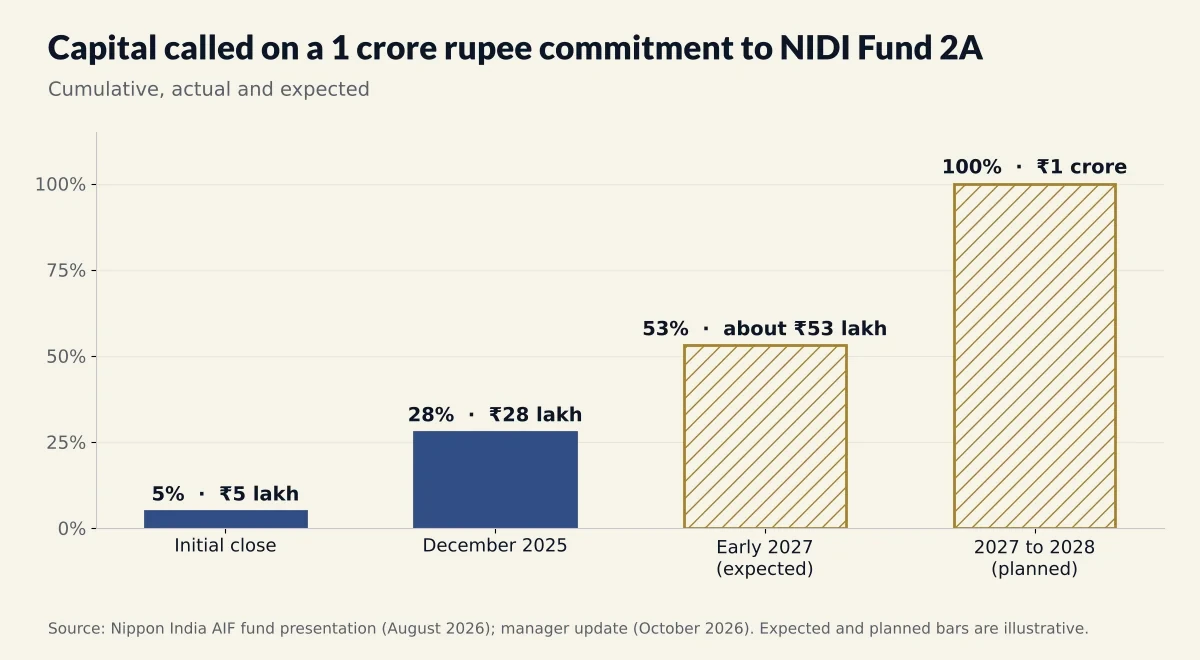
On a ₹1 crore commitment, that means ₹28 lakh when you join. About ₹25 lakh more follows in early 2027 and the balance over the next two years. Our guide to AIF capital calls covers notices and what a missed call costs.
What ₹1 crore in NIDI Fund 2A costs
The management fee depends on commitment size, and taxes come on top.
| Commitment | Management fee a year |
|---|---|
| ₹1 crore to under ₹2 crore | 2.05% |
| ₹2 crore to under ₹5 crore | 2.00% |
| ₹5 crore to under ₹15 crore | 1.75% |
| ₹15 crore and above | 1.50% |
Information as of August 2026, from Nippon India AIF’s fund presentation. The fund charges the fee on commitment during the commitment period and on net invested capital after it.
At ₹1 crore, the fee is ₹2.05 lakh a year plus GST, charged on the full commitment until March 2030. While only ₹28 lakh sits in the fund, that works out to about 7.3% of the money actually at work. The ratio falls as the fund calls more capital. Operating costs add about 0.50% a year (about ₹50,000) and a one-time set-up charge of up to 0.15% (₹15,000).
Carry is 20%, with a 100% catch-up, once investors get their capital back plus a 10% a year hurdle. With a full catch-up, the manager’s share becomes 20% of the whole profit once returns clear the hurdle comfortably. The table below gives Kalviro’s simplified illustration on ₹1 crore over eight years, before management fees and expenses.
| Gross multiple | Carry to manager | Net multiple to you |
|---|---|---|
| 2.0x | Nil (below the hurdle) | 2.00x |
| 3.0x | ₹40 lakh | 2.60x |
| 4.0x | ₹60 lakh | 3.40x |
Illustration only, not a projection. Real outcomes depend on the timing of calls and distributions, and fees and expenses reduce them.
When the money comes back
The manager plans to exit each company in four to five years, through a sale to private equity or sovereign funds, an IPO, a strategic sale (including to Japanese companies), or a secondary sale. The fund runs until March 2033 and can extend twice by a year. There is no redemption window, so plan for the full term.
NIDI Fund 1 shows how slowly cash arrives in venture funds. As of December 2025 it reported a gross TVPI of 1.55x. Its gross IRR was 20.2% on its first five fully deployed investments and 17.2% across the whole portfolio. Its DPI, the cash actually returned, was 8.94% as of March 2026. Most of the gain is still a valuation on paper, as is normal for a 2020 fund. Our explainer on DPI, TVPI and IRR covers the difference. Past performance does not indicate future returns.
Who runs Nippon India Digital Innovation Fund 2A
Nippon Life Insurance of Japan owns about 71.9% of Nippon Life India Asset Management, which manages ₹8.62 lakh crore. Its AIF arm, Nippon India AIF, runs the fund. Fund managers Sachin Bid and Ankit Agarwal lead it, with Harsh Shah and Tanmay Deshpande as associate fund managers, and T.V. Mohandas Pai and Sanjeev Bikhchandani as external advisors.
The sponsor has committed ₹20 crore, so the manager’s own money sits beside yours. Through Japan’s trade agency JETRO and its economy ministry METI, NIDI introduced 25+ start-ups to 30+ Japanese companies in the two years to August 2025. The same group also runs the Nippon GIFT City fund.
Risks a new NIDI Fund 2A investor takes
Valuations of unlisted companies are estimates until a sale or listing sets a real price. A portfolio of 8 to 12 names leaves room for one or two failures to hurt. Your money stays in until about 2033, and exits depend on IPO markets and buyer appetite at the time.
Some risks are specific to the current holdings. OLYV’s lending business depends on RBI rules and on borrowers repaying through a downturn. Most of the portfolio is still unchosen, and the fund discloses no benchmark to judge it against.
Questions new investors ask about NIDI Fund 2A
Do I pay ₹1 crore on day one? No. You sign a ₹1 crore commitment and pay the current 28% drawdown, ₹28 lakh, on joining. The rest comes in later calls over roughly 2027 and 2028.
Can I leave before 2033? The fund has a fixed term and offers no redemption. Any transfer of units follows the terms in the PPM, so treat the money as locked in.
How is the return taxed? Under current rules for FY 2026-27, Category II AIFs generally pass gains through to investors. You pay tax on them as the fund earns them. Our note on Category II AIF tax has more, and a tax professional should confirm your position.
Does Fund 1’s record tell me what Fund 2A will return? No. Fund 1 invests in venture funds, while Fund 2A buys companies directly with higher concentration. Fund 1 shows where the deal flow comes from; it is not a forecast.
Who regulates the fund? SEBI registers and supervises AIFs. The manager, Nippon Life India AIF Management, runs the fund under that registration.
The trade-off in Nippon India Digital Innovation Fund 2A
NIDI Fund 2A asks for ₹1 crore over about two more years of calls and roughly seven years of patience. In return it offers stakes in growth-stage companies chosen from a pool Nippon has tracked since 2020, with two already named. For more on how AIFs compare as a category, see our AIFs in India page.
