

DPI vs TVPI vs IRR: How to Read AIF Performance
DPI, TVPI and IRR are the three numbers Indian Category I and II AIFs use to report performance, and each answers a different question. DPI measures the cash the fund has sent back to you. TVPI adds the value still held in the fund. IRR is the annual rate linking all money in and out, unsold value included.
The difference matters most in a young fund. Indian benchmark data shows Category II funds started in FY 2025 at a pooled XIRR of 21.47%. Yet they had returned only 5% of investors’ money in cash.
This guide reads that data row by row. Figures are from NSE Indices, as of 30 September 2025, the latest edition published.
DPI, TVPI and IRR at a glance
| Metric | Formula | What it tells you |
|---|---|---|
| DPI | Distributions ÷ paid-in capital | Cash already back in your account |
| RVPI | Remaining value ÷ paid-in capital | Value still held, at the fund’s latest valuation |
| TVPI | DPI + RVPI | Total value per rupee paid in, realised and unrealised |
| IRR (XIRR) | The annual rate that sets the present value of all cash flows, including remaining value, to zero | How fast the money grew, sensitive to timing |
| MOIC | Total value ÷ invested capital, often at deal level | Similar to TVPI, usually before fund fees |
Information as of 10 October 2026. Definitions as used by Indian AIF benchmarking agencies.
For a first-time investor, DPI is the number that has already reached your bank account. TVPI and IRR include an estimate of what the remaining holdings are worth, and that estimate becomes cash only when the fund sells them, often years later.
DPI: the cash already back in your account
A DPI of 0.50 means the fund has returned half of what you paid in. A DPI of 1.00 means you have your money back, and anything above that is profit received in cash. DPI cannot fall later, because the fund has already paid that cash.
In a Category II fund, DPI usually stays near zero for the first few years while the fund invests. Kalviro’s guide to AIF capital calls shows why: money goes in over three to five years and comes back as the fund exits.
TVPI: cash returned plus what is still on paper
TVPI adds the remaining value (RVPI) to DPI. A TVPI of 1.40 with a DPI of 0.20 means most of the gain is still a valuation. Our Bharat Tech Fund review shows a live case: the manager’s earlier fund reports a MOIC above 2.0x and a DPI of 0.1. The manager values unlisted holdings under the fund’s policy, and the PPM sets out how; Kalviro’s PPM checklist shows where to find it.
As a fund ages, RVPI turns into DPI if exits go well. In an older fund, a high TVPI alongside a high DPI means the fund has turned most of its value into cash.
IRR: how fast the money grew, and why timing moves it
IRR accounts for when money went in and came out. Two funds with the same TVPI can show very different IRRs if one returned cash earlier. IRR also treats the remaining value as if it were cash today. A young fund with rising valuations can therefore show a high IRR with almost no cash back.
Benchmark agencies publish a pooled XIRR. It combines the cash flows of every scheme in a vintage as if they were one fund.
Reading DPI TVPI IRR in Indian AIF benchmark data
| Vintage (Category II, INR) | Schemes | Pooled XIRR | DPI | RVPI | TVPI |
|---|---|---|---|---|---|
| FY 2014 | 10 | 3.60% | 1.08 | 0.03 | 1.10 |
| FY 2016 | 16 | 12.52% | 1.24 | 0.58 | 1.82 |
| FY 2018 | 41 | 16.46% | 1.02 | 0.84 | 1.87 |
| FY 2019 | 56 | 17.40% | 0.66 | 1.03 | 1.69 |
| FY 2020 | 53 | 12.16% | 0.63 | 0.66 | 1.29 |
| FY 2022 | 86 | 11.48% | 0.38 | 0.90 | 1.29 |
| FY 2024 | 95 | 18.36% | 0.23 | 0.93 | 1.16 |
| FY 2025 | 47 | 21.47% | 0.05 | 1.07 | 1.13 |
Information as of 30 September 2025, the latest edition published. Post-expenses, pre-carry and pre-tax, so an investor’s own figure will be lower. Source: NSE Indices AIF Benchmark Report Highlights.
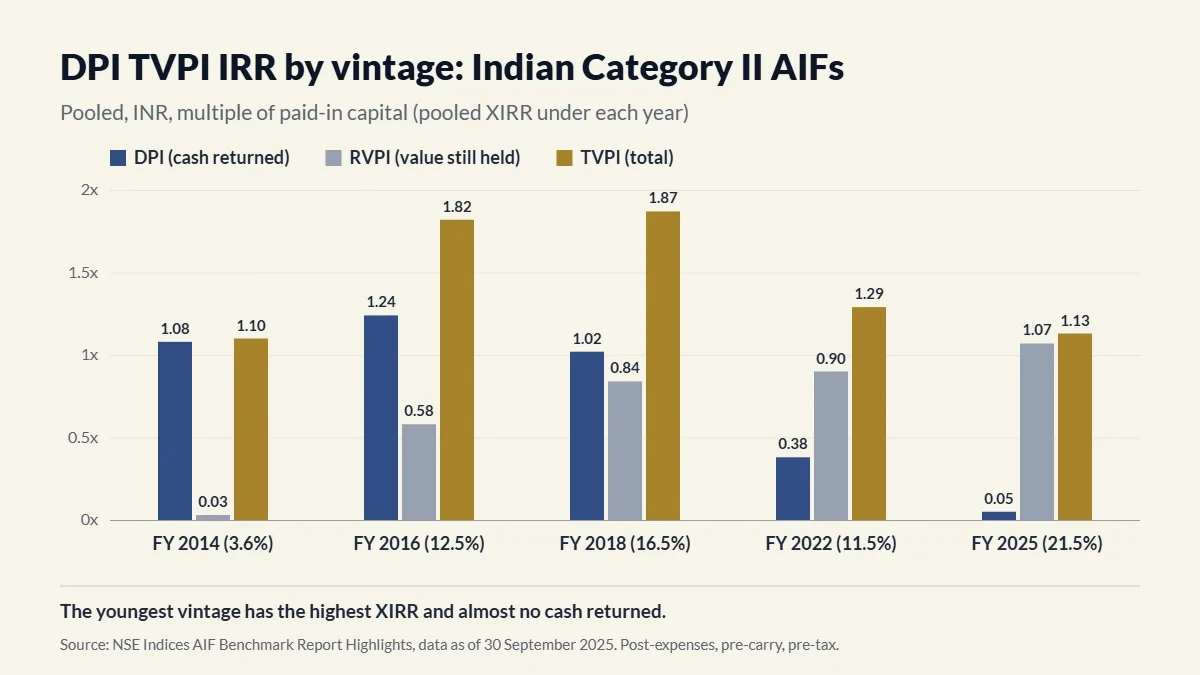
Read across the FY 2025 row and the three numbers tell different stories. Its XIRR of 21.47% is the highest in the table and its TVPI of 1.13 the lowest. The DPI of 0.05 says almost nothing has come back. The FY 2018 row shows a lower XIRR of 16.46%, but every rupee paid in has returned in cash, with 0.84 more still held.
The FY 2014 row shows the end of the cycle: DPI of 1.08 and almost nothing left to sell, at a modest 3.60%.
DPI, TVPI or IRR: which matters at each stage of a fund
| Fund age | What to read first | Why |
|---|---|---|
| Years 1 to 3 | Paid-in, fees and the investments made | DPI is near zero; IRR rests on early valuations |
| Years 4 to 7 | DPI, then TVPI | Exits start; DPI shows whether valuations turn into cash |
| Year 8 onwards | DPI and final IRR | Most value should be realised; RVPI should be small |
Information as of 10 October 2026. Kalviro’s reading of how the metrics behave over a close-ended fund’s life.
Compare a fund only with funds of the same vintage and category. The benchmark tables exist for that reason: a FY 2024 fund with a TVPI of 1.16 is in line with its peer group, while the same TVPI for a FY 2016 fund would sit well below.
A worked example on ₹1 crore
An investor commits ₹1 crore and pays ₹30 lakh in each of the first three years, ₹90 lakh in all. By year 7 the total value reaches ₹1.26 crore in both cases below, a TVPI of 1.40.
| Fund A | Fund B | |
|---|---|---|
| Paid in (years 0 to 2) | ₹90 lakh | ₹90 lakh |
| Cash returned | ₹45 lakh in year 5 | None by year 7 |
| Value still held in year 7 | ₹81 lakh | ₹1.26 crore |
| DPI in year 7 | 0.50 | 0.00 |
| TVPI in year 7 | 1.40 | 1.40 |
| IRR | About 6.6% | About 5.7% |
Illustrative Kalviro calculation on annual cash flows, as of 10 October 2026. Not based on any specific fund; before tax.
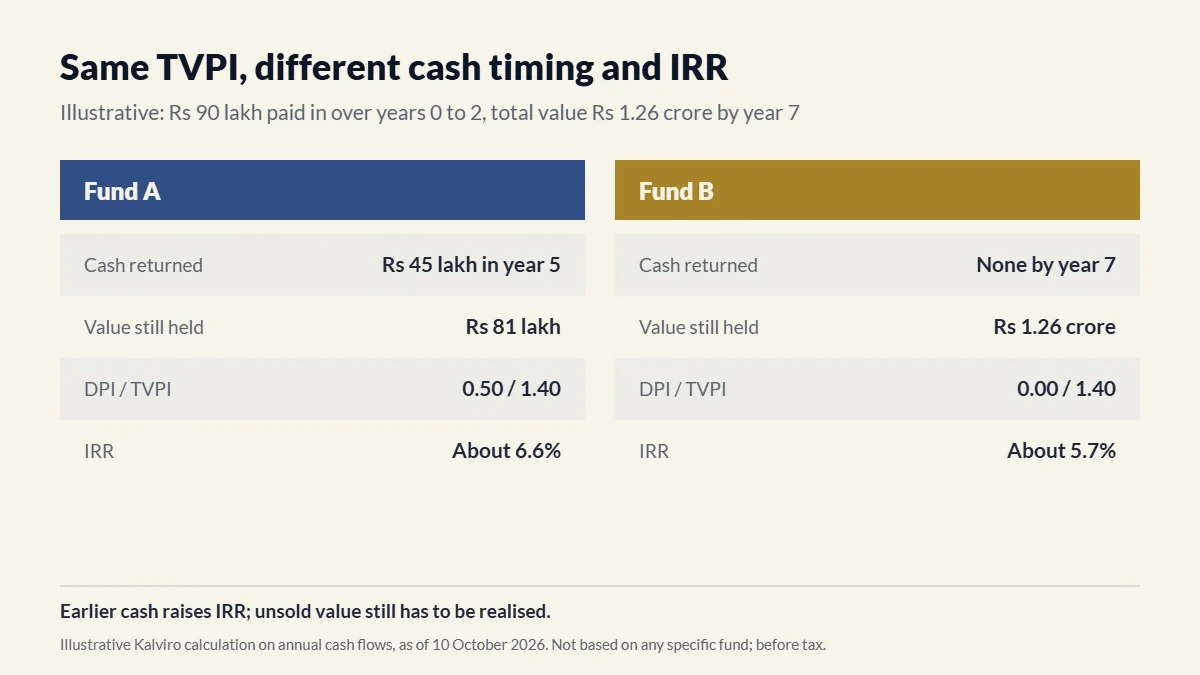
The same TVPI hides a real difference. Fund A has returned half the money and shows a higher IRR because the cash came back earlier. Fund B’s whole result still depends on selling its holdings at the stated value.
INR or USD: why NRIs may see lower multiples
The benchmark also reports each vintage in US dollars. For FY 2018 Category II funds, TVPI is 1.87 in rupees and 1.60 in dollars, and XIRR is 16.46% against 12.25%. The difference is the rupee’s fall against the dollar over the period.
An NRI who measures wealth in dollars should read the USD columns. The INR figures overstate the result in home-currency terms when the rupee weakens.
What investors ask about DPI, TVPI and IRR
What is DPI in an AIF? It divides the cash the fund has distributed by the capital you put in. A DPI of 1.0 means you have received your money back in cash.
What is a good TVPI? The benchmark gives the comparison. For Indian Category II funds, pooled TVPI at September 2025 ran from 1.13 for FY 2025 funds to 1.87 for FY 2018 funds. Read any fund against its own vintage.
Is DPI more important than IRR? In a young fund, IRR depends on valuations, while DPI is cash. As a fund matures, both matter, and a high IRR with a low DPI late in a fund’s life deserves questions.
Do the benchmark figures match what investors earned? Not exactly. They are post-expenses but before carried interest and tax, so an investor’s net multiple is lower.
Can this guide judge a specific fund’s numbers? No. It explains how to read them. The fund’s vintage, strategy and valuation policy, set out in the PPM, decide whether its figures are in line with peers.
Cash returned is the one part of an AIF’s record that no later valuation can change, so read DPI first and the other two in its light. Kalviro’s alternative investment funds in India page lists funds on offer, and the guide to private equity through Category II AIFs covers the strategies behind these numbers. Accredited investors can find lower minimums explained in the accredited investor guide.
