

GIFT City Mutual Funds vs AIFs for NRIs
GIFT City mutual funds vs AIFs is a choice between two kinds of fund set up in India’s International Financial Services Centre (IFSC) and regulated by IFSCA. Both usually take US dollars. A retail scheme, the GIFT City equivalent of a mutual fund, can start at USD 500. A restricted scheme, the equivalent of an AIF, needs at least USD 150,000.
For years GIFT City was mainly a high-ticket market. Retail schemes have widened it. In September 2025, for example, Tata Asset Management launched an India equity fund in GIFT City for NRIs and foreign investors with a USD 500 minimum.
So the question for an NRI is what the extra USD 149,500 buys. This guide compares the two on rules, minimums, liquidity and tax. It names schemes as examples, with their minimums as reported. Information is as of October 2026.
GIFT City mutual funds vs AIFs at a glance
| Point | Retail scheme (mutual fund) | Restricted scheme (AIF) |
|---|---|---|
| Regulation | IFSCA (Fund Management) Regulations, 2025 | Same regulations |
| Minimum per investor | Set by the scheme; USD 500 to USD 5,000 in recent launches | USD 150,000 |
| Number of investors | At least 20; no investor above 25% of the scheme | Up to 1,000 |
| Structure | Open- or closed-ended (closed-ended at least three years) | Open- or closed-ended |
| Typical use | Listed equity, index funds, funds of funds | Long-short, concentrated equity, private equity, credit |
| Offer document | Scheme information document | Private placement memorandum (PPM) |
| Currency | Usually US dollars | Usually US dollars |
Information as of October 2026. Sources: IFSCA fund management framework and the IFSCA (Fund Management) Regulations, 2025; scheme launch reports cited below.
Put simply, a GIFT City retail scheme works much like a mutual fund priced in dollars, with small tickets and regular redemptions. A restricted scheme is a private fund for larger investors, with fewer limits on strategy and often less liquidity. Both carry market risk, and both still move with the rupee if they hold Indian assets.
How IFSCA sorts GIFT City mutual funds and AIFs
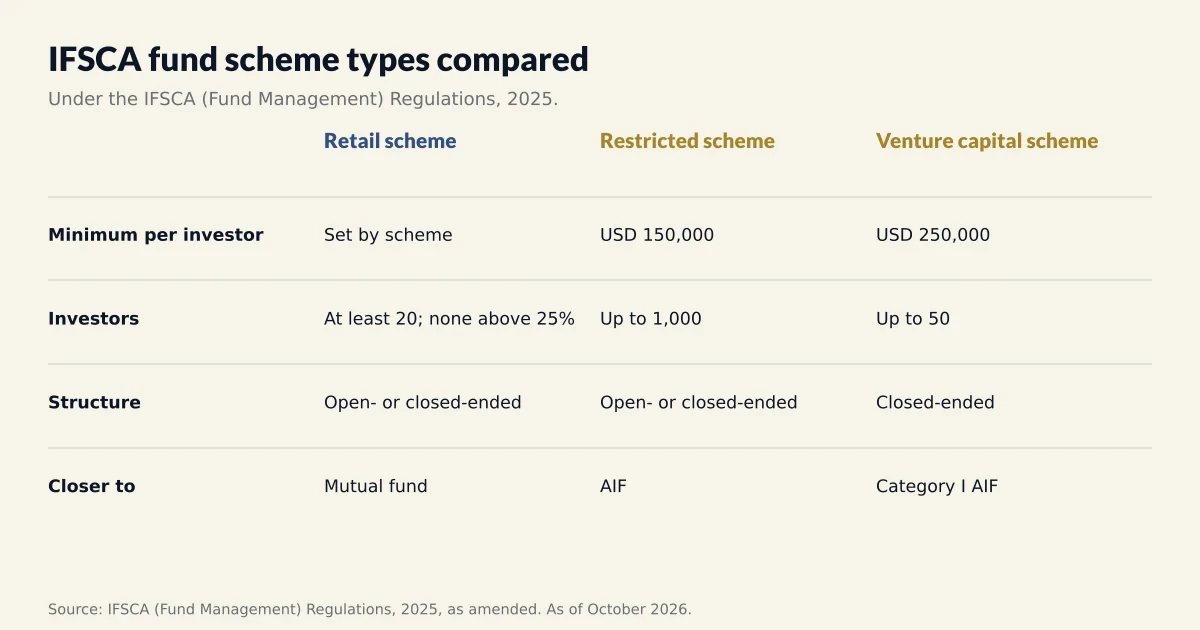
IFSCA replaced its 2022 fund rules with the IFSCA (Fund Management) Regulations, 2025, notified in February 2025. They set out three main scheme types.
Retail schemes are open to the public, including retail investors. They need at least 20 investors, and no single investor can hold more than 25% of a scheme. A closed-ended retail scheme must run for at least three years.
Restricted schemes are for accredited and larger investors. Each investor puts in at least USD 150,000. A scheme can have up to 1,000 investors and needs a corpus of at least USD 3 million. An open-ended restricted scheme can hold at most 25% in unlisted securities.
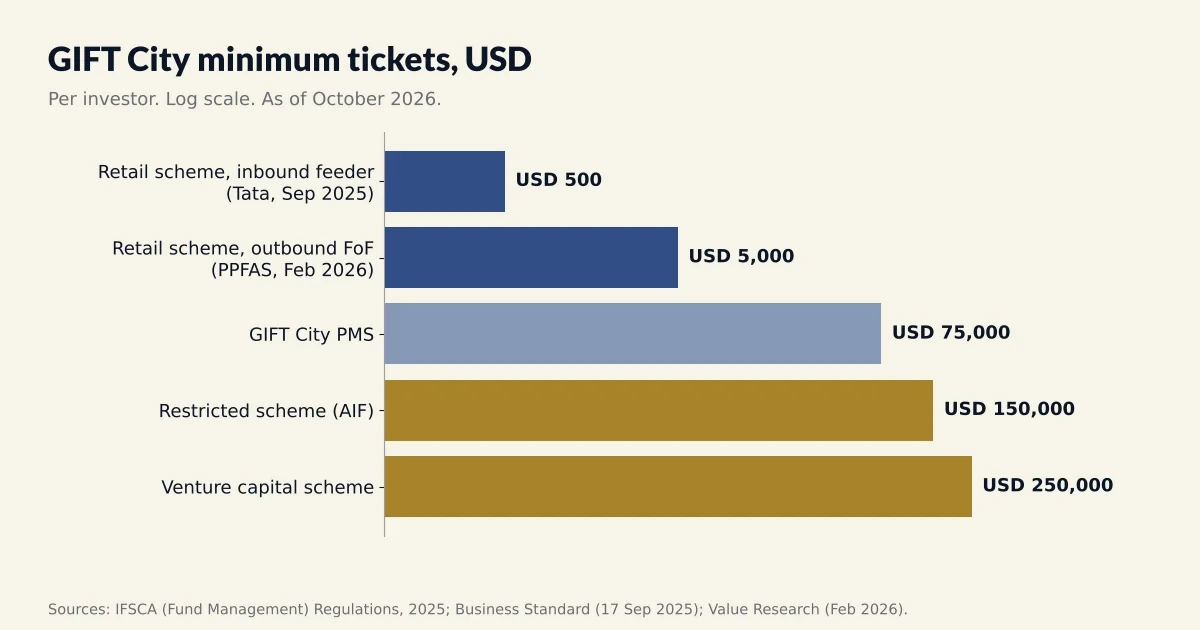
Venture capital schemes need USD 250,000 per investor, cap the number of investors at 50 and must be closed-ended. GIFT City PMS sits outside these categories, with a USD 75,000 minimum; Kalviro’s comparison of GIFT City PMS vs AIF covers it.
GIFT City mutual funds: what USD 500 to USD 5,000 buys
Three recent launches show the range.
Tata India Dynamic Equity Fund – GIFT IFSC launched on 17 September 2025 with a USD 500 minimum, according to Business Standard. It is an inbound feeder that invests in Tata’s Indian equity mutual funds and ETFs. It accepts NRIs, OCIs and foreign investors from FATF-compliant countries, not resident Indians.
PPFAS launched two outbound index funds of funds in February 2026, tracking the S&P 500 and the Nasdaq 100, with a USD 5,000 minimum. Value Research reported that the minimum keeps a resident’s first investment under the ₹10 lakh threshold for tax collected at source. These funds accept residents investing under the Liberalised Remittance Scheme as well as NRIs.
DSP’s GIFT City platform lists a global equity retail scheme with a USD 5,000 minimum, per its knowledge hub updated in August 2026.
The pattern is clear. Retail schemes mostly offer listed equity, either Indian equity for NRIs or global equity for residents and NRIs. Kalviro’s GIFT City funds list for NRIs compares current options on ticket and liquidity.
GIFT City AIFs: what the USD 150,000 minimum buys
Restricted schemes can run strategies that a retail scheme can’t, or that IFSCA limits for retail investors. Most GIFT City restricted schemes today are Category III funds, investing in listed Indian or global equity with more concentration, derivatives or long-short positions. Category I and II restricted schemes cover private equity, venture, credit and real estate.
The higher ticket buys strategy range and, in some funds, a manager’s best ideas in concentrated form. It also brings closed-ended terms or longer redemption notice in many funds, and fees that often include a performance share.
The overlap is worth checking. A restricted scheme that holds a portfolio close to India’s large-cap index adds the higher ticket and fees without adding a different exposure. The PPM and the latest portfolio disclosure show what the fund actually holds.
How GIFT City mutual funds vs AIFs are taxed
Budget 2024 extended the IFSC fund tax regime, which had applied to Category III funds, to retail schemes and ETFs from assessment year 2025-26. Under it, the fund pays a concessional 10%, plus surcharge and cess, on dividends and interest from Indian securities. Its gains on most securities other than shares of Indian companies are exempt, to the extent non-residents hold the units.
Gains on Indian company shares remain taxable inside the fund. An inbound fund that holds Indian equities therefore pays Indian capital gains tax on what it sells, whether it is a retail or a restricted scheme. Non-resident investors are generally exempt in India on what they receive from the fund and on selling their units.
Category I and II restricted schemes broadly follow pass-through rules, closer to onshore AIFs. Home-country tax applies on top in every case: a US investor faces PFIC rules on foreign funds, and a UK investor faces UK tax on gains. Kalviro’s GIFT City tax myths page explains why “tax-free” is the wrong summary.
Liquidity: dealing days, lock-ins and redemption currency
Open-ended retail schemes accept subscriptions and redemptions on dealing days set in the scheme document, much like an onshore mutual fund. Redemptions are paid in the fund’s currency, usually dollars, to the investor’s foreign or IFSC bank account.
Restricted schemes vary more. Some are open-ended with monthly or quarterly dealing and notice periods. Others are closed-ended, with capital called in stages and returned only as investments are sold, much like a Category II AIF onshore.
The rupee still matters in both. A dollar fund that holds Indian shares converts dollars to rupees to buy them, so its dollar NAV moves with the exchange rate. Kalviro’s note on currency risk for NRIs puts numbers on that.
Overlap with onshore holdings
Many NRIs already hold India through onshore mutual funds in NRE or NRO accounts, direct shares or an onshore PMS. A GIFT City India equity fund can raise the same exposure without it showing on any single statement.
Before adding a GIFT City fund, compare its top holdings and sector mix with what you already own. If they match, the GIFT City fund changes the account and currency, not the investment.
Residents investing in outbound GIFT City funds under LRS
Resident Indians can invest in GIFT City funds that invest globally (outbound) through the Liberalised Remittance Scheme, which allows up to USD 250,000 a year. India-focused (inbound) GIFT City funds are for NRIs only. Remittances for investment above ₹10 lakh in a financial year attract tax collected at source at 20%, which the investor can claim back against their tax bill.
Residents generally use outbound schemes that invest abroad; inbound feeders such as Tata’s are for non-residents. Kalviro’s note on LRS vs NRI GIFT City investing covers the differences in routes and paperwork.
GIFT City fund questions from NRIs
Are GIFT City mutual funds the same as Indian mutual funds? No. IFSCA regulates them, they usually deal in US dollars and they follow a different tax regime. An inbound feeder may still invest in the same Indian funds.
Can I run a SIP in a GIFT City fund? Some retail schemes accept regular investments; check the scheme document. AIF commitments do not work like SIPs.
Where does GIFT City PMS fit? Between the two. A GIFT City PMS starts at USD 75,000 and holds securities in an account in your name.
Is repatriation automatic? Redemptions go back in dollars to your foreign or IFSC account, following the scheme’s dealing rules and bank processing times.
Do GIFT City AIFs earn more than mutual funds? No structure guarantees a higher return. Restricted schemes can run different strategies, with different risk, fees and liquidity.
GIFT City mutual funds vs AIFs comes down to ticket, strategy and liquidity. Retail schemes now give NRIs dollar access to Indian and global equity from USD 500, with regular redemptions. Restricted schemes ask for USD 150,000 and offer strategies that retail schemes can’t run, usually with longer commitments. Kalviro’s GIFT City funds page lists the funds available in both.
