

GIFT City Tax Myths: FME Holiday vs Investor Returns

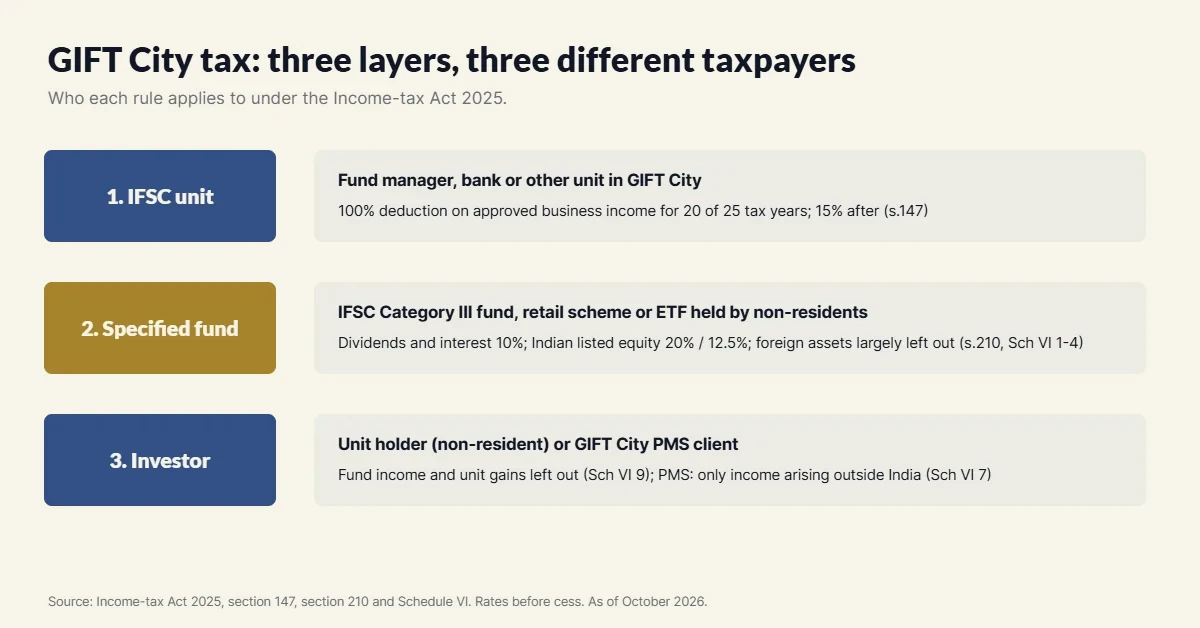
GIFT City tax works in three layers, and most myths come from mixing them up. The famous 20-year tax holiday belongs to the IFSC unit, which is the fund manager or bank running a business in GIFT City. It does not pass to the money you invest.
What reaches you depends on two other things. The first is what the fund holds and where its income arises. The second is where you live for tax. An NRI in a qualifying fund can owe nothing further in India, while a resident in a similar product follows the normal rules.
This guide sets out the three layers, six common myths, the rates that apply to a GIFT City fund and a worked example. Information is as of 10 October 2026.
GIFT City tax at a glance
| Layer | Who is taxed | What the law says | Section (2025 Act) |
|---|---|---|---|
| 1. IFSC unit | The fund manager, bank or other unit in GIFT City | 100% deduction on income from approved business, for 20 consecutive tax years out of 25 | Section 147 |
| 1a. After the holiday | The same unit | Business income taxed at 15% | Union Budget 2026 |
| 2. Specified fund | An IFSC Category III fund, retail scheme or ETF held by non-residents | Dividends and interest taxable in India at 10%; Indian listed-equity gains at 20% (short term) or 12.5% (long term) | Section 210 |
| 2a. Foreign assets | The same fund | Gains on securities other than Indian company shares, and income from foreign securities, left out of income for the non-resident share | Schedule VI, Sl. 2 and 3 |
| 3. Investor in a specified fund | The unit holder | Income from the fund and gains on its units left out of income | Schedule VI, Sl. 9 |
| 3a. GIFT City PMS client | The non-resident client | Left out only to the extent the income arises outside India | Schedule VI, Sl. 7 |
Information as of 10 October 2026. Sources: Income-tax Act 2025 as published by the Income Tax Department (section 147, Schedule VI and section 210); Union Budget speech, 1 February 2026. Rates before cess.
Six GIFT City tax myths, checked against the law
| Myth | What the law says |
|---|---|
| “GIFT City investments are tax-free.” | Relief applies to named income of named persons. A fund holding Indian shares still pays tax on those gains. |
| “The 20-year holiday covers my returns.” | Section 147 covers the IFSC unit’s own business income, such as a manager’s fees. Your gains are a separate layer. |
| “A GIFT City fund pays nothing on Indian shares.” | A specified fund pays 20% or 12.5% on Indian listed-equity gains and 10% on Indian dividends and interest. |
| “Every investor gets the same treatment.” | The fund-level relief applies to the share of income attributable to non-resident unit holders. Funds open to residents usually fall outside the specified-fund definition. |
| “GIFT City PMS is exempt like the funds.” | A non-resident PMS client is exempt only on income that arises outside India. Gains on Indian shares stay taxable. |
| “India is the only tax that matters.” | Your country of residence may tax the same gain. In the US and UK, the fund’s own tax status there can matter more than Indian tax. |
Information as of 10 October 2026. Source: Income-tax Act 2025, sections 147 and 210 and Schedule VI.
The 20-year holiday belongs to the IFSC unit
Section 147 gives a unit in an International Financial Services Centre a deduction equal to 100% of the income from its approved business activities. The unit can choose any 20 consecutive tax years out of the first 25. Before Budget 2026 the window was 10 years out of 15.
After those 20 years, the unit pays 15% on its business income from GIFT City, not the normal company rate, as announced in the Union Budget on 1 February 2026. A unit that starts operating on or after 1 April 2026 gets the deduction only if it doesn’t come from splitting up or reorganising a business that already exists in India.
For a fund manager, the approved business is mainly management fees. The holiday lowers the manager’s own tax bill. It may help keep fees competitive, but it changes nothing in the tax on your portfolio. When a presentation leads with the holiday, the question to ask is which layer it describes.
What a GIFT City fund pays on Indian and foreign assets
A Category III fund, retail scheme or ETF in GIFT City can qualify as a “specified fund”. For that share of its income attributable to non-resident unit holders, section 210 sets the rates in the table below.
| Income of a specified fund | Rate |
|---|---|
| Dividends and interest taxable in India | 10% |
| Short-term gains on Indian listed equity (section 196 type) | 20% |
| Other short-term gains | 30% |
| Long-term gains on Indian listed equity (section 198 type), above ₹1.25 lakh | 12.5% |
| Other long-term gains | 12.5% |
Information as of 10 October 2026. Source: Income-tax Act 2025, section 210. Rates before cess; applies to income attributable to non-resident units.
Schedule VI then removes several kinds of income from the fund’s taxable income altogether, again for the non-resident share. The main ones are gains on securities other than shares of Indian companies, income from securities issued by non-residents outside India, and gains on certain transfers on a GIFT City stock exchange paid in foreign currency.
So a GIFT City fund holding Indian shares pays Indian tax on its gains at fund level. A fund holding US or other foreign shares generally does not. The holdings decide the result, more than the GIFT City address. Onshore Category III funds follow different rules again, which Kalviro’s note on Category III AIFs for NRIs compares with the GIFT City route.
Which funds count as specified funds
The definition sits in Note 1(g) of Schedule VI. A specified fund is a fund located in an IFSC that holds a Category III AIF registration, or a retail scheme or ETF certificate from IFSCA. Non-residents must hold all its units, apart from those of the sponsor or manager.
There is one narrow exception. A non-resident who later becomes resident may keep the units, as long as such resident holders own no more than 5% of the units. A fund that accepts resident investors more widely does not qualify, and none of the relief in layers 2 and 3 applies to it.
GIFT City Category I and II funds work differently. They generally follow the pass-through rules in section 224 (old section 115UB), where the investor pays tax on most of the income. Kalviro’s note on Category II AIF tax explains that route.
What reaches the investor, and why residency decides it
For a unit holder of a specified fund, Schedule VI Sl. 9 leaves out any income from the fund and any gain on transferring its units. Because non-residents must hold the fund, in practice this is an NRI or foreign investor’s benefit.
A resident who invests through the Liberalised Remittance Scheme (LRS) usually uses funds or products outside this regime. The normal rules for that product decide the tax. Remittances for investment above ₹10 lakh in a financial year also attract 20% tax collected at source, which the investor can claim as a credit. Kalviro’s comparison of LRS and NRI routes to GIFT City covers the banking side.
GIFT City PMS: where the exemption stops
A portfolio management service run from GIFT City is not a fund, so the specified-fund rules do not apply. For a non-resident client, Schedule VI Sl. 7 leaves out income from the managed portfolio only to the extent it arises outside India. The client must also receive the money in an account with an offshore banking unit in GIFT City.
A GIFT City PMS that buys Indian listed shares therefore leaves the client with Indian tax on those gains and dividends. A GIFT City PMS that invests abroad can produce income that India does not tax. The minimum for a GIFT City PMS is USD 75,000, against USD 150,000 for most GIFT City AIFs. Accredited investors can invest lower amounts. Kalviro’s GIFT City PMS vs AIF guide compares the two wrappers.
A worked example: Indian shares vs US shares in a GIFT City fund
Take an NRI in Dubai who puts USD 150,000 into a specified fund. Inside the fund, the manager sells holdings bought more than a year ago for a USD 30,000 gain. The table compares a fund holding Indian listed shares with one holding US listed shares.
| Step | Fund A: Indian listed shares | Fund B: US listed shares |
|---|---|---|
| Gain inside the fund | USD 30,000 | USD 30,000 |
| Indian tax at fund level | About USD 3,750 (12.5% long-term rate) | Nil (Schedule VI Sl. 2) |
| Indian tax when the NRI redeems units | Nil (Schedule VI Sl. 9) | Nil (Schedule VI Sl. 9) |
| UAE personal income tax | None | None |
| Gain kept, before fees and currency | About USD 26,250 | About USD 30,000 |
Illustrative. Kalviro calculation under the Income-tax Act 2025, sections 210 and Schedule VI, as of 10 October 2026. Ignores cess, the ₹1.25 lakh annual exemption, fund expenses, foreign withholding on dividends and currency moves.
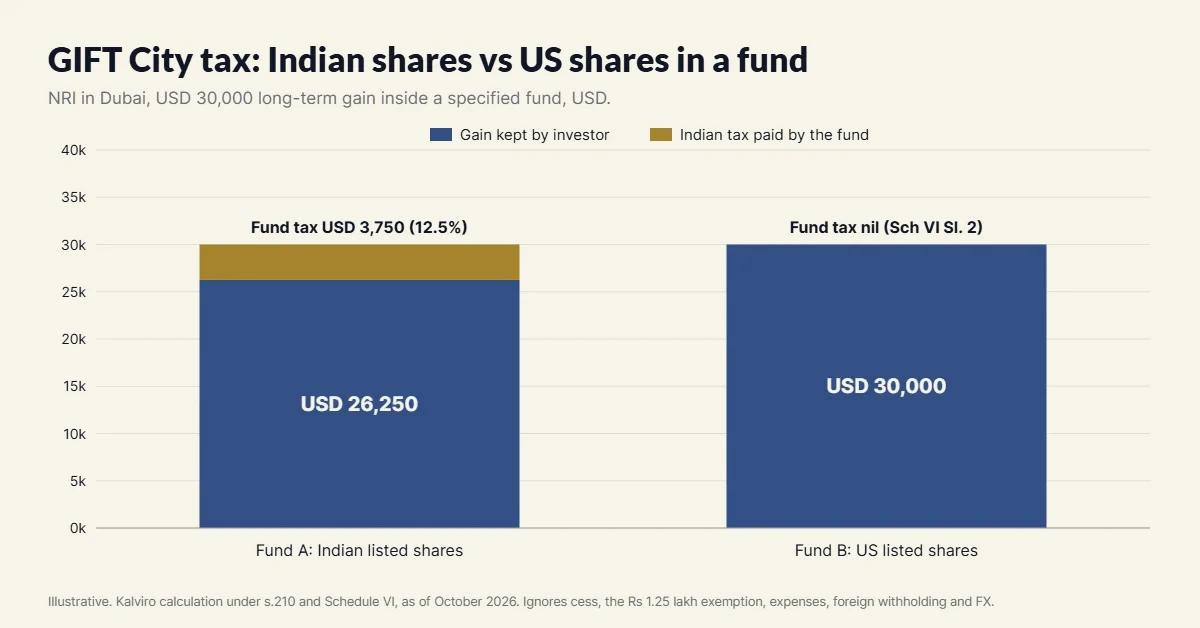
The same NRI living in the US would see identical Indian tax. The US taxes worldwide income and has its own rules for foreign funds, so ask a tax professional how it treats fund units before you invest.
GIFT City tax in your country of residence
Indian relief covers Indian tax only. The country you live in decides the rest.
| Where you live | What to check |
|---|---|
| UAE and most Gulf states | No personal income tax on these gains, so the Indian position is usually the final one |
| US | Worldwide taxation and special rules for foreign funds |
| UK | Special rules for funds based outside the UK |
| Singapore | Capital gains are generally not taxed for individuals, but the facts of each case matter |
General description only, as of 10 October 2026. Confirm with a tax professional in your country of residence.
A rupee move can also change the result in your home currency. Kalviro’s note on currency risk for NRIs puts numbers on that.
What investors ask about GIFT City tax
Is GIFT City a tax haven? No. It is a regulated financial centre with targeted relief for named income and named persons. Indian tax still applies to Indian-source income where the law says so.
Does the 20-year holiday lower my capital gains tax? No. It applies to the IFSC unit’s own business income under section 147.
Can a resident Indian get the specified-fund exemption? Generally not, because non-residents must hold a specified fund. The narrow exception covers NRIs who later become resident, up to 5% of units.
Do onshore PMS rules apply to a GIFT City PMS? No. A non-resident’s GIFT City PMS income is left out only to the extent it arises outside India. Kalviro’s PMS for NRIs guide covers the onshore route.
Why do some documents still mention section 10(4D) or 80LA? Their authors wrote them under the 1961 Act, which the Income-tax Act 2025 replaced on 1 April 2026. The rules continue under new section numbers.
Does this replace advice for my own return? No. Residency, the fund’s structure and home-country rules decide each case. A tax professional in your country of residence should confirm the position.
GIFT City tax rewards the right combination of fund, holdings and residency, and the tax holiday is the least important of the three for an investor. A non-resident in a fund holding foreign assets can pay no Indian tax at all, while the same investor in an India equity fund pays at fund level. Kalviro’s GIFT City investment options page lists the routes, and the GIFT City investment for NRIs guide covers minimums and accounts.
