

Motilal Oswal PMS Review 2026: 7 Strategies, Fees & Who It Fits
Motilal Oswal PMS is a set of SEBI-registered discretionary equity portfolios from Motilal Oswal Asset Management Company (MOAMC, INP000000670), typically from ₹50 lakh, built on a shared QGLP process across seven live strategies.
Kalviro Ventures screens Motilal the same way we screen the rest of our curated PMS list: mandate, drawdowns, overlap, and whether the fee text will survive a bad year. People also search “Motilal PMS,” “NTDOP,” “Value Migration,” or even “MOAMC PMS.” This review is the map we use with HNIs as of 31 July 2026.
QGLP still means Quality, Growth, Longevity, Price. Books stay concentrated at 25–35 stocks, with a three-year-plus horizon and BSE 500 TRI as the common benchmark. The seven strategies are not clones. Stacking three of them in one family office can quietly double the same mid-cap names.
Our view
At Kalviro we treat Motilal Oswal PMS as a house with one research language and several product doors. Value Migration and NTDOP carry the long public track records. Mid to Mega is the cleaner mid-and-small expression. Founders and India Growth are newer flexi portfolios that still share managers and, as of July 2026, a lot of overlapping ideas. Ethical is a screened universe with a third-party audit trail. Multifactor Equity is the odd one out: a rules-based portfolio, a different named manager, and a recent stretch that has lagged BSE 500 TRI.
What we like is process depth and a long listed-equity culture. What we still diligence is fee text, small-cap capacity, benchmark fit (Mid to Mega is not scored against a mid-cap index), and whether you need one Motilal strategy or two. Past returns are not a forecast. The TWRR figures we cite below are aggregate strategy-level numbers and are not verified by SEBI.
Start with mandate fit, then fees, then five-year behavior. Talk to Kalviro after you have read this, not instead of reading it.
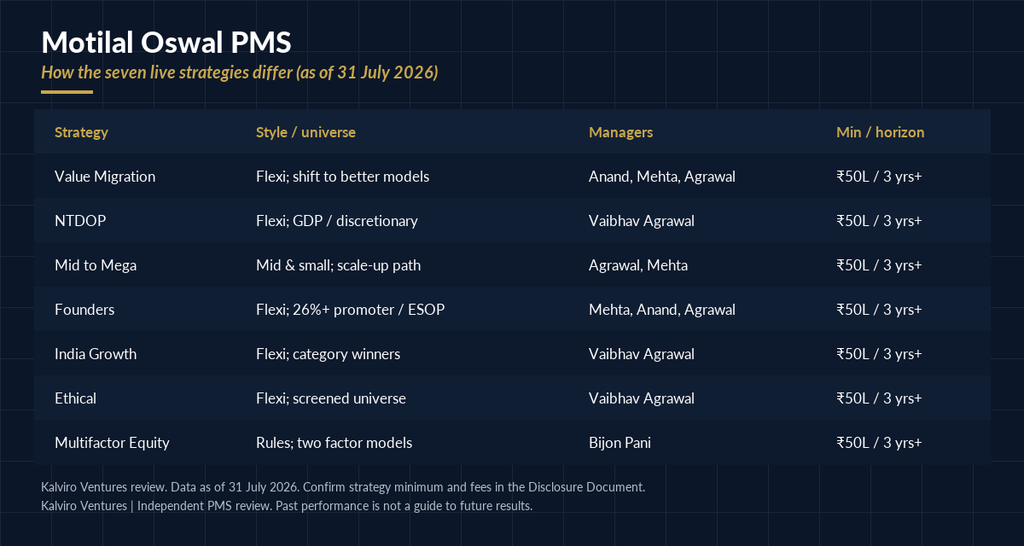
Snapshot: seven live approaches
Kalviro’s July 2026 read is consistent across all seven: 25–35 stocks, ~92–96% active ratio, 3 years+ horizon, and BSE 500 TRI. We still do not have a publishable fee grid.
| Strategy | Inception | Mandate | Managers | 1Y | 3Y | SI | Large | Mid | Small |
|---|---|---|---|---|---|---|---|---|---|
| Value Migration | Feb-03 | Flexicap | Anand · Mehta · Agrawal | −2.37% | 17.81% | 18.91% | 28.6% | 17.3% | 49.7% |
| NTDOP | Aug-07* | Flexicap | Agrawal | 4.44% | 14.48% | 14.23% | 15.4% | 34.4% | 46.0% |
| Mid to Mega | Dec-19 | Mid & Small Cap | Agrawal · Mehta | 12.19% | 23.51% | 23.13% | 12.0% | 47.5% | 39.9% |
| Founders | Mar-23 | Flexicap | Mehta · Anand · Agrawal | 3.21% | 19.65% | 25.09% | 22.4% | 36.9% | 39.4% |
| India Growth | Nov-23 | Flexicap | Agrawal | 14.98% | N.A. | 20.69% | 2.1% | 50.9% | 39.3% |
| Ethical | Jun-21 | Flexicap | Agrawal | 13.15% | 14.12% | 13.25% | 26.6% | 33.1% | 40.2% |
| Multifactor Equity | May-21 | Across Cap / Factor | Pani | 1.03% | 14.82% | 13.07% | 37.0% | 32.9% | 21.4% |
Under one year, absolute; one year and above, annualised TWRR at strategy level vs BSE 500 TRI (1Y 2.98%, 3Y 11.88% where shown), as of 31 July 2026. SI benchmarks differ because start dates differ. These figures are not verified by SEBI. Market-cap mix as of the same date; cash sits outside the three buckets and will not always sum to 100%.
Even so, one-year ranks are a weak way to pick a strategy. Value Migration had a soft 12 months after a still-respectable three-year print. On the other hand, Mid to Mega and India Growth look “hot” on one-year and six-month windows, which is exactly when we worry about capacity and overlap.
House ideology: QGLP, not seven different religions
Motilal’s equity culture is older than this PMS menu. Promoters sit as large investors across the group’s funds. As of July 2026 that figure is over ₹8,600 crore. Kalviro treats that as alignment to test, not diligence done. Related-party and conflict pages in the Disclosure Document still have to be read.
The operating system we underwrite is the same four letters:
- Quality: ROCE / ROE floors; management and capital-allocation tests.
- Growth: house themes first, with room to buy outside those themes.
- Longevity: can this growth last.
- Price: PE / PEG, plus DCF, implied return and implied growth.
India Growth is the clearest write-up of risk boxes: min/max stock weights, sector deviation limits versus the benchmark, a 35-stock cap, and a profit-taking / stop-loss framework. Ask for that page in the live pack.
“Buy Right, Sit Tight” still describes the intended behaviour: fewer names, longer holds, quality first. In contrast, the July 2026 books are not sleepy large-cap compounder lists. Several flexi strategies show small-cap weights in the high thirties to high forties. The lived experience can be closer to a mid-and-small portfolio than to a Nifty clone.
Strategy theses (what you are actually buying)
Value Migration
The oldest strategy. Capital and profits move from obsolete models to ones that fit new customer needs. Drivers include cost, innovation, technology, policy, funding access and convenience. Classic paths: IT / pharma / chemicals as offshoring; private banks versus PSU banks; ecommerce versus brick-and-mortar; renewables versus combustible energy.
As of July 2026 the book leaned Eternal, Kalyan Jewellers, One97, Bajaj Finance, Premier Energies; financials and capital goods dominated sectors; small cap ~50%. 10-year TWRR (12.32%) sat below BSE 500 TRI (13.57%), even though since-inception still leads. Kalviro’s point: long history is not the same as a decade of easy alpha.
NTDOP (Next Trillion Dollar Opportunity)
India’s GDP milestones arrive faster. Per-capita income lifts discretionary spend (housing, durables, premium wear, travel, autos) and, later, savings-linked capital goods and infrastructure. Flexi, 25–35 names. Vaibhav Agrawal is the named PM.
As of July 2026 the book was financials-heavy (35%) with jewellery, durables, NBFCs and capital-market names in the top weights. Three-year TWRR beat the index. Five- and ten-year prints lagged BSE 500 TRI. We also see two inception dates in circulation (3 August 2007 and 16 March 2023). Until APMI and the Disclosure Document agree, we will not treat the long series as settled.
Mid to Mega
Own businesses crossing from ranks ~101–300 toward the top 100, on industry tailwinds, segment leadership and value-migration benefits. This is the only strategy that labels itself mid and small cap. The benchmark remains BSE 500 TRI. That can look flattering when mid/small lead, and harsh when they do not.
Kalviro reads the process as a life-cycle grid: intro vs growth vs maturity on cash flow, promoter holding, unit economics and valuation method. July 2026 mix: ~12% large, ~48% mid, ~40% small. Three-year volatility 21.5% vs 15.1% for the index; Sharpe 0.9 vs 0.5 on the same window. We put this in front of investors who want that extra volatility, not someone who thought Motilal meant “quality large cap only.”
Founders
Founder- or professional-aligned ownership. The screen we underwrite: 26%+ promoter or meaningful ESOPs (exception for financials), PBT floor of ₹100 crore, cycle ROCE of 15%, extra 3–5 year earnings growth versus the benchmark at a valuation the team will own. Universe from about ₹5,000 crore to ₹11 lakh crore of market cap.
July 2026 turnover was real: Diamond Power Infrastructure exited; Eternal, Ather, Shriram Finance and others were added. Since-inception TWRR 25.09% vs 16.52% for BSE 500 TRI is the number everyone quotes. One-year was only a modest lead. Top weights included high-beta industrial and new-age names. Skin-in-the-game at the company level is the idea. It does not remove listed-equity drawdowns.
India Growth
Newest discretionary flexi book (Nov 2023). Category winners inside house themes (China+1, Make in India, financialisation, urbanisation, healthcare, chemicals, auto/EV). Vaibhav Agrawal is the named PM.
July 2026 market-cap mix is the most aggressive among the flexi set: ~2% large cap, ~51% mid, ~39% small, plus 7.7% cash. One-year 14.98% vs 2.98% for the index will attract tickets. A two-year-old book with almost no large-cap ballast is not a “core India” clone of a Nifty 50 fund. Two-year TWRR 7.92% vs 0.42% still leads. The sample is short. Kalviro will not size this as a core until the book has a full cycle.
Ethical
For families who need community / faith-aligned constraints. Sector screens drop tobacco, alcohol, pork, gambling, inappropriate media and similar. Accounting screens cap overall debt, limit interest-bearing activity, and restrict tools such as derivatives. A registered third party (TASIS) audits universe and allocations. Interest “purification” is a client donation of impure income, often cited as a standard 1–2% or a TASIS calculation. That is not the PMS management fee.
July 2026 holdings were capital-goods and industrial heavy (Syrma, Cummins, KEI, Apar, Global Health, CG Power). Financials are not the engine, which is the point of the screen. One-year 13.15% vs 2.98% looks strong; two-year was negative (−0.85%) versus a flat-to-soft index. The screen can help and hurt, depending on which sectors the market pays for.
Multifactor Equity
Bijon Pani (Ph.D. in factor investing, EDHEC; prior NJ AMC, IDFC AMC, Barclays, Eden Financial) runs the rules-based book. Factors: Quality, Value, Low Volatility, Momentum. Allocation: 75% Model 1 (high quality with value and momentum) + 25% Model 2 (low volatility with value and momentum). The engine is factor ranking and regular churn, not a star PM call.
As of July 2026 this book held more large-cap than the discretionary flexi strategies (~37%), with pharma and auto names in the top line (Torrent, Ajanta, TVS, NALCO, Eicher). Since inception 13.07% vs 13.93% for BSE 500 TRI lagged. Two-year −6.87% vs +0.42% is the honest recent story. We would not buy this because “Motilal equity always beats.” We would buy it only for systematic factor exposure that you can sit through in a factor winter.
Fund managers
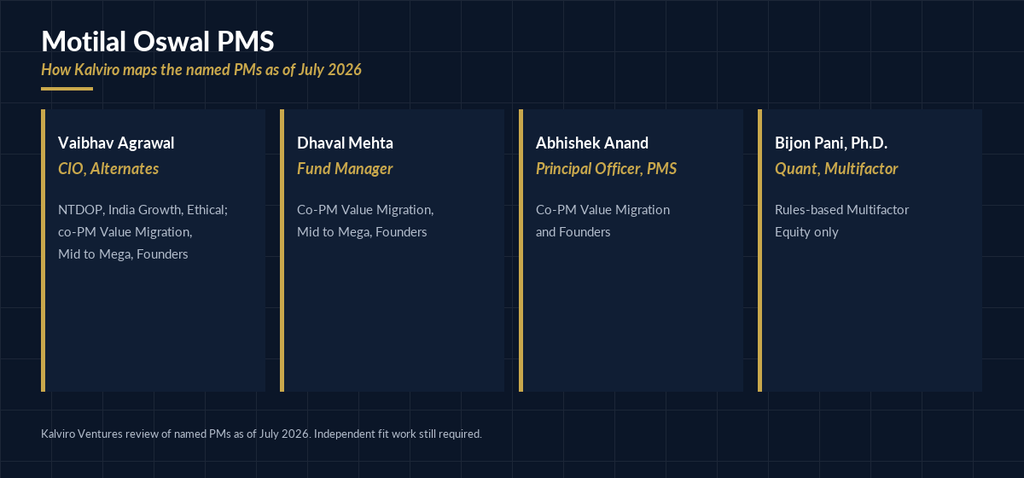
Vaibhav Agrawal — CIO, Alternates, and the common name on six of seven strategies. He currently manages about ₹10,000 crore across Motilal’s alternate products. He previously ran a proprietary PMS, and worked as a CRISIL ratings analyst and MOAMC investment analyst. Education: Computer Science (University of Pennsylvania) and MBA (London Business School). Sole named PM on NTDOP, India Growth and Ethical; co-PM on Value Migration, Mid to Mega and Founders.
Dhaval Mehta — Fund Manager. 14+ years in research and portfolio management. He previously managed about ₹3,700 crore at Aditya Birla Sun Life AMC, and has worked at ASK Investment Managers, Emkay, Ventura and Infosys. Co-PM on Value Migration, Mid to Mega and Founders.
Abhishek Anand — Principal Officer, PMS. 20+ years in financial services and equity, including a decade-plus as a portfolio manager at Centrum, plus SBI Capital and Dun & Bradstreet. Co-PM on Value Migration and Founders.
Bijon Pani, Ph.D. — Senior Fund Manager, Quant. Leads AIF/PMS quant strategies. 12+ years across India and global quant seats.
Kalviro’s key-person question is simple: too many discretionary doors share Vaibhav. A Principal Officer plus a second PM on the older / Founders books is better than a one-person boutique. Still, ask who signs off on size, cash and stops when the CIO is travelling, and how the quant book is ring-fenced from the discretionary meetings.
Minimum investment, fees, lock-in
Minimum. SEBI’s usual PMS floor is ₹50 lakh of funds or securities per client per portfolio manager. None of the seven strategies we reviewed advertises a higher house minimum. Treat ₹50 lakh as the planning number until the agreement says otherwise. Cash or, where allowed, securities can fund the account. NRIs should confirm NRE/NRO and FEMA paperwork separately; onshore PMS is not the same as Motilal’s GIFT City USD vehicles.
Horizon vs lock-in. Every strategy we cover asks for three years or longer. SEBI does not allow a portfolio manager to impose a lock-in on PMS money. Exit loads can still apply if the agreement says so, and selling a mid-cap book in a bad tape is its own cost. Read the schedule. “No lock-in” is not the same as “no friction.”
Fees. Kalviro will not invent a Motilal fee table. Until the signed schedule is in front of you, assume Indian PMS usually means a fixed management fee, a performance fee above a hurdle with a high-water mark, or a hybrid, plus brokerage, GST, custody and other expenses. Run your ticket through a PMS fee calculator using the written numbers. Then compare that drag with a simpler mutual-fund core.
Tax. Equity PMS usually means stocks in your demat, so gains are your capital-gains events (current STCG / LTCG slabs as advised by your CA). That is different from a Category III AIF. If you are still choosing the structure, use PMS vs AIF before you force a Motilal brand decision.
How the seven compare (decision table)
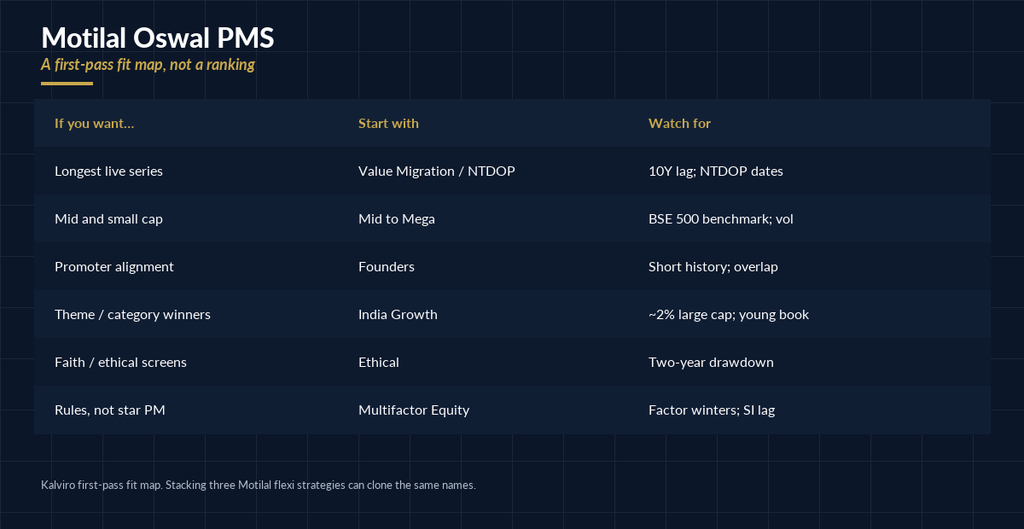
This is Kalviro’s first-pass fit map, not a ranking.
| If you care about… | Lean toward | Be careful of |
|---|---|---|
| Longest live series | Value Migration, then NTDOP (verify series) | 10Y lag vs index on Value Migration; NTDOP date conflict |
| Explicit mid/small mandate | Mid to Mega | BSE 500 benchmark; 21.5% 3Y vol |
| Promoter alignment story | Founders | Short live history; overlapping flexi names |
| Theme / “India winners” narrative | India Growth | ~2% large cap in July 2026; young track record |
| Faith / ethical screens | Ethical | Donation/purification process; two-year drawdown |
| No star-PM discretion | Multifactor Equity | Factor winters; SI lag vs BSE 500 TRI |
| One first PMS ticket | Often one of Value Migration, Mid to Mega, or Ethical — not three Motilal flexis | Clone risk across Founders / India Growth / Value Migration |
Who it may suit
Kalviro would discuss these strategies with:
- HNIs and family offices that already believe in concentrated, quality-growth Indian equity and can fund ₹50 lakh without raiding emergency cash.
- Investors who want stocks in their own demat, with 25–35 names rather than a 70-stock mutual fund.
- People who will not panic at mid- and small-cap drawdowns, because that is where several of these books actually sit.
- Ethical/Shariah-constrained families who need a professionally run listed-equity portfolio with an audit trail.
- Quant-curious investors who accept that Multifactor can trail a plain BSE 500 TRI fund for years.
We would push back if you need monthly income, if you thought Motilal meant low-volatility large caps only, or if you already own a similar mid-cap PMS and would only be adding clone risk.
Diligence checklist
Use this with Kalviro’s PMS selection criteria rather than as a shortcut.
- Which legal investment approach is on the account opening form — exact APMI name, not the marketing title.
- NTDOP start date in APMI versus the 2007 series versus the 2023 date.
- Fee election in rupees: flat year, +20% year, recovery year; hurdle; high-water; crystallisation; GST.
- Exit load and how long it lasts; how securities are sold or transferred.
- Benchmark honesty: Mid to Mega vs BSE 500 TRI; ask for a mid-cap index comparison as well.
- Overlap report: if you want two Motilal strategies, demand a name-level overlap vs your existing portfolio (jewellery, NBFCs, capital goods and new-age names repeated in July 2026).
- Cash and single-stock caps as written, plus the stop-loss / profit-take rules.
- Capacity: who closes or soft-closes Mid to Mega / India Growth if small-cap liquidity thins.
- Team: what happens if the CIO-Alternates mandate load rises further.
Related fund reviews
Frequently asked questions
Plan for ₹50 lakh, the usual SEBI PMS floor, unless the live agreement asks for more.
Seven that Kalviro currently maps: Value Migration, NTDOP, Mid to Mega, Founders, India Growth, Ethical, Multifactor Equity. There is no single “best” one. Match the job (long-history flexi, mid/small, ethical screen, or quant) using the decision table above.
Vaibhav Agrawal is on six discretionary strategies; Dhaval Mehta and Abhishek Anand co-manage the older / Founders portfolios; Bijon Pani runs Multifactor Equity.
Kalviro will not quote a fee until it is on the signed schedule. SEBI does not allow a PMS lock-in; exit fees and market liquidity still matter. Plan for three years or more.
You can, but you should map factor and sector overlap. GIFT City Founders is a different legal structure and ticket (USD), not a clone of the onshore Founders PMS.
Common mistakes
The first is buying the brand, then picking the one-year winner. India Growth and Mid to Mega can look inevitable after a strong tape; Value Migration can look “broken” after one weak year despite a 20-year series.
The second is owning three Motilal flexi PMS books that share managers and July 2026 names (jewellery, Paytm, Suzlon-type renewables, NBFCs). You paid three fee stacks for one idea.
The third is skipping the Ethical purification and screen rules, then being surprised when banks or high-leverage names never appear.
The fourth is treating Multifactor as “the safe Motilal.” Rules reduce ego. They do not reduce market or factor risk.
Bottom line
Motilal Oswal PMS is a serious onshore equity platform: QGLP as the shared language, a CIO-Alternates team with real resumes, and seven doors that range from a 2003 value-migration book to a 2021 factor engine. Kalviro’s July 2026 work is clear on the uncomfortable bits. Mid- and small-cap weights are high in several “flexi” strategies. Fees still belong in the signed schedule. NTDOP’s dates need a clean answer. Overlap across Founders, India Growth and Value Migration is a portfolio construction issue, not a branding issue.
If you have ₹50 lakh, a three-to-five-year clock, and you want one Motilal strategy rather than a pile of them, shortlist against your job for the money: long-history flexi, explicit mid/small, ethical screen, or quant. Use the decision table above, then the live Disclosure Document and APMI print for the exact approach name.
