

Carnelian Private Growth & Innovation Fund: Strategy, Fees, Risks & Who It Suits

The Carnelian Private Growth & Innovation Fund is a Category II AIF from Carnelian Asset Management & Advisors. In short, the fund puts capital to work across growth equity, late-stage pre-IPO rounds, and PIPE deals in listed companies. Carnelian calls this a Growth-to-PIPE approach, and it aims to return capital earlier than a typical single-stage private equity fund.
This review covers the strategy, team, fees, and key risks. It is for information only, so it is not investment advice or an offer to invest. Therefore, treat the Private Placement Memorandum (PPM) as the final source of terms.
SEBI AIF registration cited in the fund materials: IN/AIF2/26-27/2272. Target corpus is INR 2,000 crore, including an INR 800 crore green-shoe. Tenure is 6 years 9 months from first close, and managers may extend it by up to 2 years.
Our view
Think of this as mid-market private equity with a listed PIPE allocation, not a PMS or mutual fund. The stage mix is the main point of difference. Before you commit, check three things carefully: team depth beyond the two named partners, how much of the disclosed PE track record is still unrealized, and whether you can leave this capital locked for close to a decade. For broader Category II context, see Category II AIFs in India 2026.
Fund snapshot
| Particular | Details |
|---|---|
| Fund name | Carnelian Private Growth & Innovation Fund |
| Category | Category II AIF |
| Investment manager | Carnelian Asset Management & Advisors Pvt. Ltd. |
| SEBI AIF Reg. No. | IN/AIF2/26-27/2272 |
| Target fund size | INR 2,000 crore (incl. INR 800 crore green-shoe) |
| Strategy | Growth-to-PIPE (growth, late-stage / pre-IPO, PIPE) |
| Portfolio | 15–20 companies; indicative deal size INR 100–250 crore |
| Tenure | 6 years 9 months from first close (+ up to 2 years) |
| Commitment period | 36 months from first close (+ 1 year extension) |
| Drawdown | 10% upfront; further calls as deals are approved (indicative 12–18 months) |
| Sponsor & team commitment | INR 100 crore+ |
| Hurdle | 12% p.a. (pre-tax); no catch-up |
| Minimum (fee band start) | From INR 1 crore (confirm in PPM) |
Carnelian started in 2019. As of 30 June 2026, materials show roughly INR 20,000 crore AUM, 9,000+ client accounts, and a 25% three-year TWRR net of fees across portfolios they manage. That is platform-level listed performance context. However, it is not a return forecast for this PE fund. For Carnelian’s listed equity strategies, see our Carnelian PMS review.
What the Carnelian Growth Innovation Fund does
Carnelian says it wants to back entrepreneurs who build high-growth businesses and need more than a cheque — including governance help, board guidance, and IPO readiness.
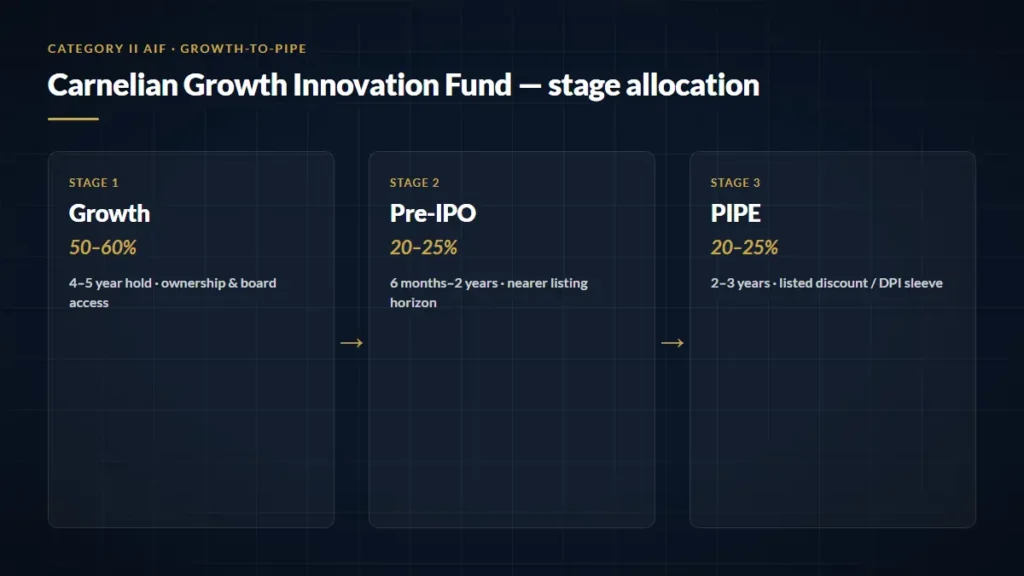
The fund allocates capital across three stages:
Carnelian Growth Innovation Fund Growth to PIPE stage allocation
| Stage | Focus | Indicative allocation | Typical holding period |
|---|---|---|---|
| Growth | Earnings growth, ownership, board access | 50–60% | 4–5 years |
| Late stage (pre-IPO) | Growth with a nearer listing horizon | 20–25% | 6 months–2 years |
| PIPE (listed) | Discounted entry into listed stocks during market stress | 20–25% | 2–3 years |
PIPE is the distinctive allocation. Because listed holdings can usually exit faster than unlisted ones, Carnelian positions PIPE as a way to generate DPI earlier. As a result, the stated goal is to begin returning invested capital from year 5. Meanwhile, many single-stage growth funds return capital later, often in years 7–10. Whether year-5 distributions arrive still depends on IPO markets and on finding genuine PIPE discounts.
Why the multi-stage structure matters
Most Indian PE funds buy growth companies and then wait for IPO or strategic sale. Liquidity arrives late, and it often arrives in a bunch.
Carnelian is trying to stagger exits instead. Growth holdings stay longer, pre-IPO names may list sooner, and PIPE names can exit in the public market if entry pricing works. That can improve the liquidity profile. Even so, it does not remove private-market risk. If IPO windows close, or if PIPE entries are not truly discounted, the earlier-return story gets harder.
Who runs this private growth fund
Vikas Khemani, Founder & CIO
CA, CFA, CS, with about 28 years of experience. He previously led Edelweiss Securities as CEO. Carnelian credits him with identifying themes early, including manufacturing and IT in 2020, PSU banks in 2022, and CDMOs in 2023.
Umesh Agrawal, Managing Partner, Private Equity
Also about 28 years across growth PE, pre-IPO investing, investment banking, and fund management. At 360 ONE Asset he managed multiple funds across around 30 portfolio companies. In addition, he has advised on and executed 90+ investment banking transactions.
Fund materials say two additional senior partners are expected to join shortly. Therefore, confirm whether those hires are done before you treat key-person risk as settled. Sponsor and team commitment of INR 100 crore+ is a useful alignment signal. Still, it does not replace independent diligence on deals and process.
Investment process: CLEAR and MAGIC
Carnelian uses two internal frameworks.
CLEAR is the forensic diligence checklist: cash flow, liability, earnings quality, asset quality, and related-party / governance analysis. The point is to reduce permanent capital loss from accounting or governance failures before the team commits capital.
MAGIC looks for what Carnelian calls a “magic moment”: earnings about to accelerate because of a concrete driver such as product scale-up, capex completion, or a macro tailwind, while valuation has not fully caught up. Materials describe a working split of roughly 20–25% from operating growth and 5–10% from re-rating. However, these are process targets, not promised returns.
What they say they will avoid:
- Competitive auctions where price discipline is weak
- Pre-revenue or loss-making businesses
- Promoters with governance concerns
- Crowded sectors with excess paper supply
- Passive capital with no value-creation plan
They also talk about helping portfolio companies with listing narrative, KPIs, investor relations, talent, and board design. For example, ask for concrete cases when you diligence the manager.
Ticket-size positioning for this innovation fund
| Ticket size | Typical investor | Competition | Entry dynamic |
|---|---|---|---|
| Below INR 100 crore | Family offices and syndicates | Many small cheques | Valuations vary widely |
| INR 100–500 crore | Mid-sized PE (Carnelian’s stated focus; co-invest available) | About 10–12 active funds | Negotiated |
| Above INR 1,000 crore | Large domestic and global PE | 25+ large funds | Auctions / control deals |
Carnelian argues that the INR 100–500 crore band offers institutional diligence with less auction pressure than mega-deals. Nevertheless, check independently how crowded that segment is at the time you invest.
The 2-pager cites PrivateCircle for market context: over INR 7 lakh crore into about 3,000 PE/VC-backed companies, 225+ DRHP filings, and 1,900+ unlisted companies growing 25%+ with positive EBITDA. That backdrop helps, but it does not replace fund-level diligence.
Portfolio and sectors
The fund plans 15–20 companies, with indicative deal sizes of INR 100–250 crore. Co-investment is available to select investor classes.
Sector focus in the materials: manufacturing (precision engineering, defence, aerospace), pharma and healthcare (CDMOs, APIs, domestic pharma), consumption, and technology (AI beneficiaries, energy transition, recycling). The fund can also invest opportunistically outside these themes, including in financials.
A 15–20 company portfolio is concentrated by design. That can support board-level engagement. At the same time, a few weak holdings can affect overall results.
Track record so far
As of 30 June 2026, Carnelian’s platform materials show about INR 20,000 crore AUM and a 25% three-year TWRR net of fees. Past performance does not indicate future results, and this is not the PE fund’s return.
On private deals, the presentation discloses seven transactions from June 2023 to October 2025 across growth, late-stage, and PIPE. Reported IRRs range from about 24% to 87%, and MOICs from about 1.6x to 5.0x. Aeroflex Industries exited in 2026. Several other names are listed or still marked to current valuations.
Keep the context clear:
- Seven deals are a disclosed sample, not a completed fund cycle
- Most positions are unrealized or only partly realized
- Live IRRs can change materially at final exit
- Ask for the full transaction history and valuation method, not only highlighted examples
Fees and terms
Investors comparing Category II PE vehicles often start with the fee table in the Carnelian Growth Innovation Fund materials:
| Investor class | Capital commitment | Fixed management fee | Hurdle | Performance share (above hurdle) |
|---|---|---|---|---|
| A1 | INR 1–4.99 crore | 2.00% p.a. | 12.00% p.a. (pre-tax) | 20.00% |
| A2 | INR 5–14.99 crore | 1.75% p.a. | 12.00% p.a. (pre-tax) | 17.50% |
| A3 | Above INR 15 crore | 1.50% p.a. | 12.00% p.a. (pre-tax) | 15.00% |
The manager charges management fees on aggregate capital commitment, plus taxes and levies, not only on drawn capital. As a result, early deployment years can cost more than the headline fee suggests.
There is no catch-up provision, which is generally better for investors than catch-up waterfalls.
The investment manager may reinvest proceeds at its discretion. Therefore, clarify distribution versus reinvestment policy in the PPM.
Drawdowns start with 10% upfront, followed by deal-linked calls over an indicative 12–18 months. The commitment period is 36 months from first close, and the manager may extend it by one year. If you miss a capital call, penal interest and default penalties can apply.
Key risks of this private growth fund
- Team depth: two senior leads today, with two partners still described as joining shortly
- Track record maturity: PE marks from mid-2023 onward; most still unrealized
- Illiquidity: Category II tenure of 6 years 9 months, plus up to 2 years extension
- Concentration: 15–20 holdings can amplify the impact of weak deals
- Exit cycle: pre-IPO and PIPE outcomes depend on market conditions outside the manager’s control
- Fee drag: fee-on-commitment can reduce net outcomes versus gross expectations
Versus a single-stage PE fund
| Parameter | Typical single-stage growth PE | This fund |
|---|---|---|
| Stages | Usually growth only | Growth, late-stage, PIPE |
| Liquidity timing | Often years 7–10 | Aim to start returning capital from year 5 |
| Listed exposure | Usually none | Yes, via PIPE |
| Holding periods | Tend to mature together | Staggered by design |
| Practical fit | One long lock-up cycle | Illiquid, with an earlier DPI objective |
Who it may suit
This may suit investors who can commit from INR 1 crore, fund drawdowns on schedule, already hold liquid assets in mutual funds or PMS, and want Category II mid-market PE with a PIPE allocation. It also requires willingness to review team hiring, full deal history, and PPM economics in detail. If you are still choosing structure, start with PMS vs AIF.
On the other hand, it is less suitable if you may need the money soon, want assured returns, or feel uneasy when most of a track record is still marked rather than exited.
Diligence checklist before you commit
- Confirm SEBI registration IN/AIF2/26-27/2272 and that the PPM matches the presentation
- Ask whether the two additional senior partners have joined, and what their roles are
- Request the full PE deal list, valuation policy, and realized versus unrealized split
- Model fees on committed capital through the deployment period
- Clarify distribution versus reinvestment and how LPs are updated
- Check cash needs across full tenure and possible extension
- Compare with other Category II PE / pre-IPO options at a similar ticket size
- Read the PPM in full before committing
FAQs
Fee bands start at INR 1 crore, in line with the usual SEBI Category II minimum. Confirm the exact class and ticket in the PPM.
Materials cite IN/AIF2/26-27/2272 for Carnelian Asset Management & Advisors Pvt. Ltd. Verify on SEBI’s registered AIF list and in the PPM before investing.
PIPE means Private Investment in Public Equity: buying listed shares, often at a negotiated discount during market stress. Carnelian includes a PIPE allocation to support earlier DPI than a fully unlisted book.
Mutual funds and most PMS strategies invest mainly in listed securities and are far more liquid. In contrast, this is a close-ended Category II AIF with substantial private exposure and multi-year lock-in.
As of 30 June 2026, seven disclosed deals show reported IRRs of about 24%–87% and MOICs of about 1.6x–5.0x. Most of these are unrealized or partly realized. They are not fund-level returns and not a forecast.
Penal interest and default penalties can apply. Therefore, plan for the 10% upfront commitment and later deal-linked drawdowns before you sign.
Common mistakes with PE-style AIFs
- Judging the fund on headline IRR without checking what has been realized
- Underestimating lock-up of 6 years 9 months plus possible 2-year extension
- Treating sponsor commitment as a substitute for deal and team diligence
- Ignoring fee-on-commitment during the early deployment years
Bottom line
The Carnelian Growth Innovation Fund offers a clear Category II structure: growth, pre-IPO, and PIPE in one vehicle, with the stated aim of earlier capital return. The fee slabs, 12% hurdle, and no catch-up are worth comparing with peers, and the early deal sample is useful context.
However, the PE vertical is still young, the partner bench is still being built out, and most disclosed private marks remain unrealized. If the strategy fits your allocation, the next step is the PPM, direct questions on hiring and realizations, and a realistic check on whether this capital can stay invested for years.
