

Neo Infra Income Opportunities Fund II: Strategy, Fees and the Fund I Record
The Neo Infra Income Fund series buys operating Indian roads and solar plants that earn contracted cash flows, mostly from central-government counterparties. Neo Alternative Asset Managers runs it as a SEBI-registered Category II AIF. Fund II, now raising, targets ₹5,000 crore and a gross return of 18–20% a year. Neo reports about ₹3,200 crore raised as of October 2026.
Fund I shows what the approach produces in practice. It raised ₹2,300 crore and is fully deployed across operating roads, solar plants and InvITs. It has also started paying regular distributions. Fund II asks investors to back the same plan at more than twice the size.
This article sets out Fund II’s terms, fees and strategy, what Fund I has built so far, and what an investor carries. It uses Neo’s Fund II presentation (October 2026, data as of 30 September 2026), Neo’s October 2026 note on Fund II’s first investment and the Fund I newsletter (June 2026).
Neo Infra Income Fund II at a glance
| Point | Detail |
|---|---|
| Fund | Neo Infra Income Opportunities Fund II (NIIOF-II) |
| Structure | SEBI-registered Category II AIF, close-ended |
| Manager | Neo Alternative Asset Managers Pvt Ltd |
| Fund lead | Abishek Goel, Head, Infrastructure and Real Assets |
| Target size | About ₹5,000 crore |
| Strategy | 80% operating roads and solar; 20% privately listed InvITs and related credit |
| Target return | 18–20% a year gross: 10–12% from distributions after deployment, 8–10% from capital gains |
| Hurdle | 10% |
| Term | 7 years from first close, extendable by 1 + 1 years: 4.5-year investment period, 2.5-year exit period |
| Drawdowns | 6 |
| Planned investments | 20 to 22 |
| Minimum | ₹1 crore (Class A1 starts at ₹1 crore) |
| Custodian / RTA | ICICI Bank / KFintech |
Information as of 30 September 2026, from Neo’s October 2026 Fund II presentation. Targets are forward-looking and not guaranteed.
In plain words, investors commit at least ₹1 crore and Neo draws it in six instalments. The fund buys road and solar assets that already earn money. The return comes partly as regular payouts and partly from selling the assets, usually to InvITs, near the end of seven years. The main risks are that buyers pay less than expected at exit and that the money stays locked until then.
What Fund I built: operating roads, solar and InvITs
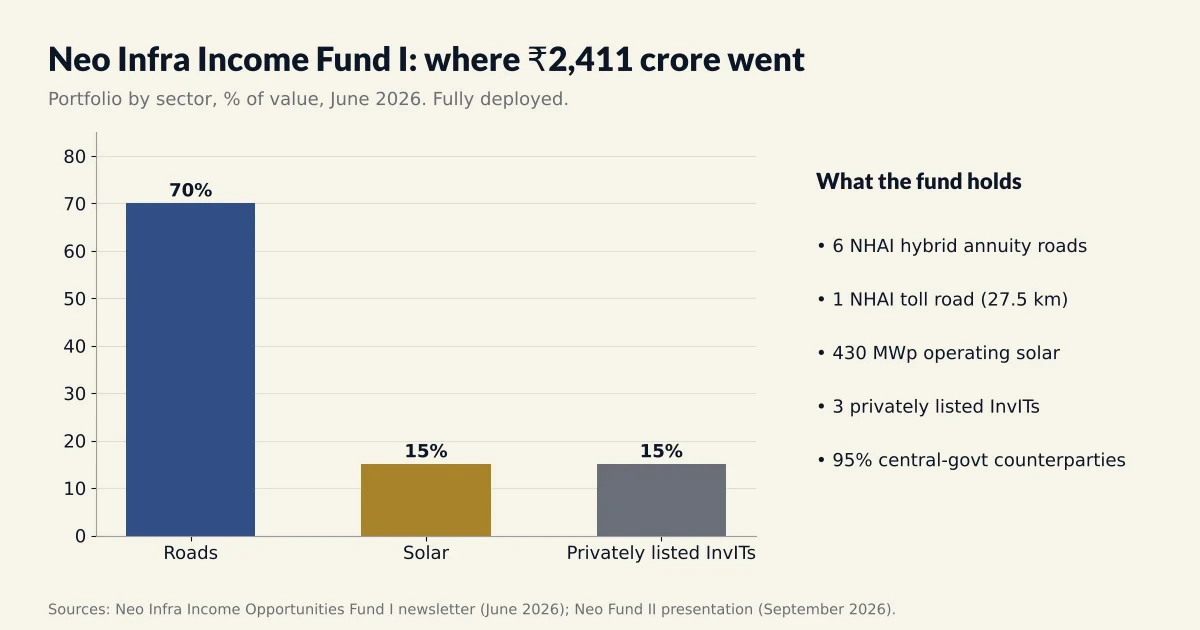
Neo’s June 2026 newsletter reports Fund I as fully deployed, with ₹2,411 crore committed against a ₹2,300 crore fund. The portfolio holds six NHAI hybrid annuity (HAM) roads, one NHAI toll road, a 430 MWp portfolio of operating solar plants and three privately listed InvITs.
By value, roads make up 70%, solar 15% and privately listed InvITs 15%. Neo’s presentation states that 95% of Fund I’s exposure is to central-government counterparties such as NHAI, and that no investment carries construction risk. Average remaining asset life is about 22 years for solar and 13–14 years for roads.
The manager reports distributions to Fund I investors of about 8.2% in FY25 and 13.4% in FY26, and 5.81% so far in FY27. It describes the fund as tracking a gross IRR of about 21%, ahead of its 18–20% target. These are the manager’s figures. Neo also reports partial sales of two InvIT holdings: ₹18 crore of its NHAI InvIT units at a 20.6% IRR, and part of its Mahindra–OTPP InvIT stake at a 17.5% IRR. The fund has not yet sold its directly held roads or solar plants, so most of the capital-gain part of the return remains unrealised.
The Neo Infra Income Fund II plan
Fund II keeps Fund I’s split. About 80% goes into operating road and solar assets that Neo buys outright, with a target gross return of about 20–21%. The other 20% goes into privately listed InvITs and, opportunistically, secured last-mile credit for NHAI HAM roads, targeting about 18–19%.
Neo sets four guardrails in the presentation. At least 80% of the fund goes into operating, long-duration assets with contracted cash flows. At least 80% stays in roads and solar. The fund will not depend on promoters to operate assets, and will not make unsecured investments in projects still under construction.
The presentation reports that Fund II has invested ₹215 crore in Altius Telecom Infrastructure Trust, a telecom tower InvIT, and has a larger pipeline under negotiation. Most of Fund II’s assets are not yet identified, so an investor commits before seeing the portfolio.
Where the Neo Infra Income Fund target comes from
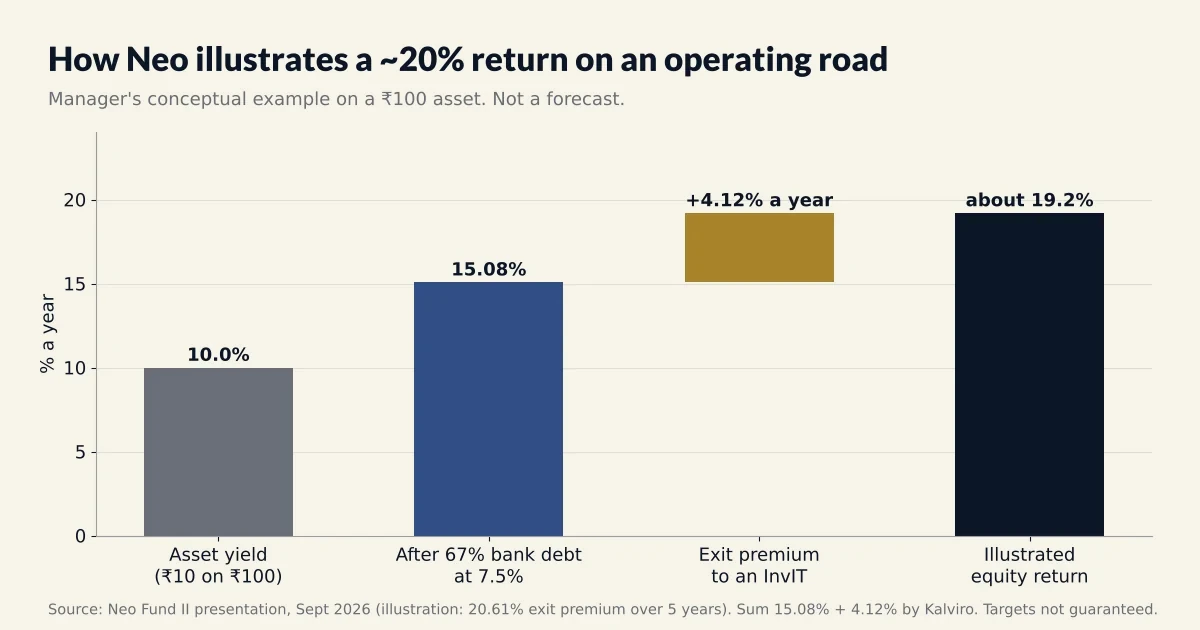
Neo illustrates how an operating road can produce a return near 20% for equity holders. The example assumes a ₹100 project earning ₹10 a year, a 10% yield on the asset. Bank debt funds 67% of the price at 7.5% interest, which costs about ₹5.03 a year.
That leaves about ₹4.98 a year for the equity holder’s ₹33, a return of about 15.08%. The rest comes from selling the asset to an InvIT at a premium. Neo’s example assumes a 20.61% premium after five years, adding about 4.12% a year.
The illustration shows what drives the result: the asset’s yield, cheap bank debt and the exit price. Each can move. Higher interest rates reduce the middle step, and a weaker InvIT market reduces the last one.
How Neo selects Neo Infra Income Fund assets
Neo describes an infrastructure platform of more than 70 people. It includes two former chief executives of large road platforms and a solar head who has built 2 GW of capacity. Its investment committee includes independent industry experts and decides unanimously. Due-diligence advisers report straight to the committee, and technical tests on assets run at two labs.
The October 2026 presentation sets out the Fund II pipeline by stage:
| Stage | Indicative size |
|---|---|
| Invested | ₹215 crore |
| Agreements signed, NHAI approval awaited | ₹600 crore |
| Advanced (exclusivity or valuation agreed) | ₹450 crore |
| Early to mid stage | ₹3,450 crore |
| Total pipeline | about ₹4,700 crore |
Information as of 30 September 2026, from Neo’s October 2026 Fund II presentation. Pipeline deals may not close.
Neo Infra Income Fund I and Fund II side by side
| Point | Fund I | Fund II |
|---|---|---|
| Size | ₹2,300 crore | About ₹5,000 crore (target) |
| Status | Fully deployed | Raising; about ₹3,200 crore raised, ₹215 crore invested |
| Portfolio | Roads 70%, solar 15%, InvITs 15% | At least 80% roads and solar; up to 20% InvITs and related credit |
| Target return | 18–20% gross | 18–20% gross |
| Term | 7 years from first close, plus a 2-year extension | 7 years from first close, extendable by 1 + 1 years |
| Distributions | About 8.2% (FY25), 13.4% (FY26), 5.81% (FY27 so far) | Not started |
Information as of June 2026 (Fund I newsletter), 30 September 2026 (Neo’s October 2026 Fund II presentation, including Fund I’s FY27 payout so far) and October 2026 (Neo’s note on Fund II’s first investment).
Neo Infra Income Fund fees by class, worked on ₹1 crore
| Class | Commitment | Management fee a year | Carry (above 10% hurdle, no catch-up) |
|---|---|---|---|
| A1 | ₹1 crore to ₹2.99 crore | 2.00% | 20.0% |
| A2 | ₹3 crore to ₹9.99 crore | 1.75% | 15.0% |
| A3 | ₹10 crore to ₹24.99 crore | 1.50% | 12.5% |
| A4 | ₹25 crore and above | 1.25% | 10.0% |
Information as of 30 September 2026, from Neo’s October 2026 Fund II presentation; other classes are set out in the PPM.
During the investment period, the management fee accrues on the money investors have paid in, starting from first close. After that, it runs on the net invested amount. Take a Class A1 investor who has paid in ₹50 lakh of a ₹1 crore commitment. At that point the management fee runs at about ₹1 lakh a year, plus GST.
The carry applies only to returns above a 10% hurdle, and without a catch-up. If the fund earns 18% overall, the manager’s share comes from the part above 10%, and the investor keeps the first 10% in full. Kalviro’s Category II AIF guide explains hurdles and catch-ups across the category.
Drawdowns, distributions and the seven-year term
Neo plans six drawdowns. Each notice gives investors 15 business days to pay, plus a 5-day grace period. Investors should keep the undrawn part of the commitment liquid; Kalviro’s note on AIF capital calls covers how to plan for it.
The fund term runs seven years from first close, extendable by one year twice: four and a half years to invest and reinvest, then two and a half to exit. Distributions start once assets are bought and earning. In Fund I, payouts rose from about 8.2% in FY25 to 13.4% in FY26 as the portfolio filled. The bulk of the capital comes back only when the fund sells its assets.
As a Category II AIF, the fund passes income through to investors under section 224 of the Income-tax Act 2025 (earlier section 115UB). Each distribution keeps its character, such as interest, dividend or capital gain. The investor pays tax on it, with tax deducted at source. Kalviro’s Category II AIF tax note explains the detail.
Risks: exit prices, interest rates and operations
Exit pricing carries the biggest uncertainty. Fund I has not yet sold its directly held roads or solar plants. The capital-gain half of the target is still a projection for both funds.
Interest rates matter twice: they set the cost of the bank debt inside each asset, and they shape what InvIT buyers will pay at exit. A toll road also carries traffic risk, which HAM roads largely avoid because NHAI pays annuities.
Operations sit with Neo. The manager runs Fund I’s assets through its own teams. By June 2026, the newsletter reports 49 operating staff plus an 8-member investment team. That gives control and also concentrates execution risk with one manager.
NRI access to the Neo Infra Income Fund through GIFT City
NRIs have two routes. The onshore fund accepts investment in rupees where its PPM allows, funded from NRE or NRO accounts. The second route runs through GIFT City, India’s international financial centre.
Neo’s March 2026 presentation for international investors sets out the GIFT City structure. Investors put US dollars into an AIF registered with IFSCA, the GIFT City regulator, run from Neo’s fund management branch there. That vehicle invests into the SEBI-registered Category II fund in India, and can also invest directly.
| Point (GIFT City route, dollar terms) | Detail |
|---|---|
| GIFT City minimum | USD 150,000 |
| Target return | About 16–18% a year gross in US dollars |
| Target after fees, carry and estimated hedging cost | 14.6–16.4% a year in US dollars |
| Hurdle | 10% in US dollars, carry without catch-up |
| Fees below US$2 million | 2.00% management fee, 20% carry |
| Fees, US$2 million to under US$10 million | 1.75%, 20% |
| Fees, US$10 million to under US$25 million | 1.50%, 15% |
| Term | 7 years from first close, extendable by 1 + 1 years (as for the rupee fund) |
| Single investment limit | 15% of the fund |
Dollar targets and fee slabs from Neo’s March 2026 presentation for international investors, which assumes the rupee falls 2% a year against the dollar; minimum and term as confirmed for the current offer. Fund size and other terms follow the October 2026 presentation. Targets are not guaranteed.
The dollar target sits below the rupee target because Neo assumes the rupee weakens about 2% a year. On its own illustration of an 18% gross dollar return, a sub-US$2 million investor nets about 14.60% a year before tax, after a 2.00% management fee, 0.25% of operating expenses and 1.15% of carry.
The GIFT City route needs at least USD 150,000, the floor the IFSCA (Fund Management) Regulations 2025 set for restricted schemes in GIFT City. On tax, Neo’s presentation notes that the Category II fund deducts tax at source and passes income through. Non-resident investors claim treaty relief with a tax residency certificate, Form 41 (earlier Form 10F) and a no-PE declaration, and can seek foreign tax credit at home. Kalviro’s comparison of GIFT City PMS vs AIF explains the wider IFSC tax position.
Related fund reviews
Questions investors ask about the Neo infra funds
Is Neo Infra Income Fund I still open? No. The June 2026 newsletter reports it fully deployed. Fund II is the one raising money.
What is the minimum for Fund II? ₹1 crore, the starting point of Class A1, subject to the SEBI rules on accredited investors.
Are the 18–20% returns guaranteed? No. Neo states them as targets that may differ materially from actual results.
How often does the fund pay out? The presentation describes coupon distributions plus capital appreciation; the PPM sets the payout schedule.
How large is Neo? Neo reports more than ₹30,500 crore of assets under management as of 30 September 2026. Kalviro also covers the Neo Prime fund.
The Neo Infra Income Fund offers income from operating roads and solar plants plus a capital gain that depends on selling them well. Fund I has deployed and started paying distributions; its exits still lie ahead. Kalviro’s alternative investment funds in India page lists the selective, curated funds available.
