

Ampersand AIF (AGOFS-1): Returns, Portfolio and What the Numbers Mean
The Ampersand AIF, formally Ampersand Growth Opportunities Fund Scheme-1 (AGOFS-1), is a Category III multi-cap equity fund managed by Ampersand Capital Investment Advisors LLP in Mumbai. Since its inception on 22 September 2017, it has compounded at 19.2% a year against 10.9% for its benchmark, the BSE 500, after fees and the tax the fund has paid.
The same record holds a flat 2022, a 10.7% fall in 2025 and a maximum drawdown of 26.6%. The portfolio keeps 45% in small caps. So the investor’s question is what kind of ride sits behind that long-run number.
This review sets out the returns, the portfolio, the tax position and the terms, using the fund’s September 2026 update. Information is as of 30 September 2026.
Ampersand AIF at a glance
| Point | Detail |
|---|---|
| Fund | Ampersand Growth Opportunities Fund Scheme-1 (AGOFS-1) |
| Structure | Category III AIF, scheme of Ampersand Capital Trust; open-ended |
| Manager | Ampersand Capital Investment Advisors LLP |
| Fund managers | Arun Subrahmanyam, Sanjaya Satapathy |
| Strategy | Multi-cap, growth-oriented listed equity; typically 30 to 35 stocks |
| Benchmark | BSE 500 |
| Inception | 22 September 2017 |
| Fund size | ₹998.8 crore |
| Unit NAV | ₹491.0 |
| Minimum | ₹1 crore; top-ups can be smaller |
| Subscriptions / redemptions | Monthly; redemptions after a 12-month lock-in |
| Fees | Fixed fee of 2.5% a year, plus GST |
| Administrator / RTA | Kotak Mahindra Bank / CAMS |
Information as of 30 September 2026. Sources: AGOFS-1 monthly fund update and Ampersand’s fund presentation, September 2026.
AGOFS-1 pools investors’ money into one portfolio of listed Indian shares picked for earnings growth. It needs ₹1 crore, locks money in for the first 12 months and then allows monthly exits. The main risk is a portfolio tilted to small companies, which can fall faster and take longer to sell in a weak market.
Ampersand AIF returns since 2017, and what “after tax” means here
| Period to 30 Sep 2026 | AGOFS-1 | BSE 500 | Nifty 50 |
|---|---|---|---|
| 1 month | -4.2% | -5.6% | -6.1% |
| 3 months | 3.7% | -3.9% | -5.2% |
| 6 months | 26.1% | 7.4% | 1.3% |
| 1 year | 10.4% | -3.2% | -8.1% |
| 2 years | -1.3% | -4.9% | -6.4% |
| 3 years | 19.8% | 8.0% | 4.8% |
| 5 years | 17.6% | 7.6% | 5.1% |
| Since inception | 19.2% | 10.9% | 9.8% |
Information as of 30 September 2026, from the AGOFS-1 monthly fund update (Morningstar Direct). Past performance as reported by the manager; fund returns stated post fees and taxes paid.
The fund led its benchmark over every period in the table, including the falls of the last month. Over three and five years the gap runs to between 10 and 12 percentage points a year.
The phrase “post fees and taxes” changes how the number compares. A Category III AIF pays tax inside the fund before an investor sees any return. A PMS or a direct share portfolio reports returns before the investor’s own tax. So a 19.2% after-tax figure from AGOFS-1 is a higher bar than a 19.2% pre-tax figure from a PMS.
Year by year: 2022, 2025 and the drawdowns
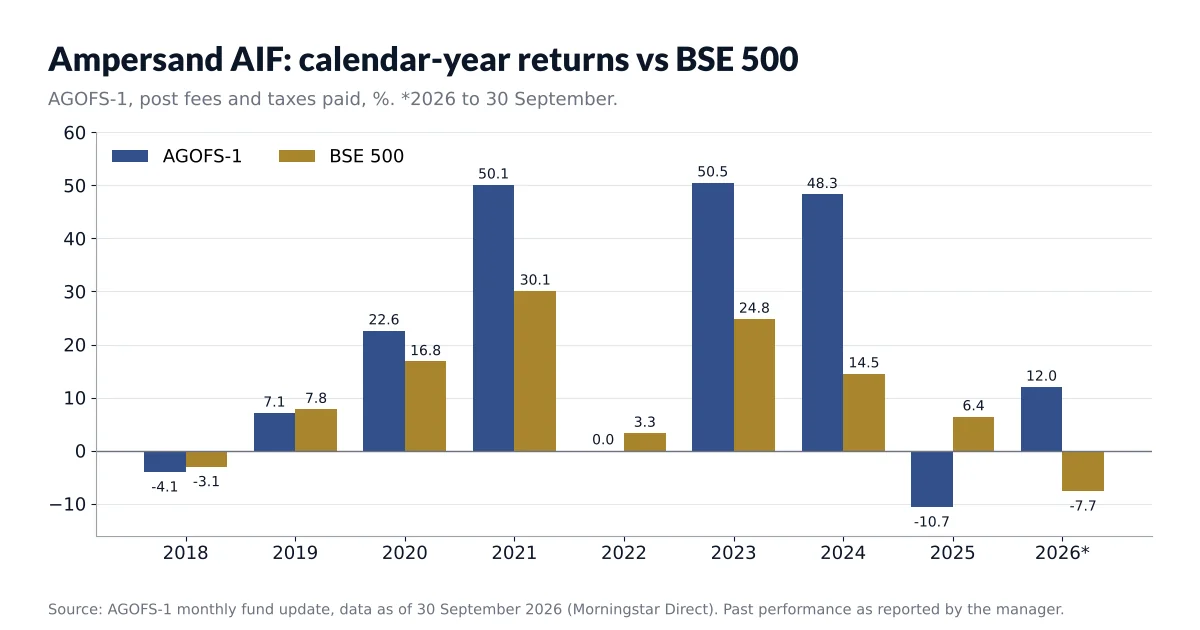
The annualised figures smooth out a lumpy path. Three years of gains near 50% did much of the work.
| Calendar year | AGOFS-1 | BSE 500 |
|---|---|---|
| 2018 | -4.1% | -3.1% |
| 2019 | 7.1% | 7.8% |
| 2020 | 22.6% | 16.8% |
| 2021 | 50.1% | 30.1% |
| 2022 | 0.0% | 3.3% |
| 2023 | 50.5% | 24.8% |
| 2024 | 48.3% | 14.5% |
| 2025 | -10.7% | 6.4% |
| 2026 to 30 Sep | 12.0% | -7.7% |
Information as of 30 September 2026, from the AGOFS-1 monthly fund update.
The fund trailed the BSE 500 in four of the nine periods, most sharply in 2025, when it lost 10.7% while the index gained 6.4%. Its worst peak-to-trough fall since inception was 26.6%. An investor who joined at the end of 2024 was roughly back to even by September 2026.
The risk ratios tell the same story in another form. Against the BSE 500 since October 2017, the fund captured 116% of the index’s rises and 83.7% of its falls, with a beta of 1.0 and annualised volatility of 19.5%. Kalviro’s guide to PMS performance metrics explains capture ratios, Sortino and drawdown.
Inside the Ampersand AIF portfolio: holdings, sectors and small caps
At 30 September 2026, the ten largest holdings made up 42.5% of the fund, and the top five 24.6%.
| Holding | Weight |
|---|---|
| Solar Industries India | 6.4% |
| Oracle Financial Services Software | 4.9% |
| Sansera Engineering | 4.4% |
| Polycab India | 4.4% |
| Bajaj Auto | 4.4% |
| Divi’s Laboratories | 4.2% |
| Lenskart Solutions | 3.6% |
| CG Power & Industrial Solutions | 3.4% |
| Glenmark Pharmaceuticals | 3.4% |
| Cummins India | 3.3% |
Information as of the 30 September 2026 portfolio date, from the AGOFS-1 monthly fund update.
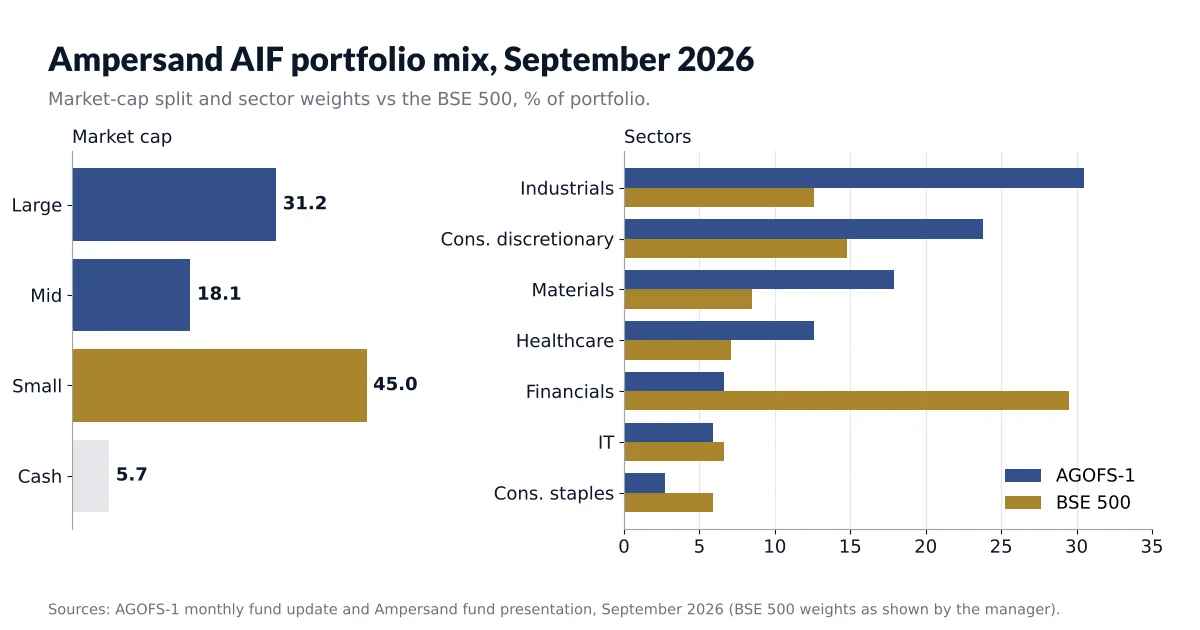
Industrials take 30.5% of the portfolio, consumer discretionary 23.8% and materials 17.9%. Financials hold only 6.6%, against 29.5% for the BSE 500 in Ampersand’s own comparison, so the fund’s path will often diverge from the index when banks lead or lag.
The market-cap split carries the larger risk. Small caps make up 45.0%, large caps 31.2%, mid caps 18.1% and cash 5.7%. Small-cap shares trade in thinner volumes, which widens falls in a sell-off and makes a large exit harder to execute.
How the Ampersand AIF team picks stocks
Arun Subrahmanyam founded the firm after three decades in financial services, the last with Bank of America Merrill Lynch’s institutional equities team. Sanjaya Satapathy, the portfolio manager, spent 2006 to 2016 as a senior analyst at the same bank. Both are partners of Ampersand Capital Investment Advisors LLP.
The stated process has three tests: the right stock, the right time and the right size. A stock must score on management quality, market attractiveness and business strategy. Timing looks at the business cycle and valuation. Position sizing balances growth against liquidity, and the team avoids micro caps.
The September update gives the portfolio’s profile. The holdings trade at 26.0 times FY27 estimated earnings, with a PEG ratio of 0.9 and a return on capital employed of 21.0% excluding financials. These rest on the manager’s estimates, not reported results.
Fund-level tax in a Category III AIF
A Category III AIF does not pass its income through to investors. The fund, set up as a trust, pays tax on its gains each year. Courts, most recently the Delhi High Court on 1 August 2025, have held that such a fund is a determinate trust where each investor’s share can be identified, which lets capital gains face the same rates as for an individual.
For tax year 2026-27, that means 20% on short-term gains from listed shares and 12.5% on long-term gains, plus surcharge and cess, paid inside the fund. Income treated as business income can face the maximum marginal rate. India generally does not tax the investor again on what the fund pays out.
The presentation calls AGOFS-1 “tax free in the hands of investors”. The accurate reading is that the fund has already paid the tax, so the investor’s return arrives net. The trade-off is that the investor cannot set personal losses or the ₹1.25 lakh long-term exemption against the fund’s gains. Kalviro’s PMS vs AIF comparison works through both structures.
Lock-in, redemptions and costs on ₹1 crore
An investor puts in at least ₹1 crore, with entry each month. A 12-month lock-in applies first. After that, redemptions run monthly.
That gives the fund more liquidity than a closed-ended Category II AIF and less than a PMS, where an investor can exit any day subject to an exit load. A ₹1 crore investment made in September 2026 can first leave in the redemption window after September 2027.
The fund charges a fixed fee of 2.5% a year. On ₹1 crore, that comes to ₹2.5 lakh a year before GST, or about ₹12.5 lakh over five years on a constant ₹1 crore. The return figures above already sit after this fee. The private placement memorandum sets out the full terms, including any charge on exit after the lock-in.
Risks to check before committing to the Ampersand AIF
Four points deserve a direct question to the manager.
Small-cap weight: at 45%, the portfolio depends on liquidity in the smallest listed companies. Ask how long the fund would take to sell a tenth of the portfolio in a falling market.
Concentration: the top ten holdings make up 42.5%, and one stock, Solar Industries, is 6.4%. A setback in a few names will show in the NAV.
Style: the fund leans towards high-growth companies at 26 times estimated earnings. In 2025 it trailed the index by 17 percentage points.
Cost: the 2.5% fixed fee applies every year, whether returns are up or down.
Related fund reviews
- ASK Real Estate Special Situations Fund IV Review
- Vivriti AIF funds
- Lighthouse Canton Growth Debt Fund II
Common questions on AGOFS
Is the Ampersand AIF open for investment? The September 2026 update lists monthly subscriptions, so the scheme is open-ended and accepts new money monthly.
Can NRIs invest in the Ampersand AIF? Indian Category III AIFs can accept NRIs where the PPM allows it, in rupees through NRE or NRO accounts. Kalviro’s note on Category III AIFs for NRIs covers the tax and repatriation points.
How does AGOFS-1 rank against other Category III funds? In NSE’s AIF benchmark report for September 2025, as shown in Ampersand’s presentation, the fund sat in the third quartile over one year (-7.66%) and in the top quartile over two years (27.57%) and three years (28.08%).
What is the NAV? ₹491.0 per unit at 30 September 2026, with a fund size of ₹998.8 crore.
The Ampersand AIF offers a nine-year after-tax record well ahead of the BSE 500, earned through a concentrated, small-cap-heavy growth portfolio that has had sharp down years. An investor takes on a ₹1 crore ticket, a 12-month lock-in and a fixed 2.5% annual fee. Kalviro’s AIF investments page lists the selective, curated funds available.
