

AI in Wealth Management: 7 Game-Changing Trends for 2025

Introduction
Wealth management in 2025 is no longer business as usual. Artificial intelligence (AI) has moved from being a futuristic concept to a daily reality, powering digital platforms, optimizing portfolios, and even shaping the way investors think about wealth.
From hyper-personalized investment strategies to real-time risk management and tokenization of assets, AI is redefining what it means to manage money. It is bridging the gap between technology and trust, reshaping not only client expectations but also how advisors deliver value.
This article dives into the emerging AI-driven trends in wealth management that are reshaping the financial landscape — for investors, advisors, and firms alike.
AI in Wealth Management
AI in wealth management is the use of machine learning, natural language processing, predictive analytics, and automation to streamline investment strategies and enhance client experiences.
Applications include:
- Client profiling: Understanding risk tolerance and financial goals.
- Portfolio optimization: Automated rebalancing and asset allocation.
- Risk management: Identifying market threats before they unfold.
- Compliance monitoring: Automating KYC, AML, and audit trails.
The result is a smarter, more agile financial ecosystem that benefits both firms and clients.
The Rise of Wealth Tech
Fintech disruptors have redefined wealth management by introducing AI-driven platforms. WealthTech startups offer:
- Low-cost robo-advisors
- Gamified investing apps
- Algorithm-driven savings tools
- Digital family office services
Traditional firms are racing to integrate these features to stay competitive. WealthTech is no longer a niche; it’s the future of advisory.
Hyper-Personalized Portfolios in AI in Wealth Management
AI enables portfolios that adapt dynamically, unlike traditional “set-and-forget” strategies. Personalization includes:
- Income projections based on lifestyle
- ESG-focused allocations
- Tax-efficient rebalancing
- Automated adjustments for life events (marriage, retirement, inheritance)
Hyper-personalization means no two investors have the same portfolio — every plan is unique, dynamic, and data-driven.
AI in Wealth Management and the Digital Client Experience
Investors now expect wealth management to feel like a streaming service — intuitive, always-on, and personalized. AI enhances client experience through:
- Digital onboarding: Automated KYC checks reduce friction.
- Chatbots: AI assistants answer queries 24/7.
- Dashboards: Real-time insights and goal tracking.
- Alerts: Personalized nudges when portfolios outperform or underperform.
Digital-first firms are winning the loyalty of younger generations by making wealth management simple, transparent, and accessible.
AI in ESG Investing
Sustainable investing is growing fast, but investors worry about greenwashing. AI helps by:
- Screening ESG reports and global filings.
- Analyzing environmental and social controversies.
- Creating ESG scores that guide portfolio decisions.
- Detecting false claims in sustainability marketing.
With AI, ESG becomes more accountable, transparent, and data-driven — aligning portfolios with true values.
Predictive Analytics in Markets
AI can identify trends before human advisors even spot them. Its predictive models are used for:
- Market risk forecasting: Spotting inflation, interest rate hikes, geopolitical shocks.
- Fraud detection: Monitoring unusual financial behavior.
- Tax planning: Predicting future liabilities and optimizing tax efficiency.
This allows investors to make proactive, not reactive, financial decisions.
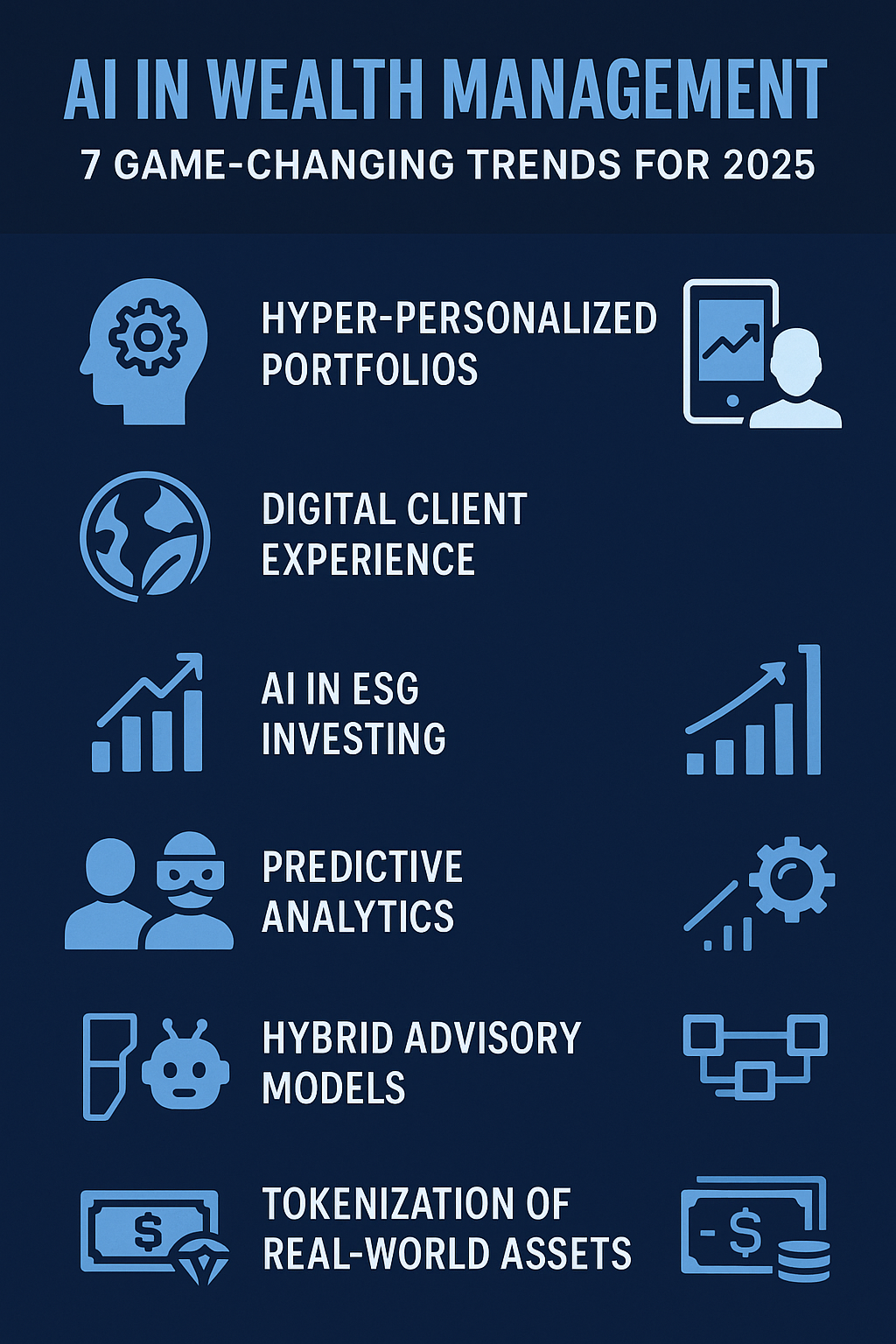
Hybrid Advisory Models in AI in Wealth Management
Instead of replacing human advisors, AI enhances them. The hybrid model combines:
- AI efficiency: Handling repetitive tasks like rebalancing.
- Human empathy: Advising on succession, philanthropy, estate planning.
This synergy ensures clients get the best of both worlds: cutting-edge technology plus trusted human relationships.
Tokenization of Real-World Assets
Blockchain and AI are democratizing access to high-value assets. Tokenization allows investors to own fractional shares of real estate, art, or private equity, which were once reserved for the ultra-wealthy.
Benefits include:
- Greater liquidity in illiquid markets.
- Lower entry barriers for mass-affluent investors.
- AI-driven asset valuation and monitoring.
This trend is reshaping diversification strategies.
Alternative Assets and AI
AI simplifies alternative investments by analyzing risk and performance across:
- Private equity and venture capital.
- Commodities and precious metals.
- Real estate and private credit.
By crunching vast amounts of unstructured data, AI makes alternatives less opaque and more accessible.
Generational Wealth & AI
Millennials and Gen Z are set to inherit trillions in wealth. Unlike their parents, they demand:
- Digital-first experiences
- ESG-focused portfolios
- Transparency on fees and performance
AI allows firms to meet these expectations with intuitive platforms and values-based investing.
Mass Affluent Segment
Not just the ultra-rich, but the mass-affluent segment now demands personalized advisory. AI makes it possible to provide affordable, scalable, and tailored solutions to this growing group.
This creates new business opportunities for firms willing to serve middle-tier investors.
AI and Risk Management
Risk is at the core of wealth management. AI improves risk management through:
- Real-time monitoring of portfolios.
- Stress testing across multiple scenarios.
- Detecting early warning signs of fraud or anomalies.
Firms that embrace AI risk tools can protect clients better against market shocks.
AI in Client Onboarding
Onboarding is traditionally slow and paper-heavy. AI streamlines it with:
- Biometric verification.
- Automated anti-money laundering (AML) checks.
- Smart document scanning and validation.
This improves compliance while reducing client frustration.
Cloud & Blockchain Integration
AI’s power depends on infrastructure. Cloud platforms and blockchain integration provide:
- Secure, scalable data storage.
- Instant settlement of tokenized assets.
- Modular API-driven wealth management systems.
This is the backbone of next-gen wealth management.
AI-Powered Annuities & Retirement Planning
AI helps retirees by:
- Projecting income streams.
- Optimizing annuity purchases.
- Balancing drawdowns with long-term goals.
This ensures a stable, predictable retirement income.
Data Security Challenges
With AI comes new risks:
- Cyberattacks on digital platforms.
- Data leaks from poor encryption.
- Misuse of personal information.
Firms must prioritize robust cybersecurity to maintain trust.
Bias in AI Algorithms
AI is only as unbiased as its training data. Risks include:
- Excluding certain client demographics.
- Producing flawed risk scores.
- Reinforcing systemic biases.
Ethical AI frameworks are essential to avoid these pitfalls.
Regulatory Evolution
Regulators are catching up, mandating:
- AI transparency in decision-making.
- Stronger AML/KYC requirements.
- Clear disclosures on algorithmic bias.
The future of AI depends on responsible innovation aligned with law.
The Human Touch in Wealth Management
Despite the rise of AI, trust, empathy, and human relationships remain irreplaceable. Advisors who combine AI insights with emotional intelligence will thrive.
Future of AI in Wealth Management
Looking forward, expect:
- Digital twins: Simulating entire client financial lives.
- Voice-activated AI advisors: Natural conversation with wealth tools.
- Inclusive platforms: Serving middle-income investors.
AI is not replacing humans — it’s expanding possibilities.
AI Adoption Roadmap for Firms
To succeed, firms should:
- Invest in secure cloud and blockchain platforms.
- Train staff in AI tools.
- Build hybrid advisory models.
- Create transparency and ethical AI policies.
Benefits for Investors
- Lower costs.
- Tailored portfolios.
- Transparent, values-driven investing.
- Real-time insights.
Benefits for Advisors
- Efficiency through automation.
- Deeper client engagement.
- More time for strategic conversations.
Global Case Studies
- BlackRock: AI-powered risk modeling.
- Wealthfront: Robo-advisory with AI personalization.
- Goldman Sachs: Digital-first wealth platforms for mass affluent clients.
FAQs
What is AI in wealth management?
AI in wealth management is the use of artificial intelligence to enhance investing, risk management, compliance, and client engagement.
Will AI replace financial advisors?
No. AI enhances efficiency but humans remain essential for emotional and strategic decision-making.
Is AI safe in wealth management?
Yes, if firms use strong cybersecurity and comply with regulations.
How does AI personalize portfolios?
By analyzing client goals, risk tolerance, spending patterns, and ESG values.
What are the risks of AI in finance?
Data privacy, algorithmic bias, and regulatory uncertainty.
Which investors benefit most from AI-driven wealth tools?
Both ultra-high-net-worth and mass-affluent clients benefit through scalable personalization.
Conclusion
AI in wealth management has become a game-changer in 2025. From hyper-personalized portfolios to tokenized assets and ESG transparency, it empowers both investors and advisors.
But while technology drives efficiency, human empathy and trust remain irreplaceable. The future belongs to firms that embrace a hybrid model: AI precision plus human wisdom.
“Capgemini’s World Wealth Report confirms this trend.”
