

Why the Indian Rupee Is Weakening: Data, Drivers & What It Really Means
Executive Summary (Must-Read)
- The Indian rupee sliding toward ₹91/USD in 2025 looks alarming but is not a currency crisis.
- The rupee is down ~6% in 2025, which is higher than its long-term average, but far lower than stress years like 2008 (24%), 2013 (23%), or 2022 (11%).
- The primary drivers are foreign portfolio outflows, strong dollar dynamics, RBI’s managed depreciation strategy, and forward-market pressures, not macro instability.
- India’s fundamentals remain supportive: resilient exports, high real yields, strong corporate earnings, and adequate FX reserves.
- This is best understood as a managed adjustment, not a meltdown — and historically, such phases often reverse faster than expected.
1. Putting the Rupee Fall in Perspective
Headline levels like ₹90 or ₹91 matter psychologically, but percentage change matters more than absolute numbers.
Table 1: Rupee Depreciation During Major Stress Periods
| Year | INR/USD (Start) | INR/USD (End / Peak) | Annual Depreciation |
|---|---|---|---|
| 2008 | 39 | 51 | 24% |
| 2013 | 55 | 68 | 23% |
| 2018 | 63 | 74 | 17% |
| 2020 | 71 | 75 | 6% |
| 2022 | 74 | 83 | 11% |
| 2025 | 83 | 91 | ~6% |
Key Insight:
2025 looks uncomfortable mainly because of the absolute level, not because the speed of depreciation is extreme.
2. What the Chart Tells Us: Long-Term Rupee Reality
Chart 1: INR/USD During Stress Periods (2008–2025)
(See chart above)
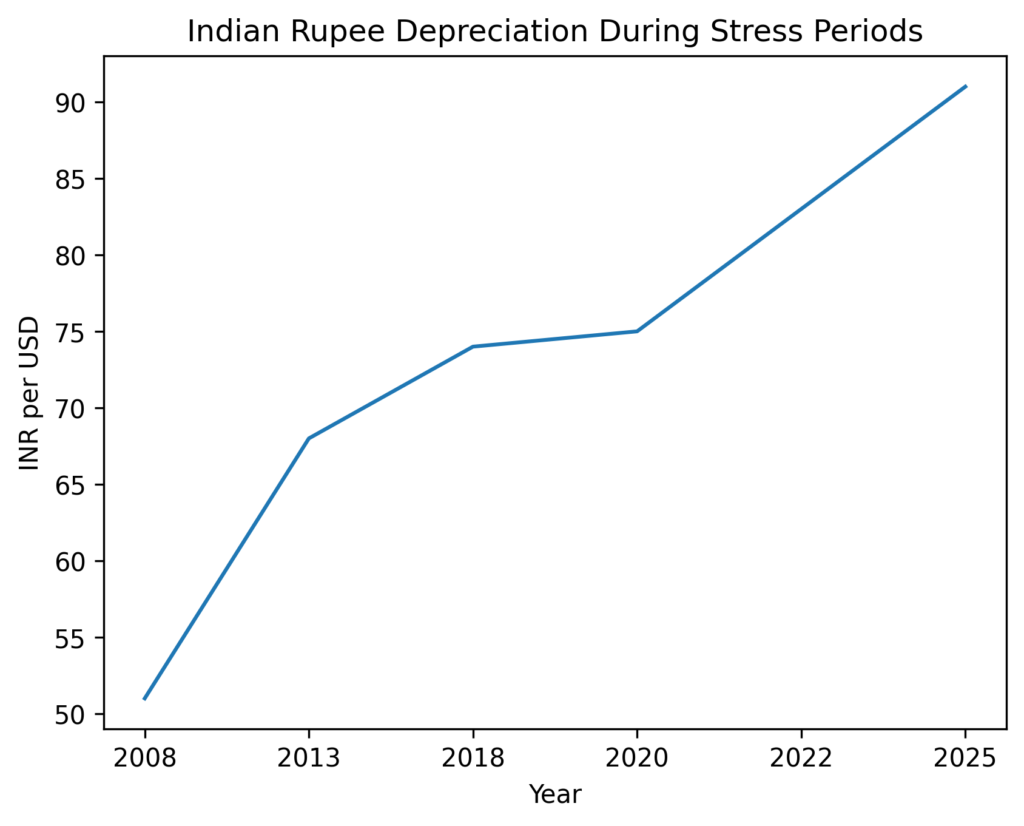
Interpretation:
- The rupee weakens in global stress cycles, not in isolation.
- Each large fall historically occurred alongside global shocks:
- 2008: Global Financial Crisis
- 2013: Taper Tantrum
- 2022: Fed tightening + Ukraine war
- 2025: Capital rotation + global trade stress
Yet none turned into a balance-of-payments crisis.
3. The Primary Driver in 2025: Capital Flows
Foreign Portfolio Investors (FPIs)
The most direct pressure on the rupee today is money moving out.
Table 2: FPI Outflows vs Rupee Weakness
| Year | Net FPI Outflows (USD bn) | INR Depreciation |
|---|---|---|
| 2018 | 12 | 9% |
| 2020 | -15 (inflows) | 6% |
| 2022 | 121 | 11% |
| 2025 | ~18 | ~6% |
Chart 2: FPI Outflows and Rupee Pressure
(See chart above)
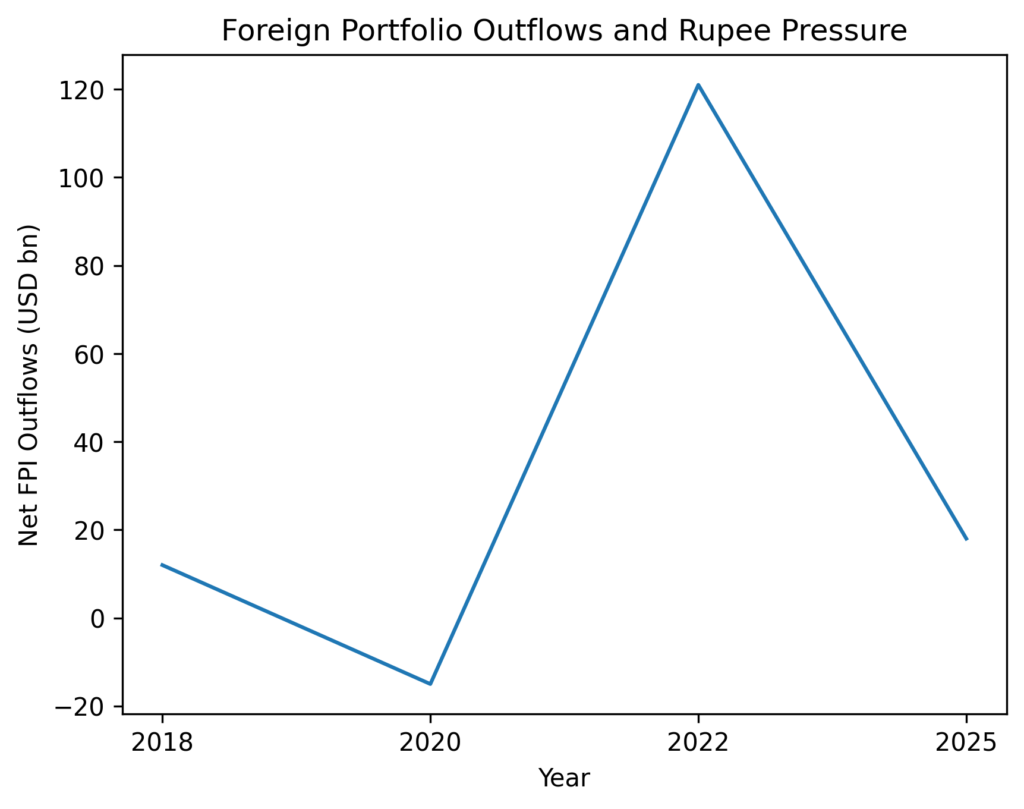
Key Insight:
Whenever FPIs pull capital from both equity and debt, the rupee weakens — regardless of domestic growth strength.
4. Why RBI Is Allowing the Rupee to Slide (Quietly)
India follows a managed-float regime, not a fixed exchange rate.
RBI’s Current Strategy:
- Avoid sharp volatility, not defend a specific level
- Preserve FX reserves for disorderly moves
- Allow gradual depreciation to:
- Support exports
- Absorb global shocks
- Avoid sudden liquidity tightening
This explains:
- Light intervention in spot markets
- Greater use of forwards, swaps, and liquidity tools
- No panic even after ₹90 was breached
5. The Role of Offshore & Forward Markets
Once ₹90 was breached:
- Offshore traders increased short positions
- Forward premiums rose
- NDF markets began pricing further weakness
This creates momentum pressure, but not necessarily fundamental weakness.
Important:
Such positioning reverses quickly when:
- Dollar weakens
- RBI signals discomfort
- Capital flows stabilize
6. The Other Side of the Story: Why This Isn’t Bearish Long-Term
Despite rupee weakness, several pro-rupee forces remain intact:
Structural Positives
- High Indian real yields vs developed markets
- Resilient exports, especially services
- Strong corporate earnings
- Large FX reserves buffer
- Stable domestic growth
Historically, these factors cap extreme depreciation.
7. Who Wins and Who Loses from a Weaker Rupee?
Beneficiaries
- Exporters (IT, pharma, manufacturing)
- Remittance recipients
- Companies with USD revenues
Losers
- Importers (oil, electronics)
- Overseas travel & education
- Companies with unhedged foreign debt
For investors, the impact is sector-specific, not economy-wide.
8. Final Takeaway: How to Read the Rupee Correctly
The rupee near ₹91 is:
- Uncomfortable but not dangerous
- Market-driven, not panic-driven
- Managed, not abandoned
Bottom Line
This episode is best described as a controlled currency adjustment during a global capital rotation, not a loss of macro credibility.
It would not take much — improving risk sentiment, easing dollar strength, or returning flows — to change the rupee narrative meaningfully.
Currency movements, interest rates, and capital flows shape market outcomes. Kalviro Ventures helps investors interpret these signals and position portfolios for long-term growth across cycles.
