

Transfer Unlisted Shares in Demat Form: The Complete Guide for Investors
Understanding Unlisted Shares in India
Unlisted shares are those that belong to companies not listed on any stock exchange such as NSE or BSE. They are usually found in startups, family-owned businesses, pre-IPO companies, and even some private enterprises. For many investors, these shares are a golden opportunity, especially if the company eventually goes public. However, since they are not traded on exchanges, their transfer requires a slightly different process compared to listed shares.
Unlisted shares may sound complex, but in reality, they represent the same ownership rights as listed shares. The only difference lies in their marketability. Unlike listed stocks, which you can sell instantly with a click, unlisted shares need a proper demat transfer process. And that’s where the importance of dematerialization comes into play.
Why People Invest in Unlisted Shares?
People invest in unlisted shares for several reasons:
- High Growth Potential: Startups and pre-IPO companies can yield massive returns once they list.
- Diversification: They provide exposure beyond traditional listed equities.
- Employee ESOPs: Employees of startups often receive unlisted shares as part of their compensation.
- Long-Term Wealth Creation: Many investors hold onto unlisted shares to benefit from company growth.
In fact, history has shown how early investors in companies like Infosys, Reliance, and HDFC Bank multiplied their wealth. Many unicorn startups today are still unlisted, making them an attractive option for savvy investors.
The Growing Market of Pre-IPO & Startup Shares
The Indian private equity and startup ecosystem has grown rapidly. With over 100+ unicorns and hundreds of upcoming IPOs, the demand for unlisted shares is at an all-time high. Investors now actively seek early entry before a company hits the market.
Platforms dealing in unlisted shares, family offices, and angel networks have fueled this growth. As a result, regulators like SEBI and RBI have issued clear guidelines to ensure smooth and transparent transactions.
What is Dematerialization (Demat)?
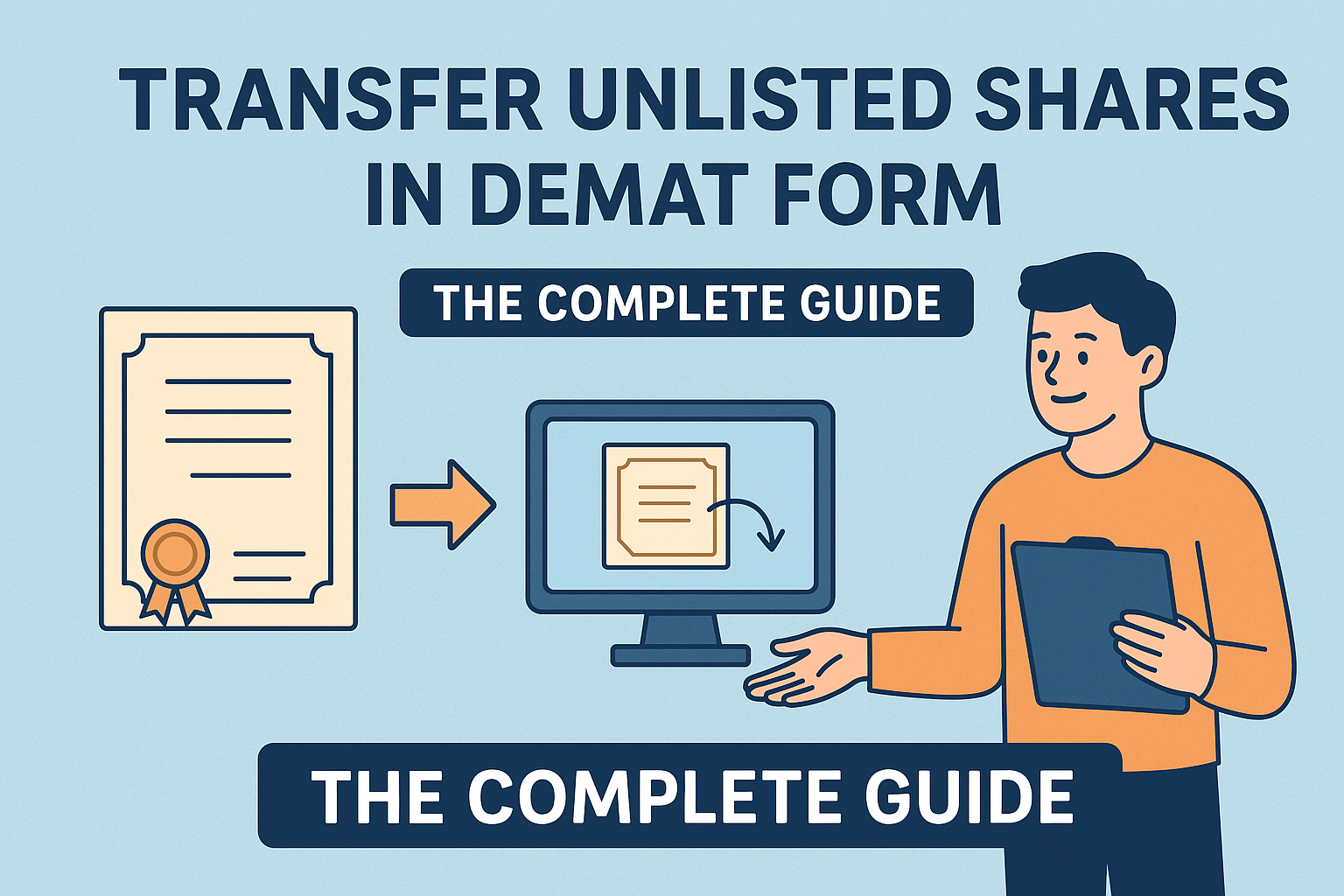
Dematerialization, or demat, is the process of converting physical share certificates into electronic format. This eliminates the risks of paper certificates such as theft, damage, or misplacement.
Just like listed shares, unlisted shares also need to be in demat form if you want to transfer them seamlessly. Without this, you may face legal hurdles, rejection of transfer requests, and even tax complications.
A Demat Account with NSDL or CDSL is mandatory for this purpose.
Difference Between Listed and Unlisted Shares
| Aspect | Listed Shares | Unlisted Shares |
|---|---|---|
| Where Traded | NSE, BSE | Off-market, private deals |
| Liquidity | High (easy to sell) | Low (requires private buyers) |
| Valuation | Market-driven | Negotiated or estimated |
| Transfer Method | Through stock exchange | Off-market transfer via depository |
| Risk Level | Moderate | Higher (less regulated) |
This table shows that while unlisted shares carry higher risks, they also offer potentially higher rewards.
Why Transfer Unlisted Shares into Demat Form?
Many investors still hold physical share certificates of unlisted companies. However, keeping them in paper format comes with drawbacks:
- Risk of loss or damage
- Complicated inheritance and gifting process
- Difficult valuation for taxation
- Time-consuming sale process
By transferring them into demat form, you not only ensure safety but also enable easier transfer to family, buyers, or beneficiaries. It also streamlines future IPO conversions.
SEBI and RBI Guidelines for Unlisted Shares
The Securities and Exchange Board of India (SEBI) and the Reserve Bank of India (RBI) regulate the transfer of unlisted shares. SEBI mandates that private share transfers must be routed through authorized depositories. RBI has specific rules if Non-Resident Indians (NRIs) are involved, especially regarding pricing and reporting requirements.
Common Legal Hurdles in Share Transfer
Investors often face roadblocks while transferring unlisted shares:
- Company refusal to register transfer
- Stamp duty disputes
- Missing or incorrect documentation
- Delay in ISIN activation
Being aware of these issues helps you plan better and avoid costly mistakes.
Rights of Shareholders in Unlisted Companies
Even if the company is unlisted, shareholders enjoy rights such as:
- Right to vote on important decisions
- Right to dividends, if declared
- Right to transfer or gift shares (subject to compliance)
- Right to information through company disclosures
These rights are protected under the Companies Act, 2013.
Step-by-Step Process to Transfer Unlisted Shares
Transferring unlisted shares in demat form requires careful execution. Here’s a simplified process:
- Open a Demat Account
- With NSDL or CDSL through a Depository Participant (DP).
- Check ISIN Availability
- Ensure the unlisted company has an ISIN (International Securities Identification Number). Without it, shares can’t be dematerialized.
- Submit Demat Request Form (DRF)
- Fill out the DRF provided by your DP and attach physical share certificates.
- Verification by Registrar and Transfer Agent (RTA)
- The RTA checks authenticity of the certificates and signatures.
- Credit of Shares in Demat Account
- Once approved, the unlisted shares are credited electronically.
- Off-Market Transfer (If Selling/Gifting)
- Use an “off-market transfer slip” to transfer shares to another demat account.
Documents Required for Share Transfer
- Original physical share certificates (if applicable)
- Demat Request Form (DRF)
- Self-attested PAN and Aadhaar copies
- Client Master Report (CMR) of buyer/receiver
- Transfer deed (in case of sale or gift)
- Stamp duty payment proof
Missing any of these documents can cause unnecessary delays.
Role of ISIN in Unlisted Share Transfers
The ISIN is like an Aadhaar number for shares. Without it, your shares cannot be moved into electronic form. Investors must verify whether the unlisted company has obtained ISIN from NSDL/CDSL.
Using Off-Market Transactions for Share Transfer
Since unlisted shares aren’t traded on exchanges, they move via off-market transfers. This means the buyer and seller agree privately, and the DP executes the transfer.
Key things to note:
- Transfer slip must be correctly filled.
- Stamp duty is payable on the transaction.
- Buyer’s demat details must match exactly.
Timeline for Transfer of Unlisted Shares
- Dematerialization: 7–15 working days
- Off-market transfer: 2–5 working days
- Company/RTA approval: Varies, may take longer
Delays often occur if documents are incomplete or signatures don’t match.
Family Transfer of Startup Shares
Many families gift or transfer startup shares to children or relatives. For example, if a father holds shares in a pre-IPO company, he can gift them to his daughter through an off-market transfer. In such cases, stamp duty applies, but no income tax is levied on gifts to close relatives.
Transfer of ESOPs Before IPO
Employees often receive ESOPs (Employee Stock Ownership Plans) in startups. Before the company goes public, they may want to transfer or sell these. The process is the same, but one must check the company’s shareholders’ agreement for lock-in clauses.
Gifting Unlisted Shares to Children
Unlisted shares are a great way to pass wealth to the next generation. Under the Income Tax Act, gifts to children are exempt. However, stamp duty still applies. This makes demat transfers a safe and tax-efficient option.
Stamp Duty and Charges in Transfer
Charges include:
- Stamp duty: 0.015% of the transaction value (if consideration is paid).
- Depository Participant (DP) charges: Varies by service provider.
- RTA charges: For dematerialization.
Tax Implications of Transferring Unlisted Shares
- Sale of shares: Attracts capital gains tax.
- Held < 24 months: Short-Term Capital Gains (STCG).
- Held > 24 months: Long-Term Capital Gains (LTCG) at 20% with indexation.
- Gift to relatives: Tax-free.
- Gift to non-relatives: Taxable if value exceeds ₹50,000.
Difference in Taxation: Gift vs Sale
| Mode | Taxable? | Stamp Duty | Notes |
|---|---|---|---|
| Gift to family | No | Yes | Exempt under Income Tax Act |
| Gift to non-relative | Yes (if > ₹50,000) | Yes | Added to recipient’s income |
| Sale | Yes (Capital Gains) | Yes | Tax depends on holding period |
Common Mistakes to Avoid During Transfer
- Not checking ISIN before applying
- Submitting unsigned/incorrect DRF
- Forgetting stamp duty payment
- Using mismatched PAN/Aadhaar details
- Relying on grey market dealers without proper contracts
Risks of Holding Physical Share Certificates
- Certificates can get lost, stolen, or damaged
- Costly legal procedures for duplicate certificates
- Hard to prove ownership in disputes
- Difficult inheritance transfers
This is why regulators encourage investors to convert shares into demat form.
Grey Market Risks in Unlisted Shares
Some investors buy unlisted shares through informal channels at inflated prices. Risks include:
- No legal recourse if seller defaults
- Fake share certificates
- Price manipulation
Always use registered brokers or professional advisors for safety.
Advantages of Keeping Unlisted Shares in Demat Form
- Safer than physical certificates
- Easier transfer and gifting
- Simplified tax reporting
- Mandatory for IPO listing conversion
- Helps in succession planning
Liquidity Options Before IPO
Though unlisted, some platforms allow investors to sell shares before IPO via private placements. Liquidity remains lower than listed shares, but demand for pre-IPO stocks is strong.
Better Record-Keeping & Inheritance Planning
Demat shares ensure clear ownership, making it easy to pass on shares to heirs without disputes. This also avoids the hassle of producing physical certificates during succession.
How Professionals Help in Share Transfer
Professional advisors help by:
- Preparing documentation
- Coordinating with RTAs and depositories
- Ensuring compliance with SEBI/RBI rules
- Handling taxation aspects
Why Choose Kalviro Ventures for Share Transfers?
Kalviro Ventures provides end-to-end assistance in demat conversion, compliance checks, documentation, and taxation. Their expertise ensures smooth transfer of unlisted shares with minimal delays.
FAQs
Can unlisted shares be sold anytime?
Yes, but they must be transferred via off-market transactions, subject to company approval.
What happens if a company never gets listed?
You still own the shares, but liquidity remains limited to private buyers.
Is transferring shares to family tax-free?
Yes, gifts to specified relatives are exempt under the Income Tax Act.
How long does dematerialization take?
Usually 7–15 working days, depending on RTA verification.
Can NRIs hold and transfer unlisted shares?
Yes, but they must comply with RBI’s FEMA guidelines.
What if the company refuses to register the transfer?
You may appeal to the National Company Law Tribunal (NCLT) for redressal.
Final Thoughts on Transferring Unlisted Shares in Demat Form
Unlisted shares can be rewarding, but the transfer process demands accuracy and compliance. By moving shares into demat form, investors ensure safety, easier transfers, and smooth succession. With rising interest in pre-IPO and startup investments, understanding this process is crucial.
For a hassle-free experience, investors often seek professional support. Firms like Kalviro Ventures specialize in simplifying documentation, compliance, and legal aspects, ensuring your wealth is protected and future-ready.
