

Indian Rupee Depreciation Against Swiss Franc: Why the Weakness Isn’t the Whole Story for Swiss Capital
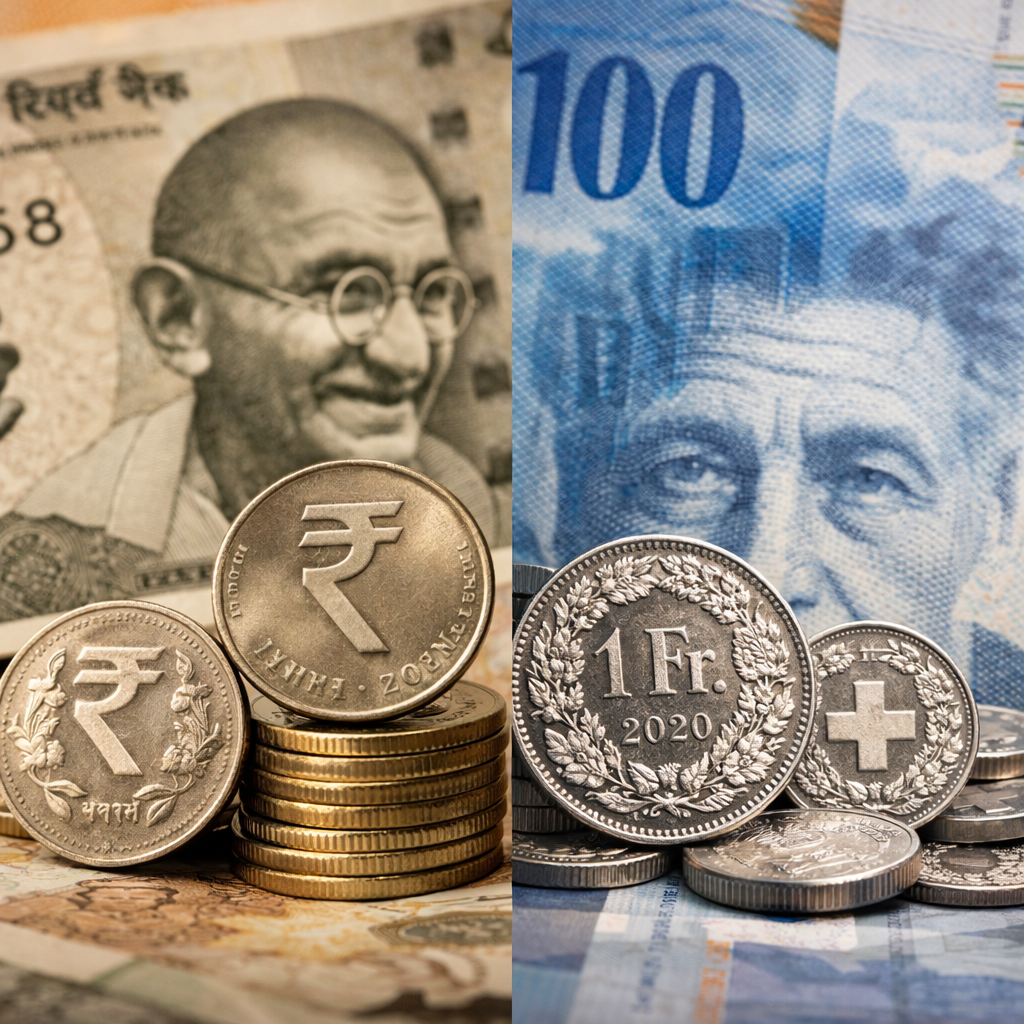
A Currency Divergence That Demands Context
For a Swiss allocator, currency risk is not a theoretical abstraction — it is a core determinant of real returns. When evaluating cross-border exposure, especially to emerging markets, the exchange rate often becomes the silent arbiter of performance.
Over the past decade and a half, Indian Rupee depreciation against Swiss Franc has been persistent. Not disorderly. Not dramatic. But steady.
That steadiness is what makes it intellectually important.
The Swiss Franc represents global monetary credibility. It strengthens during geopolitical uncertainty, financial stress, and liquidity shocks. The rupee, by contrast, represents a developing economy in structural transition — high growth, capital intensive, inflationary relative to developed markets.
The divergence between these two currencies is not accidental. It reflects two fundamentally different economic models operating at different stages of maturity.
The key question for Swiss capital is not whether depreciation occurred.
It is whether that depreciation reflects fragility — or transformation.
Indian Rupee Depreciation Against Swiss Franc: Structural Reality, Not Sentiment
Currency depreciation between economies at different stages of development is often structural.
Switzerland runs persistent current account surpluses. India frequently runs deficits driven by energy imports and capital expenditure needs.
Switzerland maintains structurally low inflation. India, by virtue of higher nominal growth, operates with higher inflation tolerance.
The mandate of the Swiss National Bank centers on price stability and managing currency strength amid capital inflows. The Reserve Bank of India balances inflation targeting with growth, credit expansion, and financial inclusion.
These mandates naturally produce different currency paths.
Importantly, Indian Rupee depreciation against Swiss Franc has largely been orderly. It has not been crisis-driven in the manner of certain emerging market episodes historically. Foreign exchange reserves remain substantial. Institutional reforms have strengthened fiscal transparency and banking resilience.
Depreciation, in this case, reflects macroeconomic math more than policy failure.
And that distinction matters for long-term capital.
Macro Divergence: Safe-Haven Capital vs Growth Capital
The Swiss Franc benefits from global risk aversion. During stress events — financial crises, geopolitical instability, liquidity tightening — capital flows into Switzerland.
India benefits from global risk appetite. During expansion cycles, foreign direct investment and portfolio flows increase meaningfully.
This asymmetry is structural.
Switzerland exports high-value, high-margin goods and financial services. India imports energy and capital goods while exporting services, pharmaceuticals, and increasingly digital capabilities.
Oil price shocks disproportionately affect India’s trade balance. Switzerland’s exposure is far more limited.
Fiscal frameworks also differ. Switzerland’s debt discipline reinforces currency credibility. India’s fiscal expansion funds infrastructure and demographic transition.
From an institutional perspective, this divergence does not signal weakness. It signals life-cycle stage.
One economy is optimizing stability.
The other is optimizing expansion.
Structural Pressures and Structural Progress
Productivity differentials contribute to long-term exchange rate movement. Switzerland’s per capita output remains among the highest globally. India’s productivity is rising but uneven.
Financial depth also plays a role. Swiss capital markets are mature and globally integrated. India’s markets have strengthened significantly but still reflect emerging market characteristics.
Yet, institutional strengthening in India is tangible.
Digitization of tax systems. Insolvency resolution reform. Banking recapitalization. Expansion of manufacturing incentives. Rapid digital payments infrastructure.
These reforms increase systemic resilience.
Indian Rupee depreciation against Swiss Franc, therefore, coexists with institutional improvement — not deterioration.
For allocators, that coexistence is critical.
Forward Outlook: Gradual Divergence, Manageable Risk
Looking ahead, structural inflation differentials may continue to exert mild downward pressure on the rupee relative to CHF.
However, growth differentials remain substantial. India’s demographic dividend, urbanization momentum, digital transformation, and supply chain realignment position it as a long-duration growth economy.
The more relevant question becomes:
Can real asset returns in India exceed currency drag?
Historically, over long cycles, the answer has often been yes.
Moreover, currency risk today is not binary. It can be hedged, structured, diversified, and priced.
Which leads directly to the strategic mechanism available to Swiss capital.
Long-Term Exchange Rate Trend (2008–2026)
A structural understanding of Indian Rupee depreciation against Swiss Franc requires examining the long-term exchange rate trajectory rather than short-term volatility.
| Year | Approx. INR per 1 CHF | Cumulative Depreciation vs 2008 | Implied CHF Appreciation |
|---|---|---|---|
| 2008 | ₹39 | — | — |
| 2012 | ₹56 | ~44% | 1.44x |
| 2016 | ₹69 | ~77% | 1.77x |
| 2020 | ₹78 | ~100% | 2.00x |
| 2024 | ₹98 | ~151% | 2.51x |
| 2026 | ₹117 | ~200% | 3.00x |
Compound Annual Depreciation (2008–2026): ~6.3% per annum
Since 2008, Indian Rupee depreciation against Swiss Franc has averaged approximately six percent annually. Over eighteen years, the rupee has weakened by nearly 200%, while the Swiss Franc has appreciated roughly threefold relative to INR. Importantly, this divergence has been gradual rather than crisis-driven, aligning closely with inflation differentials, capital flow asymmetry, and Switzerland’s structural safe-haven premium.
For Swiss allocators, the implication is straightforward: currency drag is significant but measurable. A long-term annualized depreciation of approximately six percent must be embedded into expected return assumptions rather than treated as an unpredictable shock variable. When structured appropriately, exposure to India can still generate competitive real returns despite sustained currency divergence.
GIFT City: Structuring Exposure, Not Avoiding It
GIFT City represents a structural evolution in India’s financial architecture.
Supervised by the International Financial Services Centres Authority, it provides an internationally oriented regulatory environment within Indian jurisdiction.
For Swiss investors, this matters profoundly.
Investment vehicles can be denominated in foreign currency. Regulatory clarity aligns more closely with international standards. Tax frameworks are competitive. Capital mobility is liberalized relative to mainland structures.
This allows exposure to India’s growth drivers without absorbing direct rupee volatility in the same manner as traditional onshore investment.
Rather than asking whether Indian Rupee depreciation against Swiss Franc should deter allocation, the more sophisticated question becomes:
How should exposure be structured to optimize risk-adjusted return?
GIFT City offers one credible answer.
Frequently Asked Questions
Is Indian Rupee depreciation against Swiss Franc a sign of economic weakness?
Not necessarily. It primarily reflects structural differences in inflation, capital flows, and macroeconomic maturity.
Could the rupee stabilize long term?
Stabilization is possible as productivity converges and inflation moderates, but gradual divergence may persist.
Does currency depreciation eliminate equity returns?
Over long cycles, high-growth markets can offset currency drag, though volatility must be managed.
Why is CHF structurally strong?
Safe-haven flows, low inflation, current account surpluses, and fiscal discipline support CHF strength.
How does GIFT City reduce currency exposure?
Foreign currency-denominated investment structures allow investors to access Indian assets while mitigating direct INR risk.
Should Swiss family offices consider India?
Strategically structured exposure may complement global portfolios, particularly given India’s demographic and growth profile.
Conclusion
Indian Rupee depreciation against Swiss Franc is not a headline risk story. It is a structural macroeconomic divergence between two economies at different stages of development.
Switzerland represents monetary stability and capital preservation.
India represents growth, demographic expansion, and structural transformation.
For Swiss investors, the objective should not be avoidance. It should be calibration.
Currency risk is real — but it is measurable, manageable, and structurable.
And when approached through disciplined architecture — including platforms such as GIFT City — exposure to India can move from speculative to strategic.
Currencies fluctuate.
Structural growth compounds.
The decision, ultimately, is not about fear.
It is about framework.
